

Table of contents
Salaries tax is charged at the lower of the progressive rates and the standard rate. For 2025/26 the basic allowance is HK$132,000 and the one-off reduction is capped at HK$3,000; from 2026/27 several allowances are raised. By making good use of allowances and deductible items you can lawfully save tax.
Key takeaways
- The salaries tax year of assessment runs from 1 April to 31 March of the following year, and the IRD automatically calculates tax at both the progressive rates and the standard rate and charges the lower amount.
- 2025/26 basic allowance is HK$132,000, and the one-off salaries tax reduction is capped at HK$3,000.
- Several allowances are raised from 2026/27: the basic allowance rises to HK$145,000 and the married person’s allowance rises to HK$290,000.
- Four ways to save tax: Budget tax measures, personal allowances, family member allowances and deductible items.
What is salaries tax?
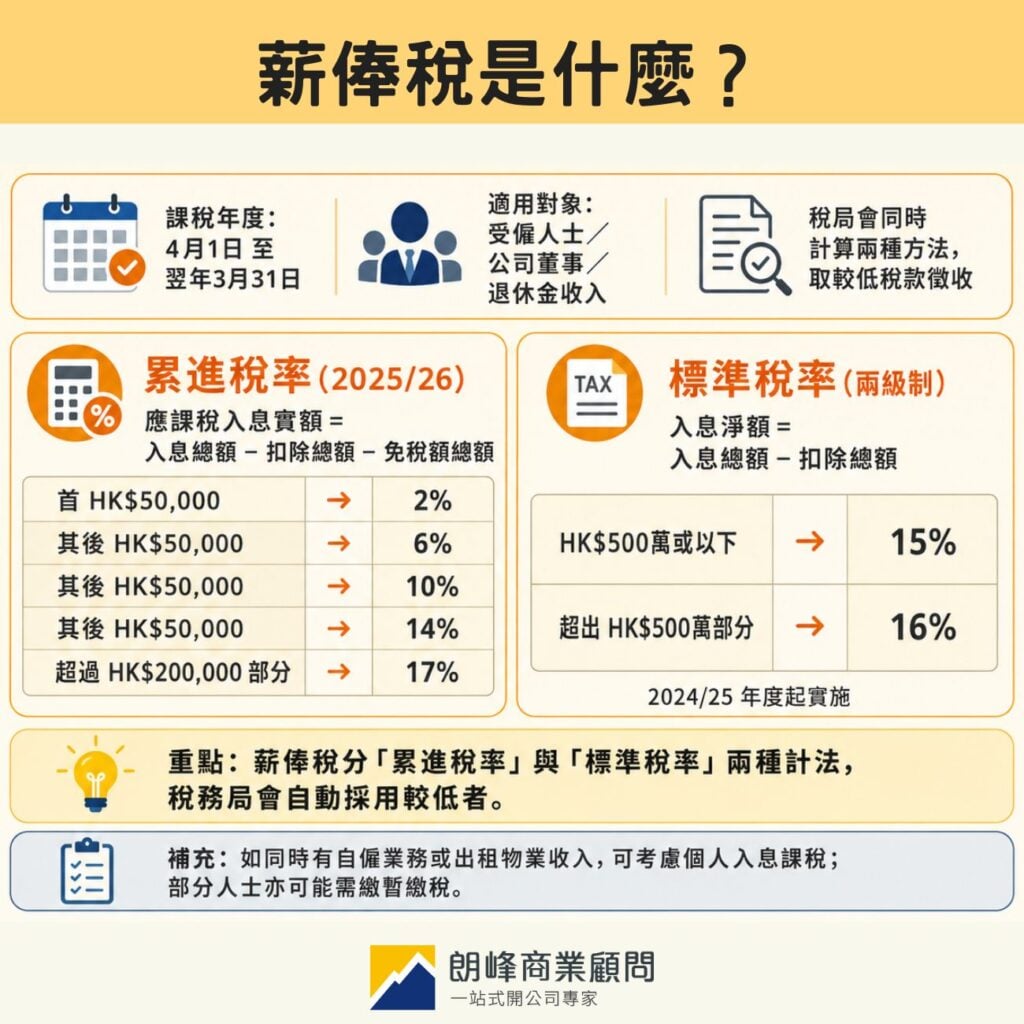
Salaries tax can be understood as the income tax of employees. The year of assessment runs from 1 April to 31 March of the following year. Anyone employed in Hong Kong, serving as a company director or receiving a pension may have to pay salaries tax on the related income. The IRD calculates tax at both the progressive rates and the standard rate and charges you the lower amount, so you do not have to choose yourself.
How salaries tax is calculated
There are two ways to calculate salaries tax: one applies the progressive rates to “net chargeable income”, and the other applies the standard rate to “net income”.
Progressive rates (2025/26)
Net chargeable income (total income − total deductions − total allowances) × progressive rates
| Net chargeable income | Tax rate | Tax |
|---|---|---|
| First HK$50,000 | 2% | HK$1,000 |
| Next HK$50,000 | 6% | HK$3,000 |
| Next HK$50,000 | 10% | HK$5,000 |
| Next HK$50,000 | 14% | HK$7,000 |
| Remainder (i.e. the part above HK$200,000) | 17% | / |
Standard rate (two-tiered)
Net income (total income − total deductions) × standard rate. From 2024/25 the standard rate has two tiers: 15% on net income of HK$5 million or below, and 16% on the part above HK$5 million.
| Net income | Tax rate |
|---|---|
| HK$5 million or below | 15% |
| Above HK$5 million | First HK$5 million at 15%, the excess at 16% |
If you also have income from a self-employed business or from renting out property and want it assessed together, you can consider “Personal Assessment”, whose calculation method is related to Profits tax filing guide; we cover this in the FAQ below.
In addition, if your salaries tax for last year reached a certain amount, this year it will be collected together with the final assessment as provisional salaries tax.
How can I save tax?
Saving salaries tax relies mainly on four things: the Budget’s one-off reduction, personal allowances, family member allowances and deductible items. The first three directly reduce the tax payable or the net chargeable income, while the last is deducted according to qualifying actual expenses; all four can be used at the same time.
As the calculation above shows, to save tax the key is the “total deductions” and “total allowances” boxes. The tax relief available this year falls broadly into four categories:
- The one-off tax measure for the year (Budget reduction)
- Personal allowances (based on your personal circumstances)
- Family member allowances (based on the conditions for supporting family members)
- Deductible items (deducted according to actual expenses)
Tax-saving method 1: key salaries tax measures in the 2026-27 Budget
2026-27 Budget (announced in February 2026, the related legislation was gazetted on 22 May 2026) includes several measures relevant to employees:
- One-off reduction of 2025/26 salaries tax: 100% reduction, capped at HK$3,000 per case, reflected in the 2025/26 final assessment; note that this reduction does not apply to provisional tax.
- Several allowances raised from 2026/27: the basic allowance rises from HK$132,000 to HK$145,000, the married person’s allowance from HK$264,000 to HK$290,000, and the single parent allowance from HK$132,000 to HK$145,000.
- Cap on expenses for residential care for the elderly: from 2026/27 raised from HK$100,000 to HK$110,000.
- Extension of the additional allowance for newborn children: from 2026/27, an additional allowance is available for the first two years after a child is born (equivalent to double the child allowance in total), applicable to children born on or after 1 April 2025.
💡 SetupHK tip: when filling in your 2025/26 tax return, just fill it in as usual. When the IRD assesses your 2025/26 final assessment and 2026/27 provisional tax, it will automatically reflect the reduction and the raised allowances, so you do not need to apply separately.
Tax-saving method 2: personal allowances
The 2025/26 basic allowance is HK$132,000, rising to HK$145,000 from 2026/27, and every taxpayer receives it automatically; eligible persons with a disability can claim an additional Disabled Person Allowance of HK$75,000, and the two can be used together.
Basic allowance
The basic allowance (also called the single person’s allowance) is available to every taxpayer. For 2025/26 it is HK$132,000, meaning that if your annual income is below HK$132,000 you generally pay no tax; from 2026/27 it rises to HK$145,000.
| Type of allowance | 2025/26 | 2026/27 |
|---|---|---|
| Basic allowance | HK$132,000 | HK$145,000 |
Disabled person allowance
Persons eligible to receive the “Hong Kong Government Disability Allowance scheme” Persons receiving allowances (including ordinary and higher disability allowances), even if they have not actually applied for the allowance, can also claim the tax exemption for persons with disabilities of HK$75,000. Proof of severe disability must be provided by the Director of Health or the Chief Executive of the Hospital Authority, with the condition lasting more than 6 months, requiring daily care from others, and not residing long-term in government-subsidized institutions, etc.
Tax-saving method 3: family member allowances
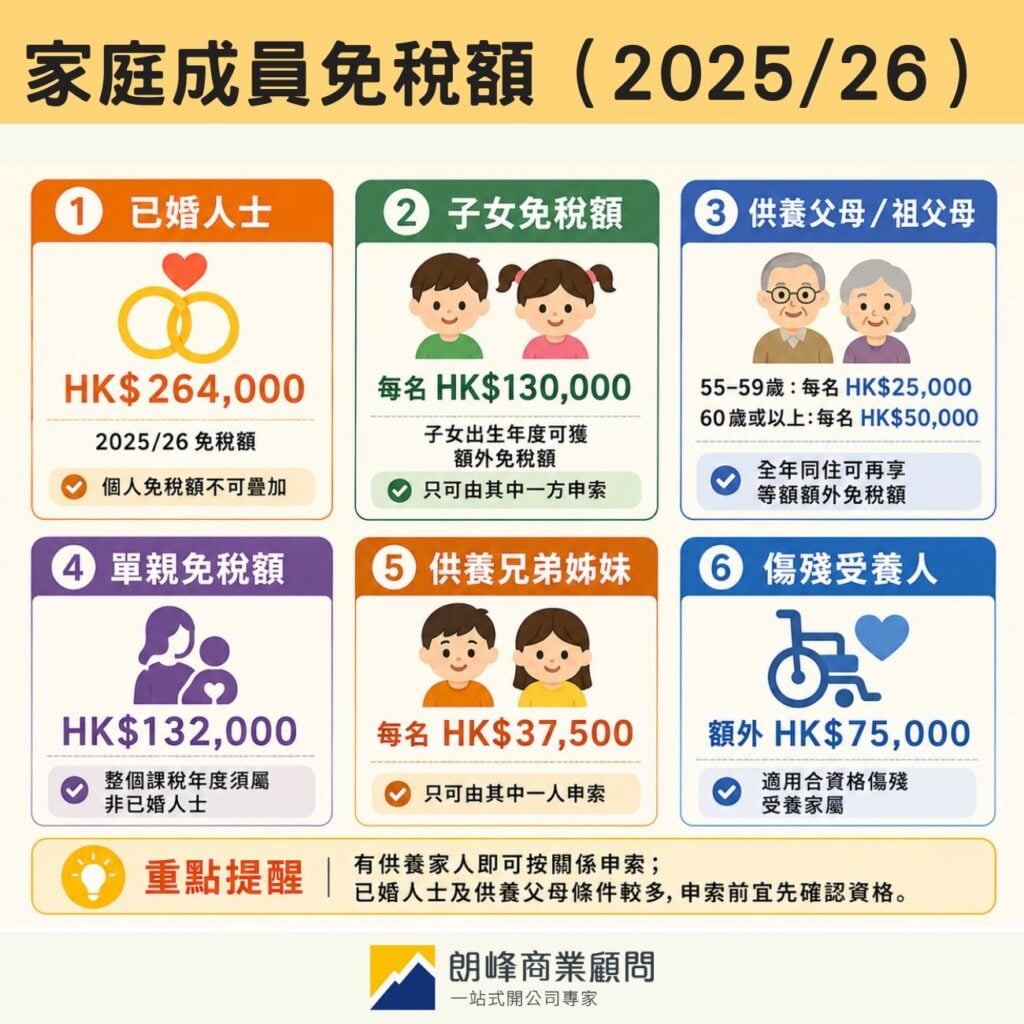
Family member allowances are claimed according to the dependency relationship. For 2025/26 the married person’s allowance is HK$264,000, each child HK$130,000 and each dependent brother or sister HK$37,500; the conditions for the married person’s allowance and the dependent parent allowance are more numerous.
If you support family members, you can claim different family member allowances depending on the relationship. Among them, Married person’s allowance and Dependent parent allowance Due to the numerous conditions and the involvement of combined filing and allocation arrangements, SetupHK has a complete topic breakdown, so we will first provide the key points here. (Content reference Hong Kong IRD information on salaries tax / personal assessment)
Married person’s allowance
A married couple can each file as individuals or elect joint assessment; the personal allowance and the married person’s allowance cannot be combined.
For 2025/26 the married person’s allowance is HK$264,000, rising to HK$290,000 from 2026/27.
As to whether joint or separate filing is better and how to calculate it, see Complete guide to the married person’s allowance and joint assessment
Allowance for maintaining a parent, grandparent or maternal grandparent
If you support parents / grandparents who are aged 55 or above and ordinarily live in Hong Kong, you can claim an allowance according to the age of the dependant (2025/26: HK$25,000 each for ages 55 to 59 and HK$50,000 each for age 60 or above); if they live with you throughout the year and you do not bear the whole cost, you can claim an equal additional allowance. The amounts are raised from 2026/27. For the detailed claim conditions, the definition of living together and the apportionment arrangements, see Complete conditions for claiming the dependent parent allowance.
Child allowance
If you support an unmarried child who meets the age or education conditions, you can claim an allowance. For 2025/26 it is HK$130,000 per child, rising to HK$140,000 from 2026/27; an additional allowance is available in the year of assessment in which the child is born. From 2026/27, an additional allowance is available for the first two years after a newborn child is born (equivalent to double in total), applicable to children born on or after 1 April 2025. The allowances for all children can be claimed by only one of the two parents.
Conditions (meeting any one): under 18; under 25 and receiving full-time education; or aged 18 or above but unable to work because of a physical or mental disability.
Single parent allowance
If you are a single person for the entire tax year and are responsible for the care of children, you can claim a single parent tax exemption (2025/26: HK$132,000; increasing to HK$145,000 from 2026/27). Please note that getting married, divorced, widowed, or living separately from a spouse during that year does not qualify for single parent status, and you must wait until the next tax year.
Allowance for maintaining brothers or sisters
If you support an unmarried brother or sister who meets the age or education conditions, you can claim an allowance of HK$37,500, which can be claimed by only one person.
Disabled dependant allowance
If you support a family member who is eligible to receive the government disability allowance (spouse, child, parent, grandparent or brother or sister), you can claim an additional HK$75,000. This item is an additional allowance, and you can still apply for it together with the other family member allowances above.
Tax-saving method 4: personal deductible items
Deductible items are deducted according to actual expenses. Common caps include HK$8,000 per insured person for voluntary health insurance, HK$60,000 in total for qualifying annuity and MPF voluntary contributions, and HK$100,000 for self-education expenses; home loan interest and residential rent can only be claimed as one or the other.
Besides allowances, qualifying actual expenses can also be deducted under salaries tax and Personal Assessment. The main deductible items and caps for the 2025/26 year of assessment are as follows:
| Deductible items | Deduction ceiling |
|---|---|
| Approved charitable donations (each donation not less than HK$100) | 35% of assessable income or profits |
| Voluntary Health Insurance Scheme premiums (per insured person) | HK$8,000 |
| Qualifying annuity premiums and tax-deductible MPF voluntary contributions | HK$60,000 |
| Self-education expenses | HK$100,000 |
| MPF mandatory contributions or recognised occupational retirement scheme contributions | HK$18,000 |
| Home loan interest (basic + qualifying additional) | HK$100,000 + HK$20,000 |
| Residential care expenses for elders (per elder) | HK$100,000 (HK$110,000 from 2026/27) |
| Residential rent (basic + qualifying additional) | HK$100,000 + HK$20,000 |
| Expenses for assisted reproductive services | HK$100,000 |
A few additional key points:
- Charitable donations: donations are deductible only if made to approved charities under section 88 of the Inland Revenue Ordinance; once your own cap is reached, your spouse can claim the rest.
- MPF contributions: the caps for mandatory and voluntary contributions do not overlap, so keep them separate when calculating. To find out how the contribution caps are calculated, see MPF contribution cap and tax deduction.
- Home loan interest vs residential rent: you can claim only one of the two. Owners deduct mortgage interest; tenants deduct rent.
How does tax filing differ for the self-employed, part-timers and directors?
Income below the basic allowance of HK$132,000 generally means no tax is payable, but whenever you receive a tax return you must file it. Do not assume that no tax payable means no need to file.
Profits from self-employment fall under profits tax, which is calculated differently from salaries tax for employees. Both the filing method and the deductible expenses differ; see Tax filing guide for the self-employed / freelancers.
Personal tax topics at a glance
This page gives an overview of personal tax. To go deeper into a topic, jump straight to the relevant guide:
- Complete conditions for claiming the dependent parent allowance- the definition of living together, age tiers and sharing arrangements, item by item
- Married person's allowance and joint assessment- joint or separate assessment: which saves you more?
- Tax filing guide for the self-employed / freelancers- how to determine self-employed status and the filing process
- Salaries tax provisional tax calculation——How to calculate provisional tax, and whether it is possible to apply for deferment
If you are looking for professional help with your tax filing, see SetupHK tax filing services.
FAQ
When will I receive my tax return?
Tax returns for individuals (BIR60) are generally issued by the Inland Revenue Department (IRD) on the first working day of May each year and must be completed and returned within one month of the issue date.
If I do not receive a tax return, does that mean I do not need to file or pay tax?
No. If you know you are chargeable to tax but have not received a tax return, you must notify the IRD after the end of that year of assessment (i.e. by 31 July of the following year). You can enquire by phone, in person at the IRD or through the eTAX platform.
What if I have entered the allowances in my tax return incorrectly or left some out?
Before you receive the notice of assessment, you can request an amendment in writing to the Assessor; after you receive it, complete form IR831 to make the correction; after you have paid the tax, make the correction by writing to the IRD.
Can Personal Assessment save tax? Which is more suitable?
Personal assessment is a method of assessment that combines salary, business profits/losses, and rental income for calculation. If you do not have other businesses or rental properties, you generally do not need to consider it; if you have self-employment or rental income, you can compare which calculation method is more tax-efficient, see Profits tax filing guide.
Is joint assessment for married persons always more tax-efficient?
Not necessarily. When one spouse's income is below the basic allowance, joint assessment stands a better chance of being the more favourable option. The IRD will in practice automatically work out the method that results in less tax, so you need not worry about choosing wrongly. For a detailed comparison, see Married person's allowance and joint assessment.
What are the consequences of filing a tax return late?
Besides possible fines and prosecution, late filing means you lose your allowances and deductible items (such as MPF contributions and approved charitable donations), leaving only the basic allowance. It is not worth it.
How to pay salaries tax?
You can pay in person at the IRD, or by online banking, PPS, FPS, ATM or credit card, among other methods.
Summary
Understand the key points for the 2025/26 tax filing and the four major tax-saving directions, so you can handle the tax filing season with ease. Remember to return the tax return within one month from the date of issue to avoid affecting your exemption amount. If you want more tailored advice on tax planning, combined filing, or deductible items, you can hand it over to SetupHK Business Consulting's tax filing team for follow-up—learn more SetupHK tax filing services, or WhatsApp us directly.
Last updated: May 2026