

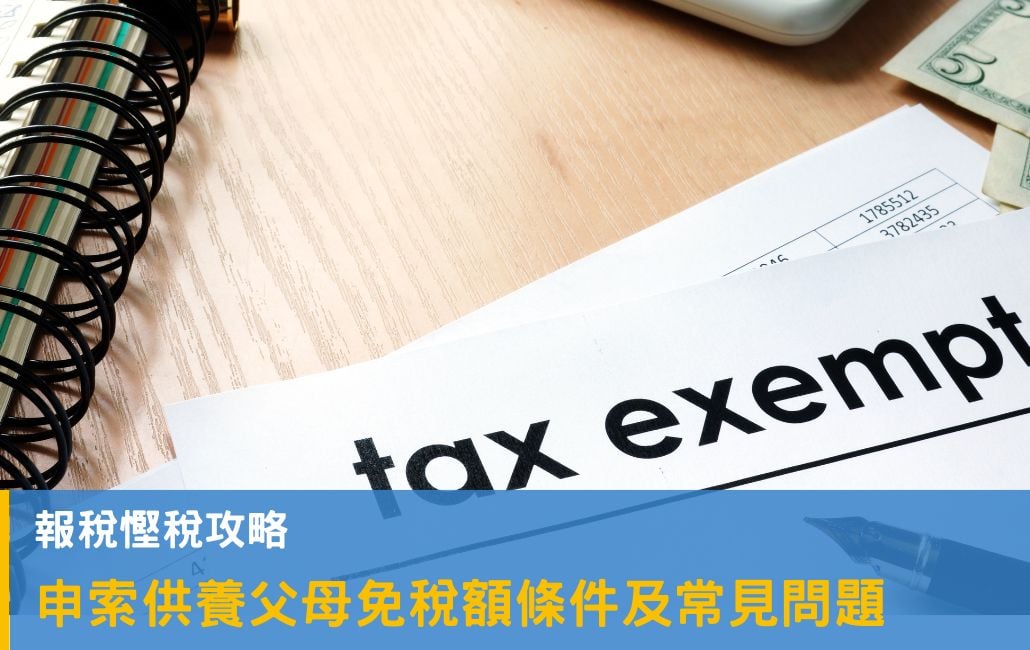

Tax deductions can be claimed for supporting parents or grandparents aged 55 or above who usually reside in Hong Kong. For the year 2025/26, the maximum amount is HK$100,000 per person; starting from 2026/27, the amount will be adjusted, and each dependent can only be claimed by one taxpayer.
Summary of key points
- Tax deductions can be claimed for supporting parents, grandparents, or great-grandparents aged 55 or above who usually reside in Hong Kong.
- For the year 2025/26: HK$50,000 for each person aged 60 or above; HK$25,000 for each person aged 55 to 59.
- If the continuous cohabitation condition is met for the entire year, an additional tax deduction of the same amount can be obtained, with a maximum total of HK$100,000 per person.
- Starting from 2026/27, the amounts will be adjusted: the amount for the 60-year-old group will increase to HK$55,000, and the amount for the 55–59-year-old group will increase to HK$27,500.
- Each dependent can only be claimed by one taxpayer and cannot be shared.
What is the Dependent Parent Allowance?
The tax deductions for supporting parents and supporting grandparents or great-grandparents are one of the family member tax deductions under the Hong Kong Salaries Tax system. If a taxpayer or their spouse supports eligible elderly individuals, they can claim the corresponding tax deduction for each dependent, directly reducing taxable income.
The tax deductions for supporting parents and supporting grandparents or great-grandparents are tiered by the age of the dependent. For the year 2025/26, HK$50,000 for each person aged 60 or above, and HK$25,000 for each person aged 55 to 59; if the dependent lives continuously with the taxpayer for the entire year and does not require full financial support, an additional tax deduction of the same amount can be obtained, with a maximum total of HK$100,000. Each dependent can only be claimed by one taxpayer.
This article focuses on the claim conditions for the tax deduction for supporting parents, the definition of cohabitation, sharing arrangements, and reporting practices.
For an overview of the overall calculation method for salaries tax and other tax deductions, please refer to salaries taxCalculationThe complete guide to personal tax deductions。
Overview of tax deduction amounts for 2025/26
| Age of dependent | Tax deduction for 2025/26 | Tax deduction for 2026/27 |
|---|---|---|
| Aged 60 or above, or eligible to claim allowances under the government disability allowance scheme | HK$50,000 | HK$55,000 |
| Aged 55 or above but under 60 | HK$25,000 | HK$27,500 |
Additional Allowances(Conditions for continuous cohabitation throughout the year, see below): The amount is the same as in the table above and can be used in combination.
| Age of dependent | Additional tax exemption (2025/26) | Additional tax exemption (2026/27) |
|---|---|---|
| Aged 60 or above | HK$50,000 | HK$55,000 |
| Aged 55 to 59 | HK$25,000 | HK$27,500 |
💡 Longfeng reminds you: If the dependent parents are aged 60 or above and have lived with you continuously throughout the year, the basic plus additional exemption can total HK$100,000. Starting from 2026/27, it will increase to HK$110,000, allowing for early planning for next year's declaration.
Three claim conditions (must meet all simultaneously)
To claim the dependent parent tax exemption, the dependent must meet the following three conditions during the tax year:
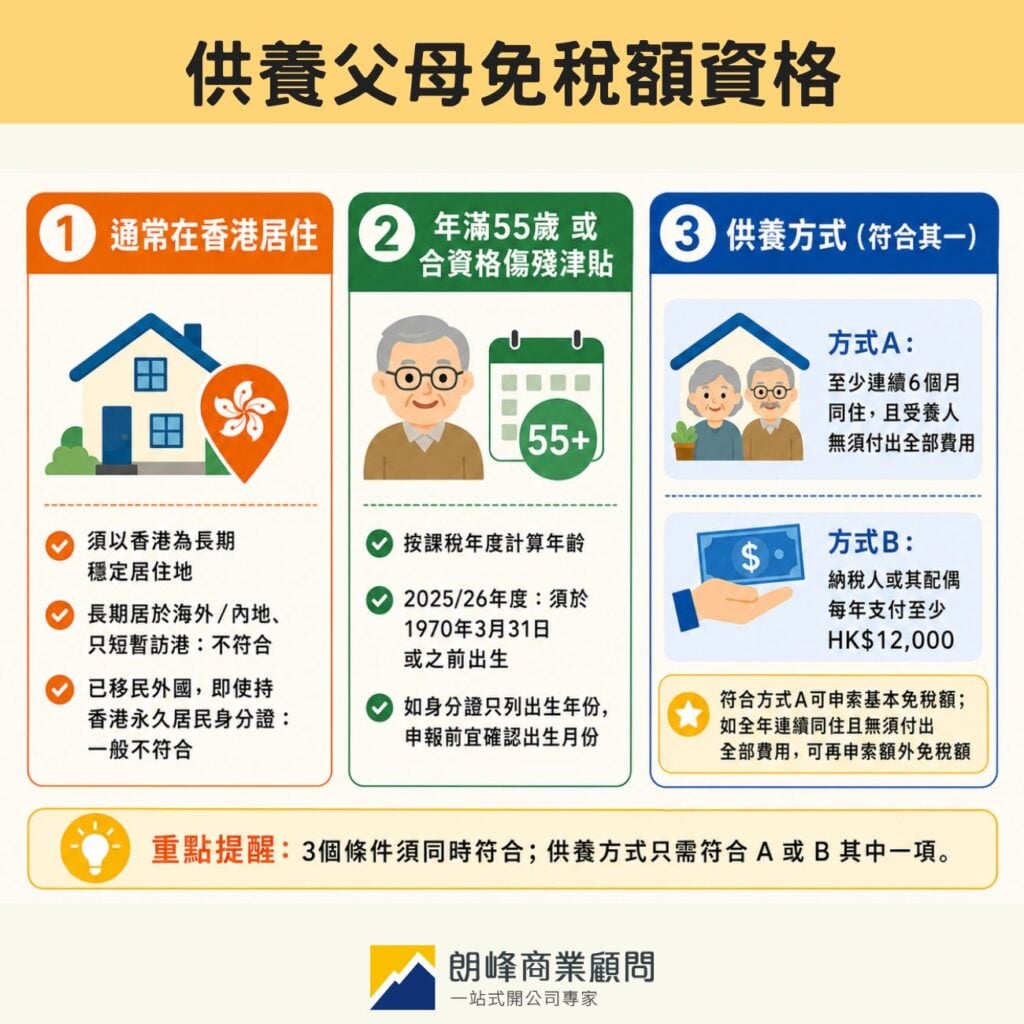
Condition 1: Usually resides in Hong Kong
The dependent must have Hong Kong as their long-term stable residence. The following situationsDo not meetThis condition:
- Long-term residence overseas or in mainland China, with only brief visits to Hong Kong each year
- Has immigrated abroad, even if still holding a Hong Kong permanent resident identity card
To claim the dependent parent tax exemption, the dependent must usually reside in Hong Kong during the tax year; seniors who have long-term residence overseas or in mainland China, even if holding a Hong Kong permanent resident identity card, do not meet this condition.
Condition 2: Aged 55 or above, or eligible to claim benefits under the government's disability allowance scheme
Age is calculated based on the tax year (from April 1 of each year to March 31 of the following year). For the 2025/26 year, one must be born on or before March 31, 1970, to meet the 55-year-old condition.
If the dependent's identity card only states the year of birth without the month, it is recommended to confirm the month of birth with the dependent before proceeding with the declaration.
Condition 3: Method of support (meet one of the following)
Method A: The dependent must live with the taxpayer for at least 6 consecutive months and does not need to bear all expenses.
Method B: The taxpayer or their spouse pays at least HK$12,000 annually to support the related person.
Meeting Method A allows for the claim of the basic tax exemption; if the dependentlives continuouslywith the taxpayer for the entire year and does not need to bear all expenses, an additional tax exemption can be claimed.
Definition of cohabitation: what counts as cohabitation and what does not?
The definition of "cohabitation" for the tax exemption for supporting parents is limited to long-term cohabitation within the same residential unit; parents living in another unit of the same building, nearby estates, or independent units where they bear the rent themselves do not meet the definition of cohabitation.
The definition of "cohabitation" is stricter, with the following common situationsDo not meet:
- Parents living in another unit of the same building (including upstairs and downstairs)
- Parents living on nearby streets or in adjacent estates
- Independent units where the rent is borne by the parents themselves
- Brief stays for any reason but not long-term cohabitation
In short, cohabitation must refer to long-term cohabitation within the same residential unit, with expenses borne or shared by the taxpayer.
Can claims still be made if parents are in a nursing home?
Parents residing in nursing homes or elderly homes do not meet thedefinition of cohabitation, and the expenses are charged by the institution,CannotClaim the tax exemption for supporting parents.
If the parents are over 60 years old, or qualify for government disability allowance, consideration can be given to claimDeduction for elderly residential care expenses, with a cap of HK$100,000 for the year 2025/26, increasing to HK$110,000 from 2026/27.
Note: For the same dependent, the deduction for elderly residential care expenses and the tax exemption for supporting parents can onlybe one or the other, and cannot be claimed simultaneously.
Who can claim? Sharing arrangement
The tax exemption for each dependent can only be claimed byonetaxpayer and cannot be shared or reported by multiple children.
It is recommended that the child with the higher taxable income claims to achieve maximum tax savings (as the marginal tax rate under progressive salary tax means that the higher the rate, the greater the deduction benefit).
Special circumstances: Parents of a deceased spouse
If the spouse has passed away, as long as the claimant lives with and is responsible for supporting the deceased spouse's parents, they still meet the claim conditions and can continue to claim.
Spouse is not a Hong Kong resident
If the spouse is not a Hong Kong resident, but their parents meet the claim conditions (such as living together for six consecutive months, etc.), the taxpayer can still claim the tax exemption for supporting the spouse's parents. Since the spouse does not hold a Hong Kong identity card, a copy of the spouse's identification document and marriage certificate must be provided when filing; if the spouse later obtains a Hong Kong identity card, the tax authority must be notified in writing within one month.
Reporting method and future audits
When submitting the tax return, there is no need to attach supporting documents immediately; relevant information can be filled in section 12.4 of the individual tax return (BIR60).
The tax authority mayconduct audits later.At that time, you must provide:
- A copy of the dependant's Hong Kong Identity Card
- Bank monthly statements (showing regular contribution records)
- Proof of living at the same address for the year (such as utility bills, lease agreements)
- Rent receipts for the foster parents' residence (if applicable)
The tax authority will verify whether the information matches past records and will confirm entry and exit records with the immigration department; it is essential to report truthfully.
What to do if there are errors or omissions in the tax return?
The tax authority allows taxpayers to correct reporting errors or omissions within 6 years after the end of the tax year:
| Timing | Processing method |
|---|---|
| After submitting the tax return and before receiving the assessment notice | Submit a written request for modification to the assessor |
| After receiving the assessment notice | Fill out the IR831 form to apply for correction from the tax authority |
| After paying taxes | Submit a written request for correction to the tax authority and submit the IR6071 form to claim the omitted tax allowance |
Frequently Asked Questions
Can parents still claim if they are working or have income?
The claim conditions do not require the dependent to be unemployed or have no other income; as long as the three conditions of residence, age, and support method are met, the parents' employment or income does not affect the eligibility for the claim.
Can siblings agree to share their parents' tax exemption?
No. The tax allowance for each dependent can only be claimed in full by one taxpayer and cannot be shared or separately reported by multiple people for the same dependent.
Can adoptive parents or stepparents make a claim?
Yes. Legally adopted parents and stepparents meet the definition of "parents" and can claim as long as they meet other claim conditions.
Can godparents claim?
No. The definition of "parents" only includes biological parents, legally adopted parents, stepparents, and the parents of deceased spouses; customary godfathers, godmothers, or stepparents who are not formally registered in marriage do not meet the definition.
Parents only have the year of birth, not the month; how can we confirm if they meet the age requirement?
It is recommended to check with the dependent about their birth month. If the parents turn 55 during the 2025/26 tax year (from April 1, 2025, to March 31, 2026), only those born from January to March 1971 meet the criteria; those born from April to December 1971 will not yet be 55 in the 2025/26 year.
What are the consequences of falsely declaring the tax exemption for supporting parents?
According to Section 80(2)(b) of the Inland Revenue Ordinance, making an incorrect declaration without reasonable excuse can result in a fine of up to HK$10,000 upon conviction, plus a penalty equal to three times the amount of tax undercharged; if fraud is involved, an additional imprisonment of three years may be imposed. For cases prosecuted by the Inland Revenue Department, please refer tothe Inland Revenue Department's official website.。
Conclusion
The key to claiming the tax exemption for supporting parents lies in three essential conditions (usually residing in Hong Kong, age, and method of support), all of which must be met; the definition of living together is also stricter, so it is recommended to confirm the actual living situation of the dependents before filing. If parents reside in a nursing home, consideration can be given to replacing it with deductions for elderly accommodation care expenses.
If you need assistance in clarifying your personal tax situation or filing your tax return, you can learn moreLongfeng Tax Filing Services, or directly contact the Long Peak Business Consulting Team via WhatsApp.
Extended Reading:
Complete guide to calculating salaries tax and personal tax exemptions.
Tax exemptions for married individuals and strategies for joint filing.
Tax reporting tutorial for self-employed individuals/Freelancers
Calculation of provisional salary taxLongfeng Tax Filing Services
Last updated: May 2026.