

Table of contents
Hong Kong accounting services help companies organise their accounts, prepare financial statements, file tax returns and manage payroll. Outsourcing to professional accountants saves costs and risk, ensures compliance and financial transparency, and suits SMEs.
Key takeaways
- Covers daily bookkeeping, statutory financial statements, tax computation and payroll and MPF administration
- Outsourcing offers the best value for money
- Quotations depend on the number of documents, the type of company and the completeness of the accounts
- Unclear accounts may lead to estimated-assessment penalties from the Inland Revenue Department and the bank freezing the company's account
- Lost documents can be remedied using bank records
What items do accounting services include?
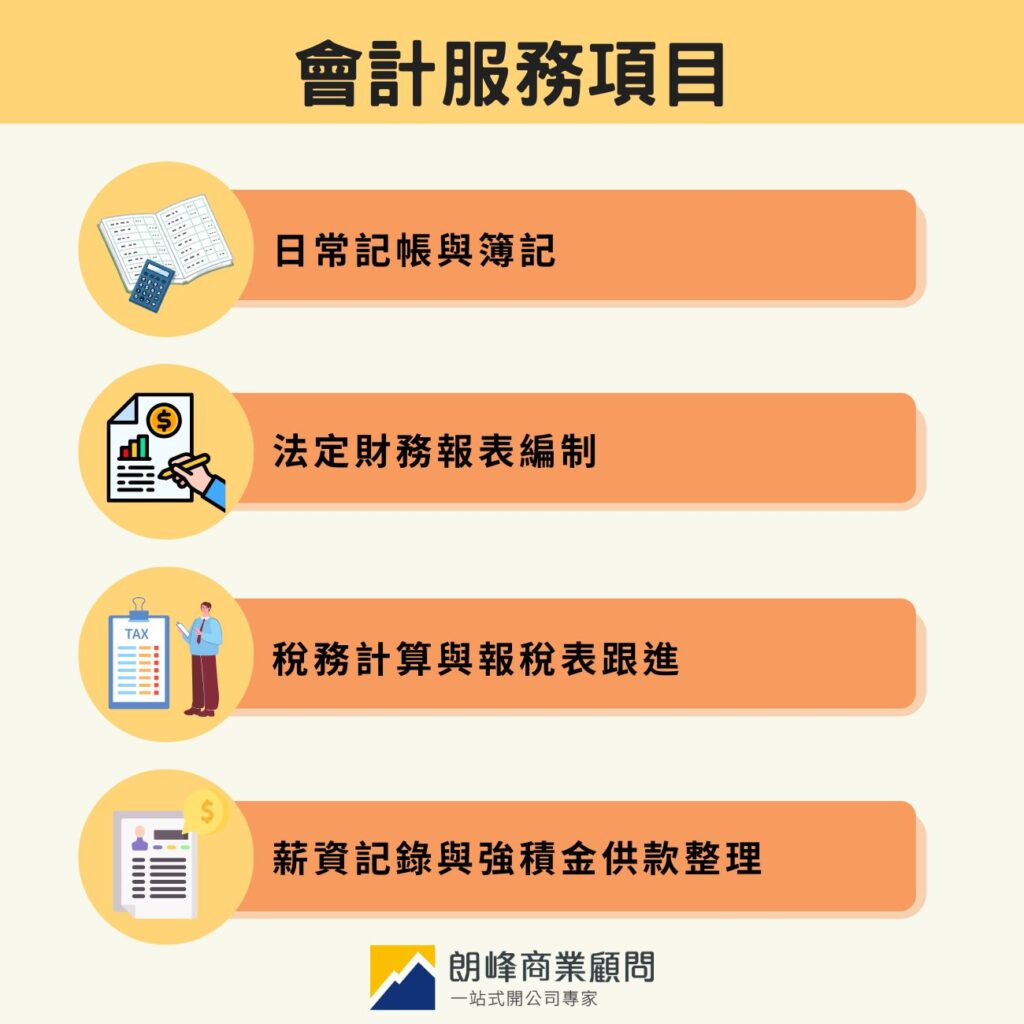
A company operating in Hong Kong, whatever its size, needs to handle its accounts and related filings regularly. The core purpose of accounting services is to help the company get its financial information in order.
Day-to-day bookkeeping and record keeping
The accounting team organises the company's daily income, expenses, invoices and bank transactions into proper accounts, so that every movement of funds can be traced and the books stay clear.
Preparing statutory financial statements
In accordance with Hong Kong's Companies Ordinance and accounting standards (HKFRS), the accounting team compiles the accounts into formal financial statements. These reports, which include the balance sheet and profit and loss account, are the company's annual “report card” and are also essential for the auditor's review.
Tax computation and follow-up on tax returns
Based on the finalised accounts, the accountant calculates the “assessable profits” and completes the profits tax return (PTR). If the IRD raises queries, the accountant also helps to reply based on experience, so that the filing goes smoothly and unnecessary misunderstandings are kept to a minimum.
Payroll records and MPF contributions
Employee payroll and MPF contributions involve employment legislation and also directly affect the company's tax expenses. Accounting services usually include recording payroll details, ensuring the related expenses are booked correctly and serve as supporting evidence for future tax deductions.
Should SMEs hire in-house or outsource? Cost-effectiveness of 3 models compared
Hiring a full-time accountant
For large enterprises with a high volume of transactions that need real-time cash flow monitoring, building an in-house team is a common choice, but it requires a long-term commitment of human resources.
- Key feature: highest cost, suited to large companies.
- Analysis: Besides the basic salary, the company must also bear hidden costs such as MPF, labour insurance, employee leave and office hardware and software. Unless large numbers of documents need to be recorded every day, this model easily leaves resources idle and creates an excessive financial burden for a typical SME.
Using accounting software yourself
As cloud technology has become widespread, subscription software has greatly lowered the barrier to bookkeeping, but note that “knowing how to operate the software” is not the same as “understanding tax compliance”.
- Key feature: lowest cost, but mistakes can easily lead to penalties.
- Analysis: Although tools such as Xero or QuickBooks are powerful, a lack of understanding of the Hong Kong Financial Reporting Standards (HKFRS) can easily lead to misclassified assets or wrongly reported private expenses. Such unintentional errors may save the initial service fee, but they can later trigger an IRD tax audit, which is not worth the trade-off.
Outsourcing to a professional accounting service
To strike the best balance between operating costs and compliance quality, engaging external professional advisers has become a lean-management trend among modern businesses.
- Key feature: good value, with a professional team safeguarding quality.
- Analysis: This model is highly flexible. The company pays only for the services it actually uses (pay-as-you-go) and is completely free of the pressure of maintaining staff. At the same time, with a double check by senior accountants, the accounts are kept in line with the latest regulatory requirements, so business owners can focus on their core business without worry.
Outsourced accounting service process
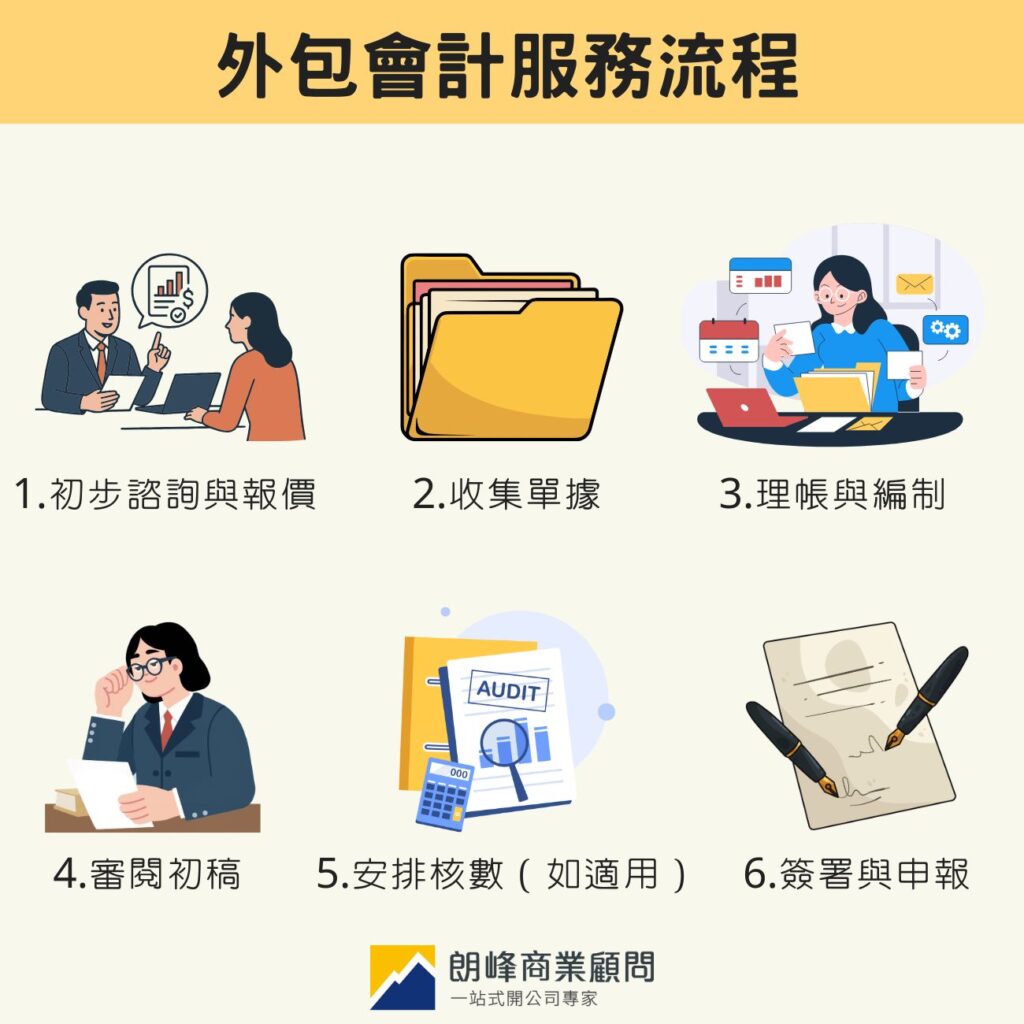
Step 1: Initial consultation and quotation
The team first assesses the company's scale of operations, number of documents and industry characteristics, then provides a clear and transparent quotation so that the client understands the scope of service.
Step 2: Collecting documents
The company organises the year's bank statements, sales invoices, expense receipts and purchase orders and submits them to the service provider (by physical courier or electronic cloud upload).
Step 3: Bookkeeping and preparation
The accounting professionals start entering and classifying data, reconciling bank balances, and preparing the balance sheet and profit and loss account in accordance with accounting standards.
Step 4: Reviewing the draft
Once preparation is complete, the draft statements are sent to the client for confirmation, to check whether any special transactions have been missed or need further explanation.
Step 5: Arranging the audit (if applicable)
Once the statements are confirmed to be correct, for a limited company the accounting team passes them to an independent auditor for the statutory audit.
Step 6: Signing and filing
After the directors sign and confirm the final audit report, the team helps complete the tax return and submit it to the IRD, completing the annual tax filing process.
How much do accounting services cost in Hong Kong?
Accounting service fees range from HK$1,000-$10,000, and usually depend on workload and complexity. The factors that affect quotations are also summarised below for your reference:
| Factor | Description | Impact on price |
| Number of documents | The total number of bank transactions, invoices and receipts. | The more documents, the longer the processing time and the higher the fee. |
| Company type | Unlimited company vs limited company. | A limited company must be audited and is subject to more regulation, so fees are usually higher than for an unlimited company. |
| Completeness of accounts | Whether documents are complete and whether old accounts need to be cleaned up (tidying loose ends). | If the accounts are in disarray and need time to be reorganised, additional service fees usually apply. |
| Reporting frequency | Annual, quarterly or monthly bookkeeping. | Annual bookkeeping is the most economical; monthly bookkeeping costs more but gives you an up-to-date view of your finances. |
Recommended Hong Kong accounting service: SetupHK
Faced with complex accounting standards and potential tax risks, many business owners feel at a loss.
Since its founding in 2014, SetupHK has focused on solving SMEs' pain points of “difficult bookkeeping and troublesome tax filing”, and has won the Economic Digest Outstanding Brand Awards for 4 consecutive years, a recognition of its professionalism. By entrusting your accounting to SetupHK, business owners receive not only compliant financial statements but also a strong financial backstop that can answer tax questions at any time and help them handle IRD reviews with confidence.
FAQ
What risks does a company face if it does not do accounting?
The most direct risk comes from the IRD's “estimated assessment” and penalties. Without accounts to support the figures declared, the IRD can overturn the filing and directly assess a higher amount of tax. In addition, if a bank finds that a company has been unable to provide financial statements for a long time, it may freeze the company's account, seriously affecting cash flow.
Can accounts still be written up if past documents have been lost?
These can usually be reconstructed from bank records and other information, but extra time is needed to organise them. It is usually advisable to first apply to the bank for reissued past statements, as basic proof of the flow of funds.
What is the difference between accounting and audit services?
“Accounting” is responsible for “preparing the books”, turning documents into financial statements; “audit” is responsible for “checking the books”, where an independent third-party accountant verifies that the statements are true and fair.
Is it troublesome to change accounting firms midway?
As long as the handover of information is clear, the transition is usually smooth. The key is the completeness of the accounts.
Do accounting services include acting as the “company secretary”?
These are two different roles. Accountants focus on finance and tax; a company secretary (Com Sec) handles administrative compliance such as notifying the Companies Registry of company changes and filing the annual return (NAR1). They are usually itemised separately on a quotation.
How long does it usually take to complete the bookkeeping?
When all information is complete, annual bookkeeping usually takes 2-4 weeks of working days. If an audit is included, extra time is needed. Business owners are advised to allow a buffer of 1.5-2 months before the tax filing deadline to avoid time pressure.
Tired of worrying about your company's accounting? Leave it to the SetupHK professional team
Each to their own expertise: a business owner's time is better spent on profit planning and key decisions. Accounting involves many details, so it is worth leaving it to professionals, which can help reduce your management burden.
SetupHK The team has deep experience in Hong Kong tax and accounting practice and is committed to helping businesses keep their accounts in order and complete filings in compliance with the rules, so that business owners can focus on growing their business with greater peace of mind.
Further reading: “Must a Hong Kong company be audited? Audit services explained: scope, fees and recommended audit firms”
Further reading: “What do Hong Kong tax filing services include? Company tax filing process, fees and real benefits explained”