


Table of contents
Want to know the 2026 Hong Kong public holidays and labour holidays? This article sets out the complete list of holidays, with the latest comparison table of statutory holidays and common questions, so that employers and employees can plan work and time off in advance.
Overview of 2026 labour holidays (statutory holidays)
The labour holidays in 2026 are as follows:

| Statutory holiday | Date |
| 1 January (New Year's Day) | 1 January (Thu) |
| Lunar New Year's Day | 17 February (Tue) |
| Second day of Lunar New Year | 18 February (Wed) |
| Third day of Lunar New Year | 19 February (Thu) |
| Ching Ming Festival | 5 April (Sun) |
| Easter Monday | 6 April (Mon) |
| Labour Day | 1 May (Fri) |
| The Buddha's Birthday | 24 May (Sun) |
| Tuen Ng Festival | 19 June (Fri) |
| Hong Kong Special Administrative Region Establishment Day | 1 July (Wed) |
| The day following the Mid-Autumn Festival | 26 September (Sat) |
| National Day | 1 October (Thu) |
| Chung Yeung Festival | 18 October (Sun) |
| Winter Solstice Festival or Christmas Day (employer's choice) | 22 December (Tue) or 25 December (Fri) |
| The first weekday after Christmas Day | 26 December (Sat) |
The 15 statutory holidays in 2026
In Hong Kong, “statutory holidays” are generally called “red days” or “labour holidays”.
Under the Employment Ordinance, all employees are entitled to statutory holidays every year (15 days in 2026), regardless of length of employment or whether they have a continuous contract, and this even applies to foreign domestic helpers.
However, since 2022 labour holidays have been increasing gradually, by one day every two years, so there will be 15 days in total in 2026, expected to rise to 17 days by 2030.
Implementation schedule for Hong Kong statutory holidays
Statutory holidays are being increased gradually from 12 to 17 days. The table below shows the 5 additional holidays expected and the implementation progress:
| Effective date | Statutory holiday |
| 2022/1/1 | The Buddha's Birthday (implemented) |
| 2024/1/1 | The first weekday after Christmas Day (Boxing Day) (implemented) |
| 2026/1/1 | Easter Monday (to be implemented) |
| 2028/1/1 | Good Friday |
| 2030/1/1 | The day following Good Friday |
Overview of 2026 public holidays (bank holidays)
The public holidays in 2026 are as follows:
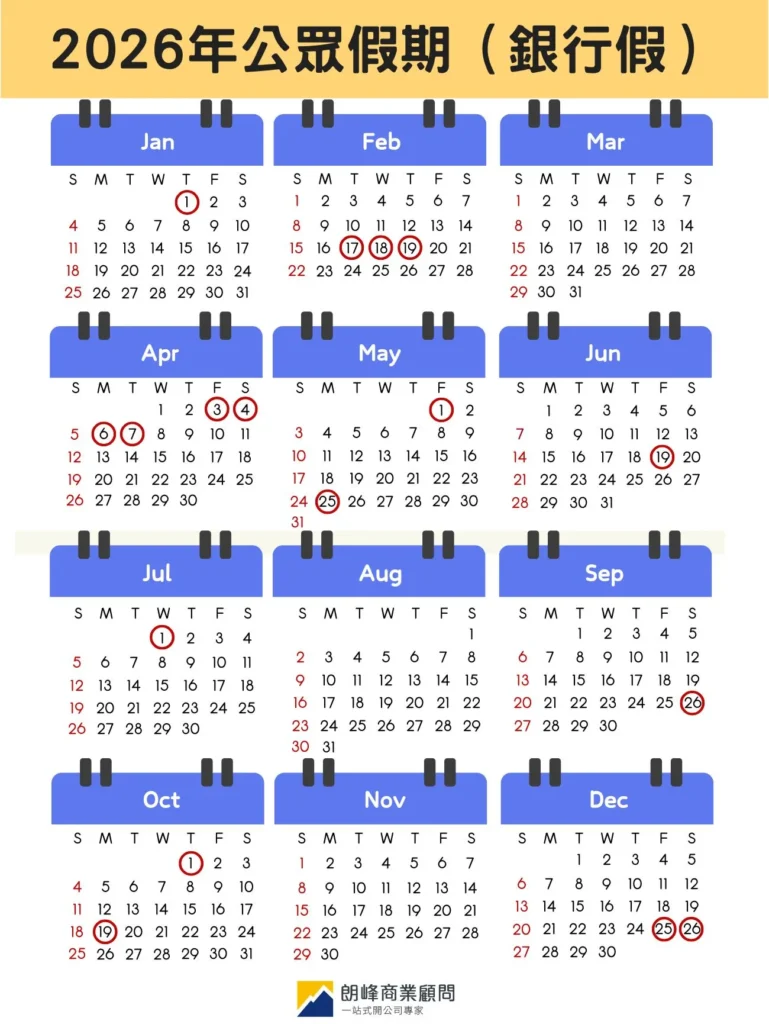
| Public holiday | Date |
| 1 January (New Year's Day) | 1 January (Thu) |
| Lunar New Year's Day | 17 February (Tue) |
| Second day of Lunar New Year | 18 February (Wed) |
| Third day of Lunar New Year | 19 February (Thu) |
| Good Friday | 3 April (Fri) |
| The day following Good Friday | 4 April (Sat) |
| The day following Ching Ming Festival | 6 April (Mon) |
| The day following Easter Monday | 7 April (Tue) |
| Labour Day | 1 May (Fri) |
| The day following the Buddha's Birthday | 25 May (Mon) |
| Tuen Ng Festival | 19 June (Fri) |
| Hong Kong Special Administrative Region Establishment Day | 1 July (Wed) |
| The day following the Mid-Autumn Festival | 26 September (Sat) |
| National Day | 1 October (Thu) |
| The day following Chung Yeung Festival | 19 October (Mon) |
| Christmas Day | 25 December (Fri) |
| The first weekday after Christmas Day | 26 December (Sat) |
A Hong Kong Government spokesman said: “As Ching Ming Festival in 2026 falls on a Sunday, the day following will be a compensatory holiday. As the day following Ching Ming Festival is Easter Monday, the first day after that which is not a public holiday will be designated a supplementary public holiday. In addition, as the Buddha's Birthday and Chung Yeung Festival in 2026 both fall on a Sunday, the day following each of these two days will be a compensatory holiday.”
What employers must know: common questions on statutory holidays
Who is entitled to statutory holidays?
All employees are entitled to statutory holidays, regardless of length of service or form of contract.
If an employee has been employed continuously for 3 months, they are entitled to holiday pay, calculated as the average daily wage over the 12 months before the holiday.
Can employees be required to work on a statutory holiday?
Yes! But employers need to note a few points:
· Employers must give at least 48 hours' notice, in writing, verbally or by posting a notice.
· The “substituted holiday” must not overlap with another statutory holiday or a compensatory holiday.
· The employer and employee may also agree to arrange the holiday within 30 days before or after.
In addition, the employer must arrange a separate day off for the employee, the so-called “substituted holiday”, which must be given within 60 days before or after that statutory holiday
If an employee works on a statutory holiday, can the employer pay overtime instead of giving a day off?
No! Under the Employment Ordinance, an employee who works on a statutory holiday must be given a substituted holiday, which cannot be replaced by overtime pay. Offenders can be fined HK$50,000.
If a statutory holiday falls on an employee's rest day, is a substituted day off needed?
If a statutory holiday falls on an employee's rest day, the day off must be given on the day after the rest day. If two consecutive days are both statutory holidays, a substituted day off must be arranged separately.
What employees must know: common questions on statutory holidays
Are rest days always paid?
Not necessarily! Whether they are paid depends on the employment agreement at the time.
Can an employer require an employee to work more than 7 days in a row?
No! Under the law, an employee must be given at least 1 rest day in every 7 days.
Moreover, an employer cannot make working on rest days a condition for paying a bonus or year-end bonus, otherwise the agreement is treated as invalid! However, the two parties may reach an agreement on rest day arrangements.
Why do the numbers of statutory holidays and bank holidays differ?
Hong Kong is gradually increasing statutory holidays to 17 days, and by 2030 the two will be fully aligned.
Not sure about Hong Kong's statutory holiday rules? SetupHK offers professional advice
For many employers and HR departments, Hong Kong's statutory holiday rules involve the Employment Ordinance and a great deal of detail, and a small oversight can breach the law or lead to labour disputes.
If you are not sure how to handle your employees' holiday arrangements correctly, the SetupHK team has many years of experience and provides dedicated help in interpreting the law and offering suitable solutions, so that you can keep your business compliant with ease while protecting employees' rights and trust.