


Table of contents
Every Hong Kong limited company must have a company secretary. A company secretary is not an ordinary clerk, but an officer responsible for the company's statutory compliance: keeping statutory records, filing the annual return on time, and notifying the Companies Registry when company particulars change. Based on the Companies Ordinance, this article explains a company secretary's duties, who can act, whether a director can double up, and the risks of doing it yourself versus outsourcing.
What is a company secretary?
The company secretary system originates from the United Kingdom. In Hong Kong the role is called company secretary; in the Mainland, listed companies have a board secretary. A company secretary is different from a secretary who answers phones and arranges schedules day to day. They are an officer of the company, responsible for ensuring the company operates in accordance with the law and acting as the contact between the company and government departments.
Section 474(1) of the Companies Ordinance provides that a company must have a company secretary. The company secretary named on the incorporation form when the company is formed is the first company secretary from the date of incorporation. Listed companies must also meet the Listing Rules' requirements on company secretary qualifications.
Who can be a company secretary?
A company secretary can be an individual or a company (body corporate). The conditions are set out in section 474(4) of the Companies Ordinance:
- Individual: must ordinarily reside in Hong Kong.
- Body corporate: its registered office must be in Hong Kong, or it must have a place of business in Hong Kong.
Can a director also act as company secretary?
Generally yes, but section 475 has two exceptions:
- If a private company has only one director, that director may not also act as company secretary.
- For a private company with only one director, its company secretary cannot be a company that likewise has that director as its sole director.
So a private company with only one director must find another person or organisation to act as company secretary; a company with two or more directors can have one of the directors act as company secretary.
Do you need a licence to be a company secretary?
A director or employee of your own company acting as company secretary does not need a licence. But if someone acts by way of business as secretary for other companies or provides a registered office address, that counts as a “trust or company service” under the Anti-Money Laundering and Counter-Terrorist Financing Ordinance and requires a licence issued by the Companies Registry; operating without a licence is an offence (Cap. 615, Schedule 1 and section 53F).
Duties of a company secretary
A company secretary's work runs from incorporation until the company is dissolved, and mainly includes the following. Each has a statutory deadline, and missing it may result in a fine.

Keeping statutory registers
The company must keep a register of members (shareholders), a register of directors, a register of company secretaries and a Significant Controllers Register. Even if the company has no significant controllers, it must still keep a Significant Controllers Register (section 653H). Statutory records also include written resolutions and minutes of meetings of members and directors, which must be kept at the company's registered office or at a specified place notified to the Companies Registry.
Preparing and filing the annual return
A private company must deliver an annual return (NAR1) to the Companies Registry within 42 days after each anniversary of incorporation (section 662). A private company generally only needs to complete the company particulars; only in the circumstances listed in section 664(4) (for example, where the number of members exceeds the limit) must it attach documents as required of a public company.
Further reading: What is an annual return
Reporting changes in company particulars
When a director or company secretary is appointed or resigns, or their particulars change, the company must notify the Companies Registry within 15 days (section 652). Changes of registered address, share allotments and transfers and so on also each have a prescribed form and deadline.
Further reading: Share transfer documents and process, Change of registered address
Business Registration Certificate renewal and changes of particulars
Business Registration Certificates are issued for one year or three years and must be renewed before they expire; if the business name, address or nature changes, you must also notify the Business Registration Office.
Further reading: Business Registration renewal
Organising meetings and other work
Organising and minuting board meetings and general meetings, handling share transfer documents, safekeeping the company's statutory documents, and assisting with deregistration when the company ceases business.
Further reading: How to deregister a company
What legal responsibilities does a company secretary have?
A company secretary is an officer of the company. Where a company breaches the reporting requirements of the Companies Ordinance, the Ordinance generally provides that “the company and every responsible person commit an offence”. Taking the annual return as an example, if it is not delivered on time, the company and every responsible person are liable to a level 5 fine, plus a further fine of HK$1,000 for each day the offence continues (section 662(6)); for late notice of a change of company secretary, the liability is a level 4 fine, plus a further HK$700 for each day the offence continues (section 652(3)).
If the annual return is filed late, the Companies Registry's registration fee also increases according to the length of the delay:
| Time of delivery | Registration fee (HK$) |
|---|---|
| Within 42 days of return date | 105 |
| Up to 3 months late | 870 |
| More than 3 months late, but not more than 6 months | 1,740 |
| More than 6 months late, but not more than 9 months | 2,610 |
| Over 9 months late | 3,480 |
Can a company secretary do it themselves? Doing it yourself versus outsourcing
If you meet the eligibility requirements in Section 2, your own people can act as company secretary. The advantage of doing it yourself is saving the service fee and having a clearer view of the company's compliance status; the cost is that you have to remember all the deadlines yourself and bear responsibility for any mistakes. The two most common slips are:
- Late delivery of the annual return: you only find out you missed the deadline when you receive a penalty notice.
- Failing to report changes within 15 days: after a change in directors or shareholders, the Companies Registry is not notified, and the statutory registers no longer match the actual position.
If you outsource to a licensed secretarial firm, they will proactively remind you of deadlines, prepare and file documents on your behalf, and handle change notifications.
| Comparison item | Doing it yourself | Outsourcing |
|---|---|---|
| Direct cost | No service fee, but it takes time | Per the provider's quotation |
| Expertise | You must master it yourself | Handled by the provider |
| Risk of errors | Higher, borne by you | Lower, checked by the provider |
| Time commitment | Needs regular follow-up | Mainly providing information |
| Suitable for | Companies familiar with company law and with simple businesses | Most start-ups and SMEs |
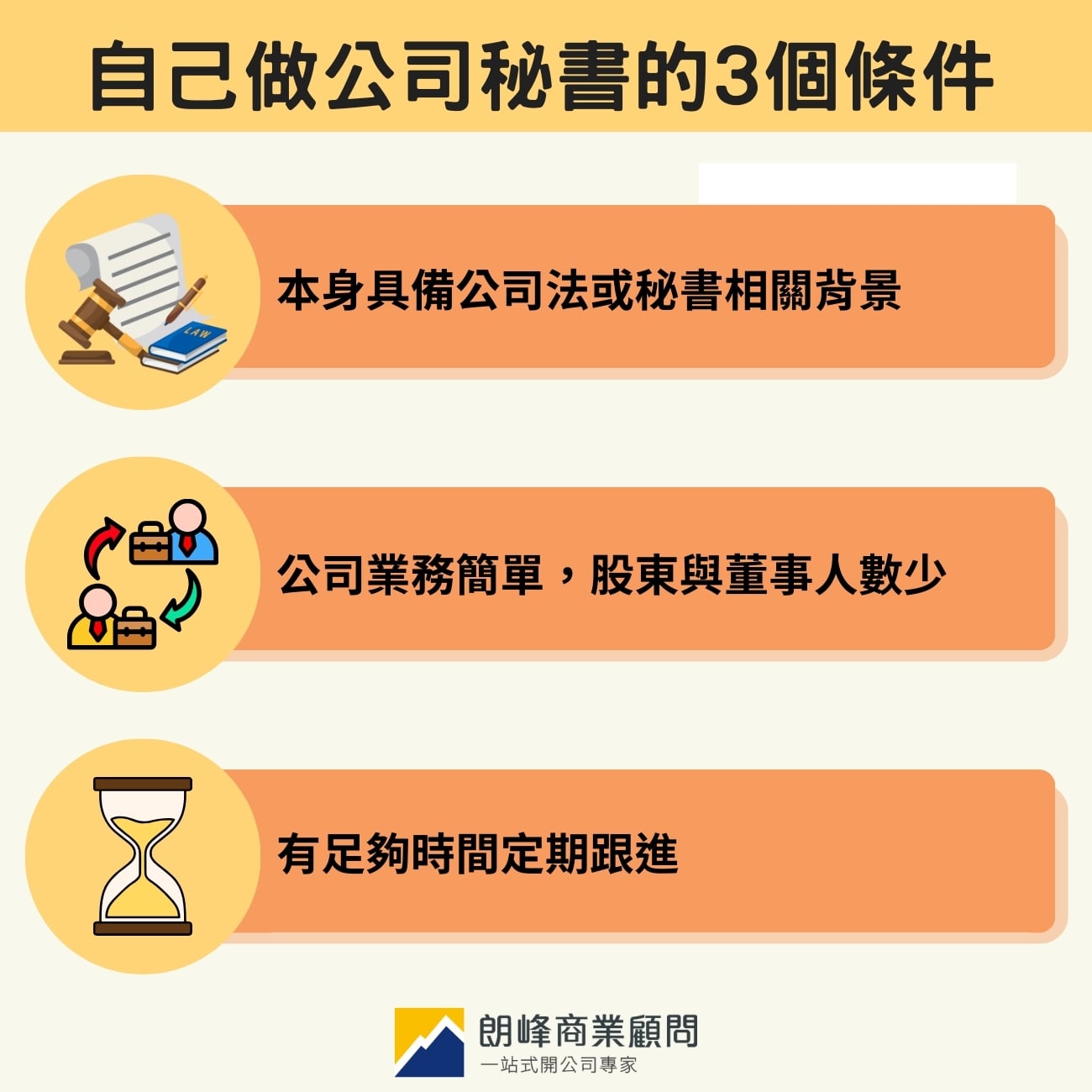
Only do it yourself if you meet these 3 conditions
- Be familiar with the main provisions of the Companies Ordinance and the filing procedures, or have a background in company secretarial work.
- Companies with simple operations: few shareholders and directors, a stable structure and few changes.
- Have time to follow up regularly: you will not forget statutory deadlines because the business is busy.
Even if you meet all three, we recommend setting calendar reminders for each filing deadline; if you are unsure about anything, seeking professional advice early is cheaper than fixing things afterwards.
How do you choose a company secretary service?
- Check the licence: ask the provider for its Trust or Company Service Provider licence number, and verify it by name or licence number on the website of the Registry for Trust and Company Service Providers.
- Ask about fees: apart from the basic monthly or annual fee, check whether the annual return, company changes, rush service or extra copies of documents are charged separately, and confirm the full fees before signing.
- Data confidentiality: a secretarial firm will have access to the company's statutory documents and shareholder information, so find out how they safeguard them.
- Whether they can also handle accounting and tax filing: having the same team follow up saves the time of referrals between different firms.
FAQ
Who can act as company secretary?
An individual must ordinarily reside in Hong Kong; a body corporate's registered office must be in Hong Kong, or it must have a place of business in Hong Kong (section 474(4)). Acting as secretary for other companies by way of business also requires a Trust or Company Service Provider licence.
Can a director also act as company secretary?
If a private company has only one director, that director cannot also act as company secretary; if there are two or more directors, one of them can act as company secretary (section 475).
How do you change the company secretary?
The board passes a resolution to appoint the new company secretary and delivers a notice to the Companies Registry within 15 days of the appointment; when the outgoing secretary ceases to act, notice must likewise be given within 15 days (section 652). Form ND2A is used for notices of appointment or cessation, and Form ND2B is used where the company secretary's particulars change (Companies Registry FAQ).
If I do it myself now, can I outsource it later?
Yes. A company can change its company secretary at any time: deliver the notice using the method in the previous question, and hand the statutory records over to the new company secretary.
Summary
A company secretary has no control or ownership of the company, but must ensure the company operates in accordance with the law day to day; where the company breaches reporting requirements, the company secretary, as a responsible person, may also be prosecuted. Companies with simple businesses and a good knowledge of the regulations can do it themselves; in other cases, handing it to a licensed secretarial firm is the safer choice.
SetupHK holds a Trust or Company Service Provider licence (TC009022) and offers company secretarial services from HK$99 per month, with the same team able to handle accounting and tax filing.
If you need to appoint a licensed firm as your company secretary, see SetupHK's Company secretary.