

Table of contents
Hong Kong tax filing services cover bookkeeping, audit coordination and profits tax returns. A professional team helps calculate tax, submit the audit report and reply to IRD enquiries, reducing the risk of errors, omissions and late filing.
Key takeaways
- Tax filing services include tax computation, completing the various tax returns and following up on IRD letters
- Engaging professionals saves time, reduces risk and optimises tax
- Engaging a professional firm allows the company to join the “Block Extension Scheme” and legitimately extend the filing deadline
- Limited companies, companies with frequent transactions, companies seeking financing and those unfamiliar with tax rules are advised to engage an agent
- Fees depend on the type of company, turnover, number of documents and whether back-posting of accounts is involved
What items do tax filing services include?
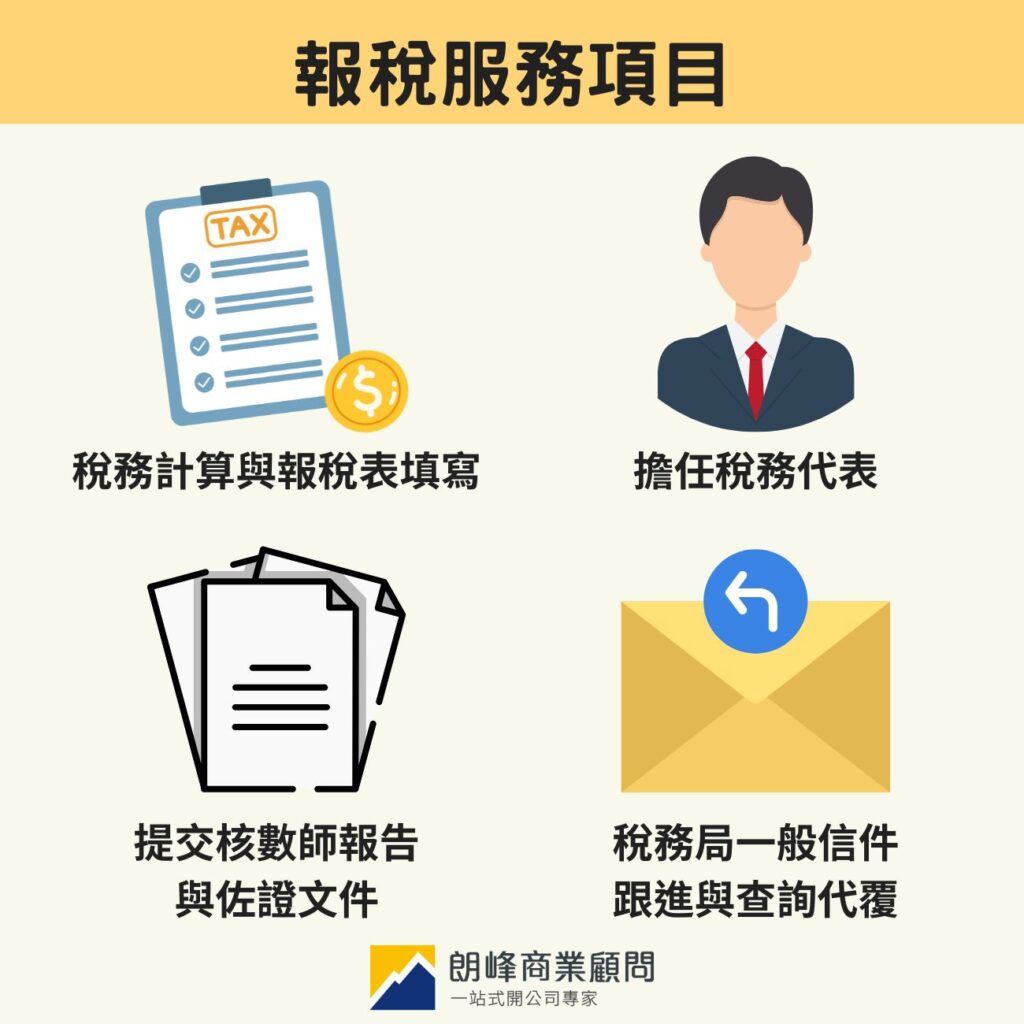
Tax computation and completing the various tax returns
The service provider calculates the “assessable profits” from the company's financial statements. In the process, non-deductible private expenses are excluded and depreciation allowances are calculated precisely, to reduce the final tax payable.
The scope of service usually covers the three taxes of profits tax, salaries tax and property tax, and the completion of the various statutory forms:
- Limited company tax return (BIR51): for profits tax filing by limited companies, to be submitted together with the auditor's report.
- Unlimited company tax return (BIR52): for profits tax filing by partnership businesses.
- Employer's return (BIR56A): to fulfil employer obligations by reporting employee remuneration records.
- Individual tax return (BIR60): helps sole proprietors report business profits together with their personal income.
Acting as tax representative: extension applications and schedule management
The greatest administrative advantage of engaging a professional firm is that it can be appointed as the company's “tax representative”.
Under IRD rules, a company with a tax representative can join the “Block Extension Scheme”. This mechanism allows the company to legitimately extend its filing deadline by several months, giving business owners more time to prepare documents and funds and easing the administrative pressure of each tax season.
Exclusive to limited companies: submitting the auditor's report and supporting documents
For Limited company, the financial statements audited by an auditor (the auditor's report) must be attached when submitting the profits tax return. The service provider checks that the financial data in the profits tax return is consistent with the audit report and submits everything together as the IRD requires, reducing the risk of mismatched information or missing documents.
Following up on general IRD letters and replying to enquiries on your behalf
After the return is filed, the IRD may still write to ask about details. For general written enquiries, the service provider helps draft compliant replies that explain any special circumstances in the accounts. This greatly reduces business owners' anxiety about official correspondence and keeps communication smooth.
Can a limited company file its own tax return?
From a legal standpoint, a limited company may handle its own tax filing, but in practice the overall process is fairly complex, as it must work with the statutory audit and correctly understand the various tax deductions and filing rules. With insufficient knowledge of the tax rules, it is easy to make errors in the details that affect the outcome of the filing.
Filing it yourself vs engaging a service
To help you assess this more clearly, we have put together the following table:
| Comparison item | Doing it yourself | Engaging a tax filing service |
| Time cost | Higher (you must organise documents and study the form instructions yourself) | Lower (you only need to provide the original documents and confirm the paperwork) |
| Accuracy and risk | More prone to errors and omissions, with the risk of penalties or an excessive estimated assessment | High accuracy, checked by professionals, with compliance assured |
| Tax optimisation | You can only fill in the form literally, making it harder to find potential deductions | Professionals proactively suggest legitimate deductions and exemptions |
| Extension applications | You must apply separately yourself, which is a complicated procedure | Automatically included in the Block Extension Scheme, with a longer grace period |
In which situations should you consider professional tax filing help?
If your company meets any of the following characteristics, seeking external help is usually the most cost-effective choice:
- Limited company structure: a statutory audit is required and cannot be completed on your own
- Frequent transactions or many documents: there is no dedicated in-house accountant to organise the accounts
- Wishing to apply for financing: banks place great importance on the standard of financial statements and tax records
- Unfamiliar with tax rules: worried that filling in a form incorrectly will lead to heavy penalties or unnecessary tax investigations
4 steps for outsourcing a limited company's tax filing
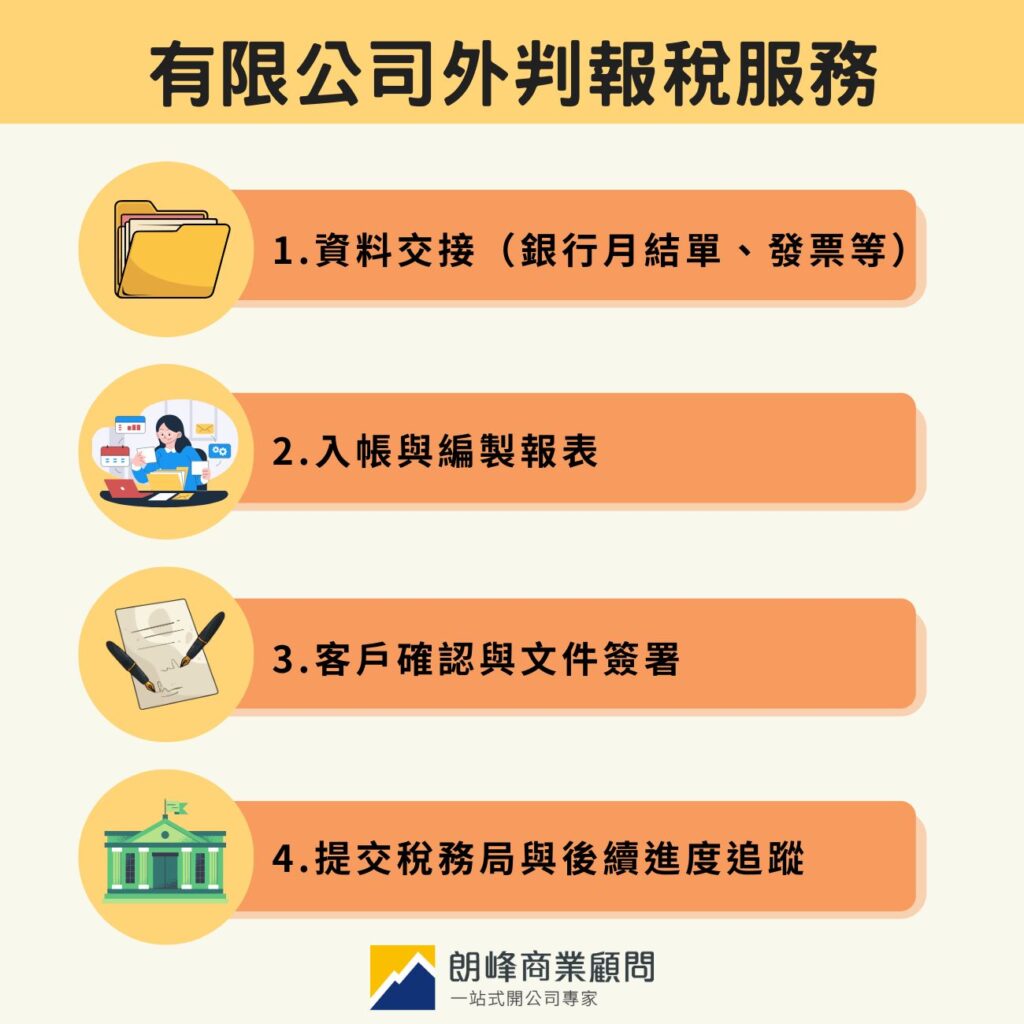
Step 1: Handover of information (bank statements, invoices, etc.)
The business owner only needs to collect the year's operating documents, including bank statements, sales invoices, purchase documents and expense receipts, and hand them to the service provider's team sorted by month.
Step 2: Bookkeeping and preparing the statements
The service provider turns disorganised documents into accounts that comply with accounting standards and prepares the profit and loss account and balance sheet. This stage is the foundation of tax filing and ensures that the data truly reflects the company's operations.
Step 3: Client confirmation and document signing (including the audit report)
Once the accounts are complete, they are sent to a practising certified public accountant for audit (applicable to limited companies), and the audit report is produced and the tax return completed. After confirming that the contents are correct, the business owner signs the documents.
Step 4: Submission to the IRD and follow-up tracking
The service provider submits the signed documents to the IRD and monitors the acknowledgement of receipt and the assessment result, ensuring the whole filing process is completed satisfactorily.
Hong Kong tax filing service fees
There is no fixed standard for tax filing fees, which are usually adjusted according to the following factors:
| Factor | Description |
| Company type | Unlimited company No audit is required, so fees are lower; a limited company must by law submit an auditor's report, so the quotation usually includes the practising certified public accountant's audit fee. |
| Annual turnover | Turnover reflects the scale and potential risk of the business. The market usually sets fee bands by amount, and the higher the turnover, the wider the scope of the auditor's checks. |
| Number of documents | The number of bank statements and invoices directly determines the hours needed for bookkeeping. If transactions are frequent or documents are complex, more manpower is needed to organise them. |
| Whether back-posting of accounts is involved | Handling backlogged accounts requires tracing old data and confirming the continuity of assets, which is far more technically difficult and time-consuming than annual filing. |
Which tax filing service is best? Recommended: SetupHK
SetupHK has helped hundreds of clients solve business challenges every year since its founding in 2014, and has won the Economic Digest Outstanding Brand Awards for 4 consecutive years, making it a trusted tax ally for SMEs.
Unlike some intermediary models on the market, SetupHK insists on “following up with its own in-house team throughout”: from bookkeeping and audit coordination to tax filing, everything is personally overseen by in-house professional consultants, effectively safeguarding data security and improving processing efficiency. The team is good at explaining complex tax rules in plain language and proactively watches for potential tax risks and concessions on clients' behalf, so business owners can put down the administrative burden with peace of mind and devote themselves fully to business growth.
FAQ
Do I need to file a tax return if the company is not operating?
Even if a company is not actually operating, it must still submit a tax return to the IRD, usually as a “nil return”. If this is ignored, penalties will be incurred.
Can a service provider help if past documents have been lost?
In some cases, accounts can be reconstructed with the help of bank records or other documents, but the actual feasibility still depends on how complete the information is.
How soon must the tax return be submitted after receiving it? What happens if it is late?
A profits tax return usually has to be submitted within 1 month of receipt. If a tax representative is engaged, an extension of several months can be applied for according to the year-end date. Late submission may result in a fine (up to HK$10,000 plus 3 times the tax involved), and the IRD may also first issue an estimated assessment and demand payment, leaving the company to lodge an objection afterwards.
Does a company still need to file a tax return and be audited if it is making a loss?
Under the Inland Revenue Ordinance, even if a company makes a loss, it must still submit a tax return and an audit report as required by law.
Worried about errors or late tax filing? SetupHK provides professional service
Tax filing involves many procedures and document requirements, and companies that handle it themselves can easily increase their risk through oversights in the details. Leaving it to an experienced professional team ensures filing is completed on time and reduces the impact of procedural errors.SetupHK Providing a complete solution to help businesses operate lawfully and in compliance, so that you can handle every tax year with ease.
Further reading: “Accounting and auditing explained: 4 key differences and statutory essentials every Hong Kong company must know”
Further reading: “Unlimited company tax filing guide: understand profits tax calculation, deductible items, the filing process and key filing points in 5 minutes”