


Table of contents
The MPF offsetting arrangement was abolished on 1 May 2025. Today (2026), an employee who is dismissed or leaves may receive a long service payment or severance payment if eligible. For employees who joined before 1 May 2025, the amount is calculated in two parts: pre-transition and post-transition. Based on the Labour Department's Concise Guide to the Employment Ordinance, this article explains how the two differ, who is eligible, the 2026 calculation method with examples, the cap and payment deadlines.
Key takeaways
- An employee can receive either a severance payment or a long service payment, not both; the two are calculated the same way.
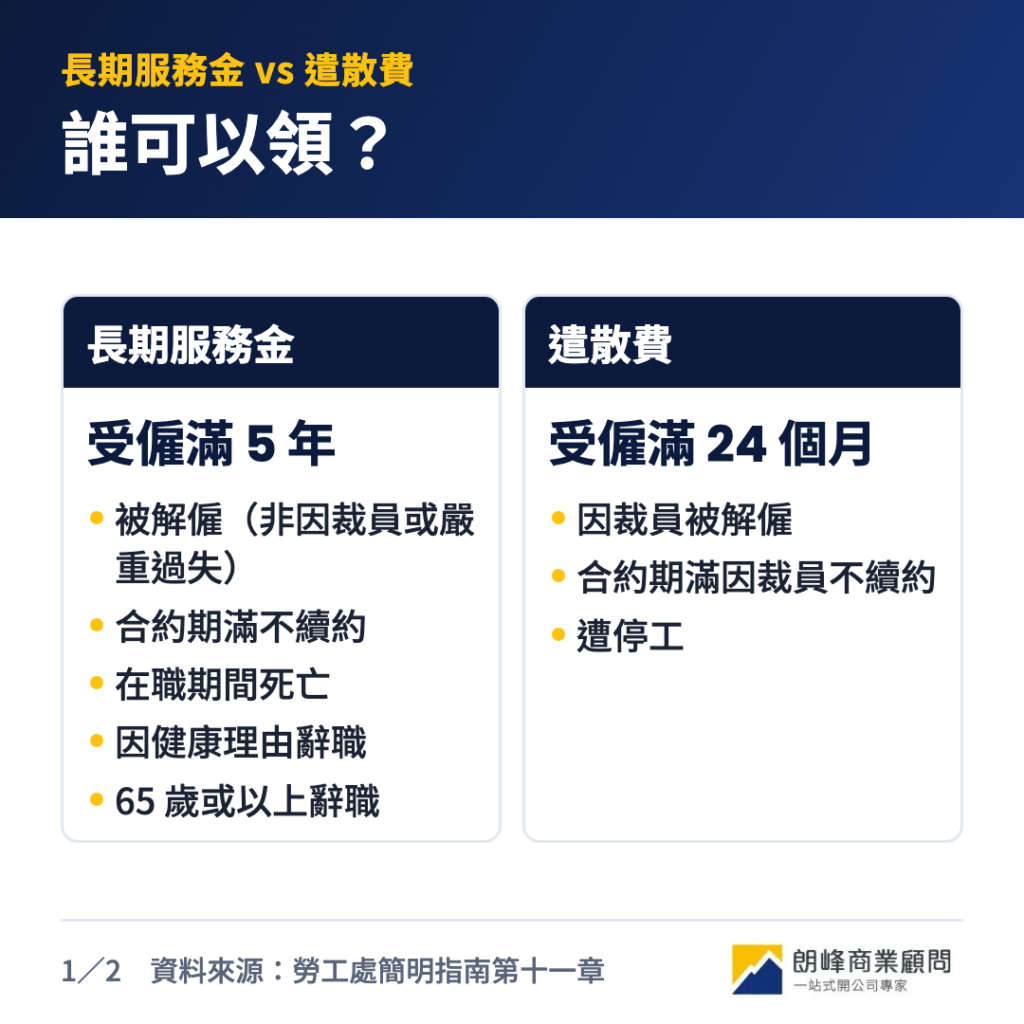
- Severance payment: at least 24 months under a continuous contract, and dismissed by reason of redundancy or laid off. Long service payment: at least 5 years under a continuous contract, and one of the specified situations applies.
- For employees who joined before 1 May 2025, the amount has a pre-transition and a post-transition portion; MPF mandatory contributions can only offset the pre-transition portion.
- Each year of service counts for at most $15,000, and the total is capped at $390,000.
- Severance and long service payments made under the Employment Ordinance are not subject to salaries tax.
Long service payment and severance payment
Under the labour rights set out in Hong Kong's Employment Ordinance, employees who are dismissed by the company, made redundant or laid off in specified circumstances can receive a certain amount of compensation through long service payment and severance payment.
Note: at any one time, an employee is entitled to either a severance payment or a long service payment, not both; the two cannot be received together.
Continuous contract is the basic requirement for both: the employee must have worked for the same employer for 4 weeks or more and at least 17 hours a week; if the employee works less than 17 hours in a week, the requirement is still met if that week and the 3 weeks before it total at least 68 hours. This rule applies from 18 January 2026; employment before that date is still assessed on at least 18 hours a week.

What long service payment is
An employee who has worked under a continuous contract for at least 5 years meets the basic requirement for long service payment, and receives it on leaving in any one of the five situations below.
Conditions for receiving long service payment
Conditions for receiving long service payment:
- The employee is dismissed summarily for reasons other than redundancy or serious misconduct;
- The employee is on a fixed-term employment contract that is not renewed after it expires;
- The employee dies during employment;
- The employee resigns after a registered medical practitioner or registered Chinese medicine practitioner issues a specified certificate certifying that they are permanently unfit for their current job;
- The employee resigns at the age of 65 or above.
* If the employee dies during employment, the eligible person must complete the specified form and apply to the employer for long service payment within 30 days after the employee's death.
What severance payment is
Severance payment: an employee who has worked under a continuous contract for at least 24 months and leaves for one of three reasons, such as redundancy or lay-off, receives severance payment as compensation.
Conditions for receiving severance payment
Conditions for receiving severance payment:
- Dismissed because of redundancy;
- Not renewed because of redundancy after a fixed-term contract expires;
- Laid off.
An employee dismissed in any of the following circumstances is regarded as dismissed because of redundancy:
- The employer closes the business or intends to close it;
- The employer ceases or intends to cease carrying on the business at the place where the employee is employed;
- The employer's requirement for work of the kind the employee does, or for work of that kind at the place where the employee is employed, has reduced or ceased
If the employment contract provides that the employee's pay depends on the amount of work provided by the employer, for example pay calculated by the number of orders or by output, and the employee has no work and so receives no wages, the total number of such days will be regarded as lay-off in the following situations:
- More than half of the total number of normal working days in any 4 consecutive weeks
- More than one third of the total number of normal working days in any 26 consecutive weeks
Normal working days do not include days of factory closure, rest days, annual leave and statutory holidays.
How to calculate long service payment and severance payment in 2026 (after the MPF offsetting abolition)
Before looking at the calculation methods, you need to know about the “MPF offsetting mechanism”, which affects how long service payment and severance payment are calculated:
Abolition of the MPF offsetting mechanism
In the past, when an employee was made redundant or left and met the conditions, the employer had to pay severance payment or long service payment, but could use the employer's contributions in the employee's MPF account to “offset” part of it. This is commonly known as the “MPF offsetting mechanism”.
On 9 June 2022 the Legislative Council passed the Employment and Retirement Schemes Legislation (Offsetting Arrangement) (Amendment) Ordinance 2022, which abolished the MPF offsetting arrangement. The change took effect on 1 May 2025 (the transition date).
This means that from 1 May 2025, employers can no longer use accrued benefits from MPF mandatory contributions to offset the severance payment or long service payment for service after the transition date, so employees receive more compensation in practice.
What can still be offset after the abolition, and the government subsidy
- Pre-transition service: for employees already employed before the transition date, the severance payment or long service payment is split into a pre-transition portion and a post-transition portion. Employers can still use the accrued benefits of mandatory MPF contributions to offset the pre-transition portion, but not the post-transition portion.
- Voluntary contributions and gratuities: the accrued benefits of the employer's voluntary MPF contributions, and gratuities based on length of service, can still be used after the transition to offset severance payment or long service payment (for both the pre-transition and post-transition portions).
- Government subsidy: the Government has launched the 25-year Subsidy Scheme for the Abolition of the MPF Offsetting Arrangement; after paying a severance or long service payment, employers can apply for a subsidy on the post-transition portion.
For details, see the Labour Department's page on the abolition of the MPF offsetting arrangement; to apply for the subsidy, see the Subsidy Scheme for Abolition of MPF Offsetting website.
Calculation formula for long service payment and severance payment
Long service payment and severance payment are calculated the same way. If the employee joined before 1 May 2025 and is dismissed on or after that date (for example, made redundant in 2026), the amount is split at 1 May 2025 (the transition date) and calculated in two parts:
| Type of employee | Pre-transition portion (service before 1 May 2025) | Post-transition portion (service from 1 May 2025) |
|---|---|---|
| Monthly-rated employees | Last full month's wages before the transition date × 2/3 × reckonable years of service before the transition date | Last full month's wages before termination × 2/3 × years of service from the transition date |
| Daily-rated or piece-rated employees | Wages for any 18 days chosen by the employee from the last 30 normal working days before the transition date × reckonable years of service before the transition date | Wages for any 18 days chosen by the employee from the last 30 normal working days before termination × years of service from the transition date |
- Cap per year of service: "wages × 2/3" or "18 days' wages" is capped at $15,000 (two-thirds of $22,500).
- 12-month average wages can be used instead: for the pre-transition portion, the employee may elect the average wages of the 12 months immediately before the transition date; for the post-transition portion, the average wages of the 12 months immediately before termination.
- Service of less than a year is calculated pro rata.
- If the employment does not span 1 May 2025 (for example, the employee joined on or after 1 May 2025), the whole period uses one formula and is not split.
Calculation examples
Example 1: made redundant in 2026 (monthly wages below $22,500)
A monthly-rated employee joined on 1 May 2016 and was made redundant on 30 April 2026. The last full month's wages before the transition date (April 2025) were $18,000, and the last full month's wages before termination were $21,000:
- Pre-transition portion: $18,000 × 2/3 × 9 years = $108,000
- Post-transition portion: $21,000 × 2/3 × 1 year = $14,000
- Total severance payment:$122,000
The employer can use the accrued benefits from MPF mandatory contributions to offset only the $108,000 pre-transition portion. The $14,000 post-transition portion cannot be offset by mandatory contributions, but can be offset by accrued benefits from voluntary contributions or by gratuities based on length of service, and the employer can apply for a government subsidy for this portion.
Example 2: monthly wages above $22,500
An employee joined on 1 May 2015 and was made redundant on 30 April 2026. The last full month's wages before the transition date were $30,000, and before termination $32,000. Two-thirds of each ($20,000 and about $21,333) exceeds the $15,000 cap, so both portions count $15,000 per year:
- Pre-transition portion: $15,000 × 10 years = $150,000
- Post-transition portion: $15,000 × 1 year = $15,000
- Total severance payment:$165,000
Example 3: joined on or after 1 May 2025
An employee joined on 1 May 2025 and is made redundant on 30 April 2027 (exactly 24 months), with last full month's wages of $15,000: $15,000 × 2/3 × 2 years = $20,000. All the service falls after the transition date, so the employer cannot use MPF mandatory contributions to offset any of it.
To estimate your own case, use the Labour Department's calculation tool.
Government subsidy for employers
The Labour Department runs a 25-year Subsidy Scheme for the Abolition of the MPF Offsetting Arrangement, which shares employers' costs of paying the post-transition portion of severance or long service payments:
- Subsidy rate: for each subsidy year, the employer's subsidy rate is set with $500,000 as the dividing line, and the rates decrease gradually over the 25-year subsidy period.
- How to apply: submit through the scheme's online platform, or send the application form with copies of supporting documents to the scheme's service office by email, fax, post or in person.



Caps on long service payment and severance payment
If the relevant date of termination is on or after 1 October 2003, for a long service payment or severance payment the maximum amount is $390,000.
If the amount has both a pre-transition and a post-transition portion, the total of the two also cannot exceed $390,000, and any excess is deducted from the post-transition portion.
Employees' reckonable years of service
For employees with very long service (for example, those who joined before 1990), where the relevant date of termination is on or after 1 October 2004, reckonable service is as follows:
- Manual employees whose employment contract is terminated after 1/10/2004: fully reckonable years of service, regardless of pay.
- Non-manual employees whose contracts end after 1/10/2004 and whose average monthly wages in the 12 months before 8 June 1990 did not exceed $15,000: all years of service are reckonable
- Non-manual employees whose employment contract is terminated after 1/10/2004, with average monthly wages for the 12 months before 8 June 1990 exceeding $15,000: service is reckonable back to 1980
Long service payment calculator and severance payment calculator
To estimate the actual amounts of long service payment and severance payment, you can use the Statutory Employment Entitlements Reference Calculator.
Time limits for payment of long service payment or severance payment
Time limit for payment of severance payment
Under the Employment Ordinance, an employee who wants to claim severance payment must give the employer written notice of the claim within 3 months of dismissal or lay-off, and the employer must pay it within 2 months of receiving the notice.
Time limit for payment of long service payment
A long service payment must be paid within 7 days after the termination of the employment contract.
Are severance and long service payments taxable?
Severance and long service payments made under the Employment Ordinance are not subject to salaries tax. However, if the employer pays an amount based on years of service that exceeds the statutory long service payment, the excess is taxable; contractual gratuities are employment income and are also subject to salaries tax (Inland Revenue Department examples).
4 things employers should do after the offsetting abolition
- Keep pre-transition wage records: the pre-transition portion is based on wages for April 2025 (the last month before the transition date) or the average for the 12 months before it, so keep these records until the employee leaves.
- Provide for it early: the post-transition portion can no longer be offset by MPF mandatory contributions, so set money aside according to staff's years of service.
- Apply for the government subsidy: after paying a severance or long service payment, apply for a subsidy on the post-transition portion through the scheme's online platform.
- Pay on time: a long service payment must be paid within 7 days of termination; a severance payment must be paid within 2 months of receiving the employee's written claim.
FAQ
If an employee with 5 years of service is dismissed for redundancy, does the company need to pay both severance payment and long service payment?
No. An employee is entitled to either a severance payment or a long service payment at any one time, never both. As for the MPF, after the offsetting abolition the employer can only use accrued benefits from mandatory contributions to offset the pre-transition portion.
If an employee with 5 years of service resigns before the age of 65 because of poor health, can they receive long service payment?
it can be claimed. After 5 years of service, an employee who resigns on health grounds can receive a long service payment, but must give the employer a certificate from a registered medical practitioner or registered Chinese medicine practitioner stating that they are permanently unfit for their present job; the employer may arrange, at its own expense, a further examination by a doctor it nominates.
What are the consequences if an employer does not pay long service payment and severance payment to employees?
Severance payment: an employer who delays paying severance payment without reasonable excuse is liable on conviction to a fine of up to ,000.
Long service payment: an employer who wilfully and without reasonable excuse fails to pay long service payment on time is liable on conviction to a fine of up to $350,000 and imprisonment for 3 years.
If an employee does not renew their contract before it expires, can they receive long service payment or severance payment?
If, at least 7 days before the contract ends or expires, the employer offers in writing to renew the contract or re-engage the employee on a new contract, and the employee unreasonably refuses, then the employee is not entitled to a long service payment or severance payment.
Can severance payment or long service payment still be offset by MPF contributions now?
It depends on the years of service and the type of contribution. For the accrued benefits of mandatory MPF contributions, there are two situations after the transition:
- Years of service before 1 May 2025 (pre-transition portion): the employer can still offset using the accrued benefits of mandatory MPF contributions.
- Years of service from 1 May 2025 (post-transition portion): the accrued benefits of mandatory MPF contributions can no longer be used for offsetting, but the accrued benefits of the employer's voluntary MPF contributions and gratuities based on length of service can still be used.
If an employee had less than 2 or 5 years of service before 1 May 2025, does this affect eligibility?
No. Eligibility is unchanged after the offsetting abolition and is based on the whole period of employment; splitting service into pre- and post-transition only determines the amount of each portion (example from the 1823 government hotline).
Can an employee who resigns get severance payment?
Generally, no. Severance payment only applies to dismissal by reason of redundancy, a fixed-term contract not renewed by reason of redundancy, or lay-off. An employee who resigns can receive a long service payment if they have at least 5 years of service and resign at age 65 or above, or on health grounds (with the specified certificate from a registered medical practitioner or registered Chinese medicine practitioner).
Professional accounting services in Hong Kong: SetupHK
We have many years of experience helping employers handle employee termination procedures. We are familiar with the Employment Ordinance and the changes to the MPF offsetting policy, and can help you complete the calculations and filings in compliance with the law, so your business can run with peace of mind. We provide the following professional services:
- Dedicated staff to help with calculation and reporting of amounts: based on the employee's length of service, reason for leaving, wages and MPF records, we calculate precisely the severance payment or long service payment payable, and confirm whether offsetting can be used.
- One-stop documentation and procedural support: whether an employee is about to leave, has been dismissed, or in special circumstances such as the death of an employee, we can provide a complete solution and advice on handling the paperwork.
- Compliance risk control: we remind you of statutory deadlines, help you keep supporting records and handle employee enquiries or complaints, to avoid legal disputes or labour disputes later.
Just provide basic employee information and employment records, and we can handle the entire compensation calculation process for you, so you can deal with departures properly in compliance with the law and safeguard your company's reputation and internal management.
Source
- Labour Department: A Concise Guide to the Employment Ordinance, Chapter 11: Severance Payment and Long Service Payment
- Labour Department: Concise Guide to the Employment Ordinance, Chapter 1: Application of the Employment Ordinance
- Labour Department: Abolition of the MPF Offsetting Arrangement thematic website
- Labour Department: Subsidy Scheme for the Abolition of the MPF Offsetting Arrangement
- Inland Revenue Department: Salaries tax issues arising from the abolition of the offsetting arrangement under recognised retirement schemes
- 1823: Does employment of less than 2 or 5 years before the transition date affect eligibility?
This article was reviewed by Marx Chan, Founder and Director of SetupHK. The information above was checked against government websites on 1 November 2026.
This article is for reference only and is not legal advice. For individual cases, refer to the legislation or contact the Labour Department.
Update log: on 1 November 2026, the calculation method was updated for 2026; a summary, three calculation examples, the government subsidy, tax and employer to-dos were added; the long service payment penalty and FAQs were corrected; and the new continuous contract rule was added.