


Table of contents
Under Hong Kong's Employment Ordinance, as long as the attendance certificate is issued by a registered healthcare professional, it is valid proof for paid sick leave, which protects the employee's rights.
Is sick leave paid? Start with the Labour Department's Employment Ordinance
Sickness allowance (four-fifths paid sick leave)
Under Cap. 57 of the laws of Hong Kong, the ' Employment Ordinance', for an employee to be entitled to paid sick leave, the employee must comply with the Employment Ordinance and also meet conditions such as the number of sick days, accumulated entitlement and submission of a medical certificate.
Employees who meet the following conditions can receive sickness allowance. The allowance is calculated at four-fifths (80%) of the employee's average daily wages, which is why it is called 'four-fifths paid sick leave'.
In what circumstances is an employee entitled to paid sick leave?

Sick leave of not less than 4 consecutive days
The condition for paid sick leave is that the employee is absent because of illness or injury for no fewer than 4 consecutive days. However, if the employee is hospitalised, they can apply for sickness allowance even if the absence is shorter than 4 days.
Note that if leave is needed because of a work injury, the employer must handle it under the Employees' Compensation Ordinance. Work injuries are not covered by sick leave.
The employee has accumulated enough paid sick leave
For every completed month of service under a continuous contract, an employee accumulates two days of paid sick leave, up to a maximum of 120 days. The employee must be within the accumulated entitlement to receive sickness allowance.
The employee can produce proof
When taking paid sick leave, an employee must produce a medical certificate, which is usually issued by the registered medical practitioner who saw them. The employee must use it as proof of sick leave.
Situations where paid sick leave does not apply
If the employee does not meet the conditions above, the employer can refuse to pay for sick leave. In addition, if an employee takes paid sick leave but does other work during that period, the employer also has the right to refuse to pay the allowance.
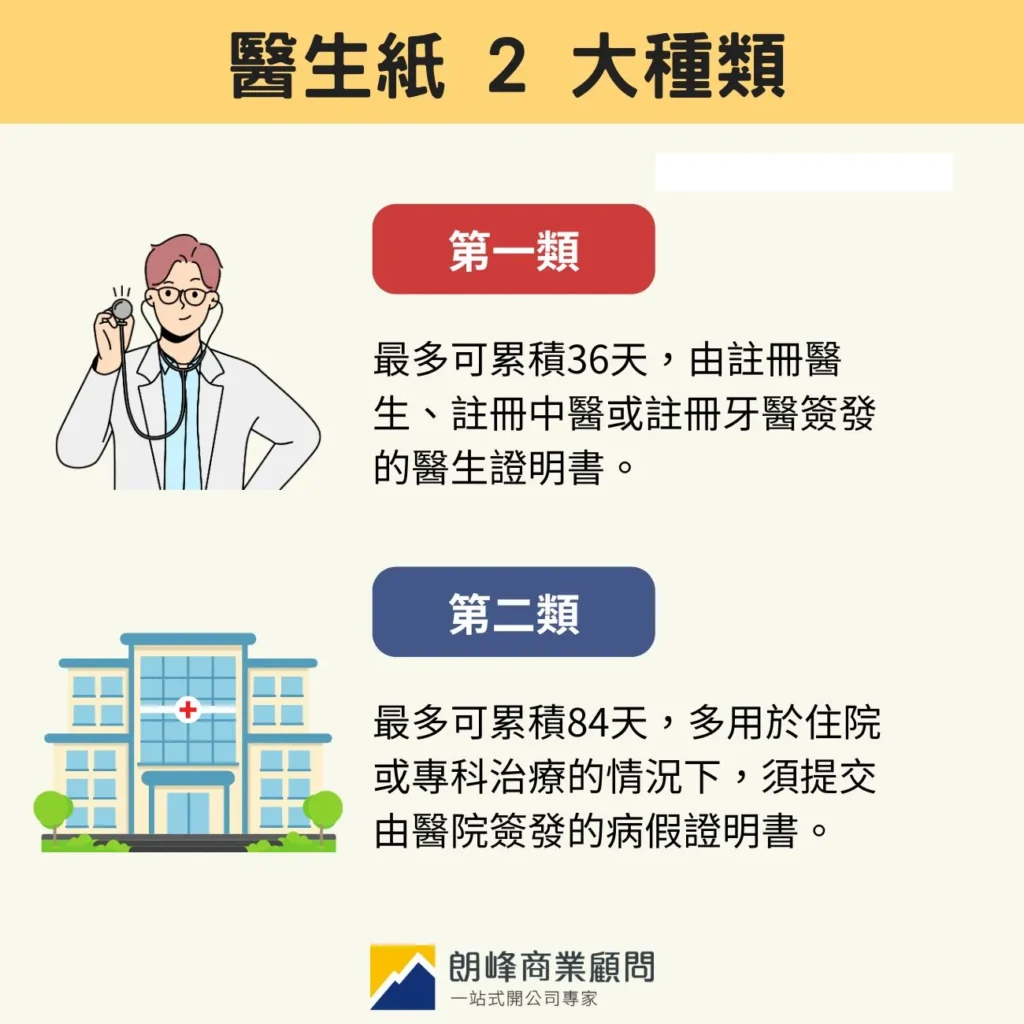
2 types of medical certificate
The medical certificates that serve as proof of sick leave fall into the following two types:
Type 1
The most common type 1 medical certificate is the sick leave certificate, which can be accumulated up to 36 days. It is a medical certificate issued by a registered medical practitioner, registered Chinese medicine practitioner or registered dentist.
If you are pregnant and have an antenatal check-up at a general outpatient clinic or a clinic, you can produce an attendance certificate issued by a registered medical practitioner, registered Chinese medicine practitioner, registered midwife or registered nurse as proof.
Type 2
Under Labour Department rules, once an employee's sick leave exceeds 36 days, it is counted as type 2 paid sick leave, which can be accumulated up to 84 days.
This is mostly used for hospital stays or specialist treatment. The employee must submit a sick leave certificate issued by a registered medical practitioner who treated them at the hospital. If the employer requires it, the certificate must also state the diagnosis or the medical history of the treatment.
If you are pregnant and have an antenatal check-up at a hospital outpatient department or as an inpatient, you can produce a medical certificate issued by the registered medical practitioner, registered Chinese medicine practitioner, registered midwife or registered nurse who carried out the check-up.
Attendance certificate vs medical certificate
An attendance certificate differs from a medical certificate. It states only the date and time of the visit and does not recommend a number of sick days. Only pregnant employees can take sick leave with an attendance certificate from a qualified practitioner. Other employees cannot use one to apply for sick leave.
How do you accumulate paid sick days? What is the maximum number of paid sick days?
How paid sick leave accumulates
An employee employed under a continuous contract accumulates 2 days of paid sick leave for every completed month of service during the first 12 months of employment, and 4 days for every completed month of service after that.
Maximum paid sick leave
Paid sick leave can keep accumulating throughout the whole period of employment, up to a maximum of 120 days.
How paid sick leave is calculated
Calculation method
The sickness allowance rate is four-fifths of the employee's average daily wages. The average daily wage is calculated on the employee's pay in the 12 months before the leave. If the employee has been employed for less than a year, the average of wages for the actual period of employment applies.
An example:
Employee A has accumulated 30 days of sick leave, takes 5 consecutive days of paid sick leave from the company and submits a medical certificate.
If Employee A's average daily wage is HK$500, the sickness allowance is 500 x 80% = HK$400. From this, the total sickness allowance for the 5 days of sick leave is HK$400 × 5 days = HK$2,000.
Further reading:[713 Ordinance] A must-read for employers! How do you calculate 12-month average wages? How are paid sick leave, bonuses and commission counted?
What employers need to know about payment
The Employment Ordinance requires employers to pay sickness allowance to employees together with the next payment of wages. Employers must not delay or refuse payment without good reason, otherwise they may be fined.
If an employee cannot produce a qualifying medical certificate, the number of sick days exceeds the accumulated entitlement, or the employee does other paid work during sick leave, the employer has the right to refuse payment.
FAQ
Can an employer dismiss an employee who is on paid sick leave?
No! According to the ' A Concise Guide to the Employment Ordinance', unless the employee has committed serious misconduct that warrants summary dismissal, an employer cannot dismiss an employee on paid sick leave at will.
Does the paid sick leave calculation include the year-end bonus?
Sickness allowance is calculated on the employee's ' average wages', which refers to the fixed pay component. Extra payments such as year-end bonuses or discretionary bonuses are not counted.
Can employees on probation take paid sick leave?
Yes! As long as the employee is employed under a continuous contract, paid sick days start to accumulate after one month of work, at two days per month, and so on according to the accumulation method described above.
Can a pregnant employee's attendance certificate count for paid sick leave?
Yes! If a pregnant employee is absent because of an antenatal check-up, an attendance certificate can be used as a medical certificate, provided that it is issued by a registered medical practitioner, registered Chinese medicine practitioner, registered midwife or registered nurse.
Not sure about the labour law on paid sick leave? SetupHK offers professional advice
The rules on paid sick leave look simple, but grey areas often arise in practice. Examples are when an attendance certificate counts, whether a year-end bonus should be included in average wages, or how sick days should be accumulated correctly.
If employers or employees still have questions about the details of the Employment Ordinance, the professional team at SetupHK is familiar with Hong Kong labour law and can give businesses and employees clear explanations and compliance advice, helping you avoid unnecessary disputes and risks.