


Table of contents
A company transfer requires the company's information and statutory documents to be in order and stamp duty to be paid; once the register of members is updated in accordance with the procedure, the transfer takes effect. As long as you have the documents, process and filing deadlines under control, the share transfer can be completed safely.
Key takeaways
- Prepare documents including company registration details, articles of association, NAR1/NSC1 and financial statements
- Stamp duty must be paid within the time limit (2 days if signed in Hong Kong; 30 days if signed outside Hong Kong)
- The IRD calculates the duty on the higher of the transaction price and the net asset value
- After stamping, the company must update the register of members and share certificates
- A change of director must be reported within 15 days
- In the instrument of transfer, pay particular attention to the consideration, share numbers and the identity details of both parties
Can a company be transferred? First clarify the existing conditions
Before starting the share transfer, you need to confirm the company type and the reason for the transfer, as these affect how complex the later steps will be.
Private limited company vs public limited company vs unlimited company
Different types of company offer different flexibility for transfers:
| Company type | Method of transfer | Restrictions on share transfers | Shareholder approval required | Suitable situations | Level of regulation |
| Private limited company | Share transfer (equity) | Usually restricted by the articles of association; existing shareholders may have pre-emption rights | Board approval + shareholder consent (as required by the articles) | Internal adjustment of shareholdings in SMEs, bringing in investors or arranging retirement succession | Moderate. Governed by the Companies Ordinance |
| Public limited company | Shares can be freely traded | Fewer restrictions. Shares may be offered to the public | Board approval (if required by the articles); public trading usually does not require individual shareholder consent | Listed companies or companies raising funds externally, where share transfers are more open and transparent | High. Strictly regulated under the Securities and Futures Ordinance, among others |
| Unlimited company | No share transfer | Ownership is transferred by changing the partnership agreement or the business owner | Consent of the board and the company's shareholders (as required by the articles) | Business mergers or internal adjustment of ownership | Low. Shareholders bear unlimited liability for the company's debts |
When does a company need to carry out a share transfer?
A company transfer is particularly suitable in the following situations:
- Bringing in new investors
- Adding or removing shareholders
- The owner retires or arranges a successor
- Company acquisitions and mergers
- A shareholder exits or shareholdings are restructured
As long as the company continues to operate normally, shares can usually be transferred smoothly.
Documents and information required for a share transfer
Preparing the transfer documents is the part of a share transfer that most tests professional skill. To avoid errors that lead to the IRD rejecting the documents or to late penalties, we recommend preparing the following documents and information in stages:
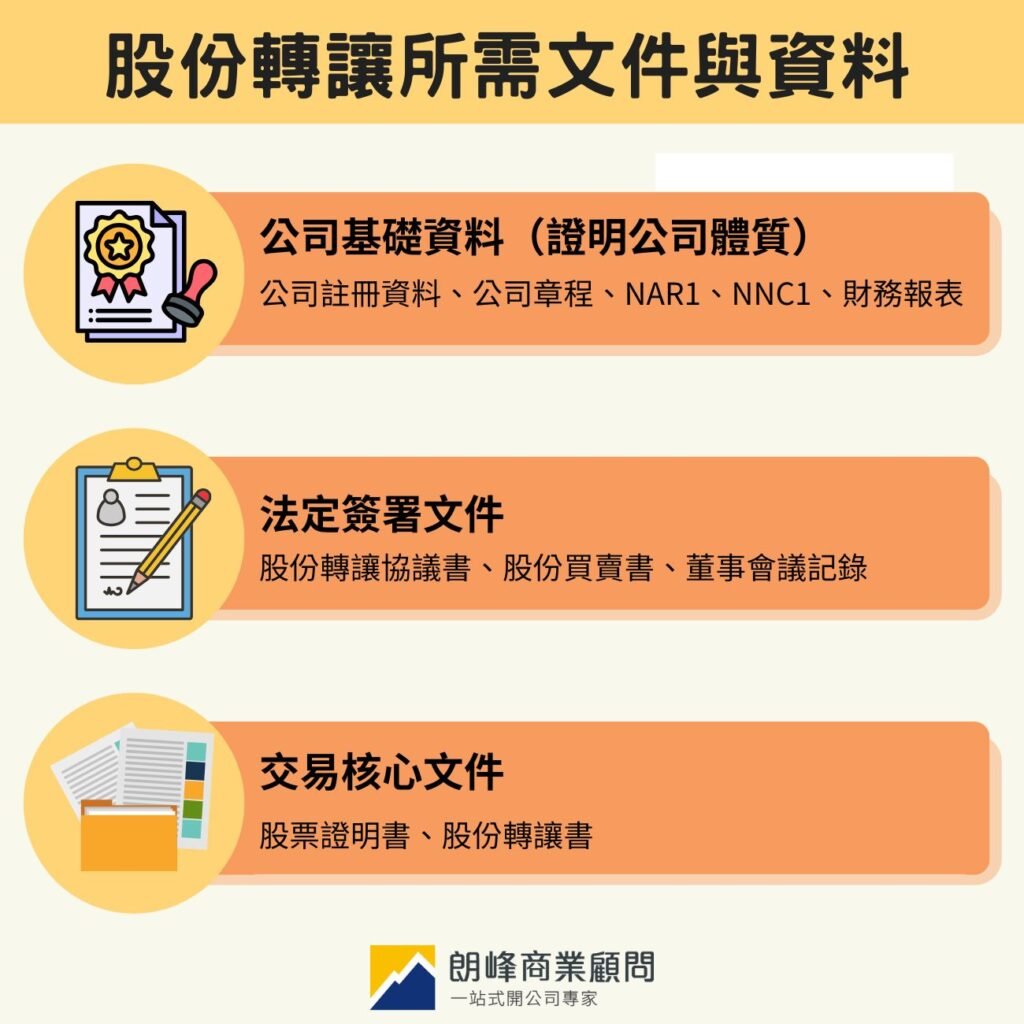
Basic company information (to show the company's standing)
These are mainly used to prove the company's legitimacy and as the basis for calculating stamp duty, so they must be in order:
- Company registration details (company name, registration number, date of incorporation, etc.)
- Articles of Association
- Latest annual return (NAR1) or incorporation form (NSC1)
- Limited company incorporation form (NNC1, if the share transfer takes place before the first anniversary)
- Latest audited financial statements or management accounts within the past 3 months
Statutory signed documents
These must be signed by both buyer and seller and drafted by a professional to ensure legal effect:
- Instrument of Transfer
- Contract notes (Bought Note & Sold Note)
- Companies Registry returns (e.g. NAR1 / AR1, reporting changes in shareholders or directors)
- Board meeting minutes (approving this transfer)
Core transaction documents
Key documents that evidence the transaction details and the change in ownership:
- Share Certificate
- Instrument of Transfer
Hong Kong instrument of transfer sample: download and completion notes
A professional instrument of transfer needs the following points checked carefully:
- Share details: The number, class and share numbers of the shares being transferred must be stated accurately.
- Consideration: The actual transaction price must be stated. Note that if the price declared is lower than the net asset value, the IRD will still calculate stamp duty on the higher value.
- Identity and signatures: The transferor and transferee must state their full legal names and addresses, and signatures must be clear and attested by a qualified witness.
- Professional services: We recommend leaving the drafting and checking of such documents to professional advisers, to make sure every field meets the legal requirements.
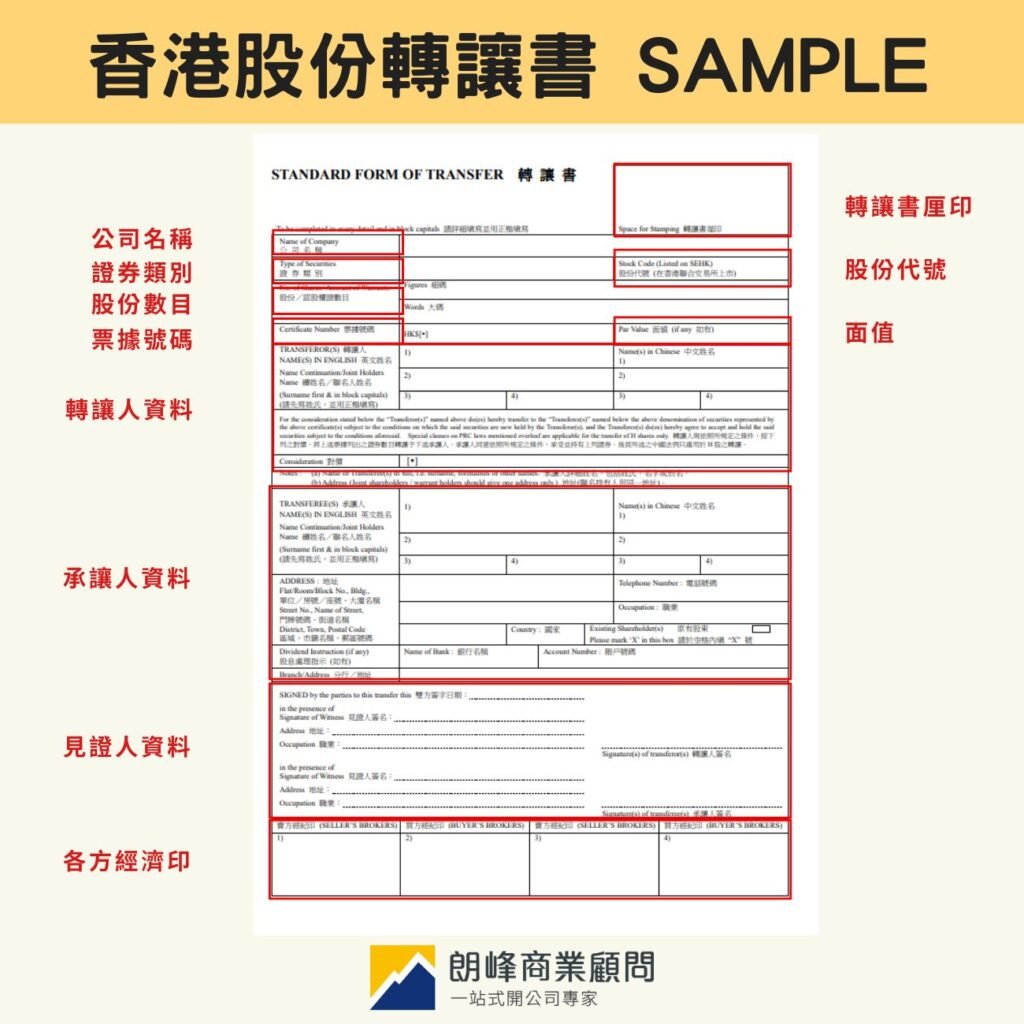
Download link: Hong Kong instrument of transfer sample
The 5 key steps in a company share transfer
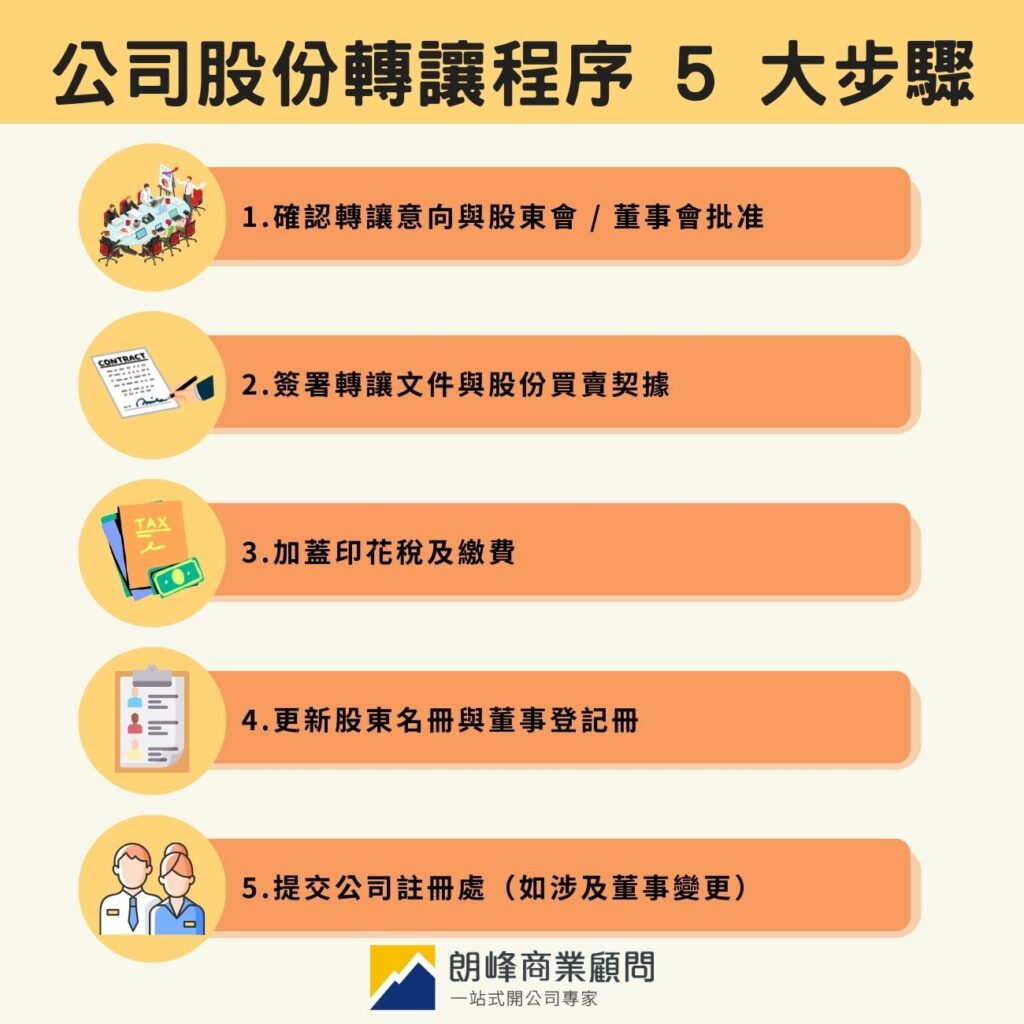
Step 1: Confirm the intention to transfer and obtain shareholders' / board approval
Tip First review the articles of association to confirm whether a board meeting or an extraordinary general meeting is required, then formally pass and record the necessary approval resolution. This is the lawful first step that starts the transfer process.
Step 2: Sign the transfer documents and the contract notes (Bought & Sold Note)
Both buyer and seller (transferor and transferee) must sign all required statutory documents, including the instrument of transfer and the bought and sold notes. The signing date of these documents is the starting point for calculating the stamp duty deadline.
Step 3: Stamping and payment of stamp duty
This is the most time-critical step. The accountant will help calculate the exact stamp duty and submit the documents to the IRD (Stamp Office) to pay the stamp duty and have the documents stamped. Only after this step does the share transfer of a limited company take legal effect.
Step 4: Update the register of members and register of directors
Once the documents are stamped, the company secretary must immediately make the internal changes: cancel the old share certificate held by the transferor, issue a new share certificate to the transferee, and update the company's register of members and register of directors.
Step 5: File with the Companies Registry (if directors are changing)
- Change of shareholders: The change need not be reported immediately; it can be reported together with the company's next annual return (NAR1).
- Change of directors: If a director resigns or is appointed, you must, within 15 days of the change, submit to the Companies Registry the relevant ND2A form.
Stamp duty on transfers: calculation and payment deadlines
Stamp duty rate and calculation formula
The total stamp duty on a Hong Kong share transfer is: Value of shares transferred x 0.2% + document fee. From the two items below, the IRD takes the higher amount as the basis for calculating stamp duty:
- The actual transaction price of the shares (the consideration).
- The proportionate net asset value of the shares.
Suppose a company's shares are transferred at an actual transaction amount of HK$1.5 million, while the net asset value of those shares is HK$1 million. Since “actual transaction price > net asset value”, HK$1.5 million is used as the basis for stamp duty. The table below shows how the stamp duty is calculated and the amount payable:
| Fee type | Calculation | Amount payable | Remarks |
| Share stamp duty | $ 1,500,000 x 0.2% | HK$ 3,000 | Borne equally by buyer and seller (50% each, i.e. $1,500) |
| Fee for contract notes | $5 x 2 copies | HK$ 10 | The buyer and the seller each pay a $5 document fee |
| Total stamp duty payable | $ 3,000 + $ 10 | HK$ 3,010 | Total amount payable to the IRD |
Stamp duty payment deadlines and late penalties
Statutory deadline:
- Sale or purchase completed in Hong Kong: Within 2 working days.
- Sale or purchase completed outside Hong Kong: Within 30 days.
- Until stamp duty is paid and the documents are stamped, the shares cannot be formally transferred
Late penalty: The IRD will impose heavy penalties, which can range from 2 to 10 times the stamp duty payable (10% → 20% → 30%, increasing in stages).
FAQ
What are the consequences if the company transfer documents are incomplete or wrongly signed?
The transfer may be delayed or returned, and documents may need to be re-signed or supplemented. This can even affect the stamp duty filing and lead to unavoidable late penalties.
What are the risks of not checking the company's debts before a transfer?
The buyer may take on unpaid taxes, contractual liabilities or employee disputes. We recommend carrying out financial and legal due diligence (DD) in advance.
Will transferring shares affect my bank account?
If the company's directors change, the bank may require updated KYC documents to make sure the account is operated lawfully. After the transfer, you should notify the bank immediately, and prepare the board resolution the bank requires and the identity documents of the new shareholders / directors, so the bank can carry out a fresh review.
Can shares be transferred if the company has no audited financial statements?
Yes, but management accounts or a director's confirmation must be provided to show the company's financial position.
Can the articles of association restrict share transfers?
Yes. The articles of association of most private limited companies usually contain restrictions such as “board approval” or “pre-emption rights for existing shareholders”, aimed at protecting existing shareholders' control of the company.Tip The articles of association must be checked carefully before any transfer.
Does it make a difference whether the transfer is signed in Hong Kong / outside Hong Kong?
The main difference lies in the time limit for paying stamp duty. Signing in Hong Kong gives you only 2 working days, a very short deadline, whereas signing outside Hong Kong gives you 30 days as a grace period. This directly affects the time pressure you face in handling the documents.
Worried that a company transfer is too complicated? SetupHK helps you complete it smoothly
SetupHK provides end-to-end guidance, from checking the shareholding structure, drafting documents and board resolutions, to stamp duty filing and updating the register of members and the Companies Registry, with professional advice and risk warnings throughout. We help SME owners complete company transfers with peace of mind, saving time and legal risk.
Further reading: “What is a company secretary? Definition, duties and eligibility to act explained”