


Table of contents
After registering a company, many people think of opening a company bank account to make future business dealings easier. For a start-up, however, opening a company account is not easy. SetupHK has put together the things to consider when opening a company bank account.
What are the benefits of opening a company bank account?
Many people note that you are not required to open a company account when forming a company, so what are the benefits of opening one?
Meets regulatory requirements
Although forming a company does not require you to open a company account afterwards, if you use a personal account for business purposes, the bank may freeze your funds. Banks are regulated by the HKMA and are responsible for monitoring suspicious fund flows and money laundering. Do not assume that using a personal account for business will go unnoticed: under the bank's monitoring, the transactions of personal customers and business customers are in fact clearly different.
Easier tax filing
For a start-up or a one-person company, managing funds in a personal account, or telling personal funds from company funds and purposes, is not difficult. But if you cannot produce the documents for the accountant to audit at tax filing time, it will cause confusion and may even mean paying higher service fees. And if the salary records of the owner or employees come from a personal account, they are more likely to be investigated by departments such as the IRD.
More banking services
When people think of banking services for company business accounts, many think of company loans and credit cards. Besides better loan rates, there are also services that make managing the company easier, such as banking fee waivers, free payroll services, corporate online and mobile banking, and links to accounting systems.
Greater company credibility
Because it is difficult to open a corporate account, successfully opening a company account shows that the company's background information and operations meet the bank's requirements, which can increase the company's credibility with its customers.
The HKMA's minimum document requirements
Why is it so difficult to open a company account? To combat money laundering, the HKMA requires banks to carry out Customer Due Diligence procedures before providing account services to customers, so as to understand the customer's background and needs and provide banking services that suit the customer.
Banks must set their own risk assessment policies that meet the HKMA's requirements and are responsible for them. A bank that is found not to have discharged its duty of ongoing monitoring of the business relationship through customer due diligence will be fined. Banks therefore attach great importance to compliance in account opening and account use, and control their procedures and account opening eligibility more strictly.
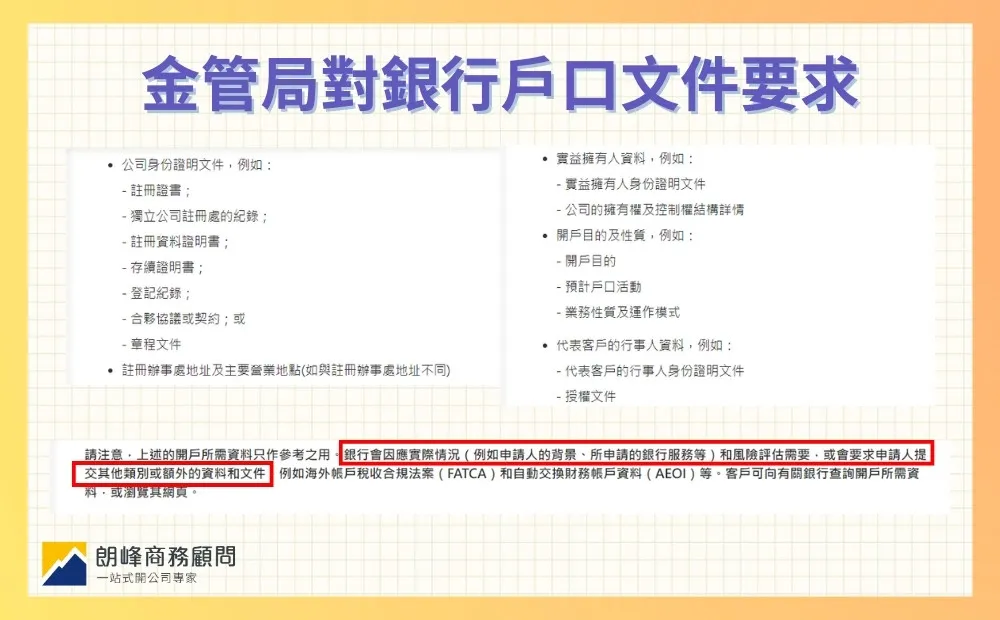
For applications for personal or company accounts, the HKMA states that banks may ask for the following information or require customers to produce the originals of the relevant documents:
Company identification documents For example: certificate of incorporation, records from the Companies Registry, certificate of registration particulars, certificate of continuing existence, registration records, partnership agreement or deed, constitutional documents
Registered office address and principal place of business (if different from the registered office address)
Beneficial owner information, for example: identification documents of the beneficial owner
Details of the company's ownership and control structure; purpose and nature of the account opening, for example: purpose of opening the account, expected account activity, nature of the business and mode of operation
Information on persons acting on behalf of the customer, for example: identification documents and authorisation documents of the persons acting on behalf of the customer
The above are the HKMA's minimum requirements, and banks may ask applicants for other documents according to their own requirements.
Documents required for bank account opening
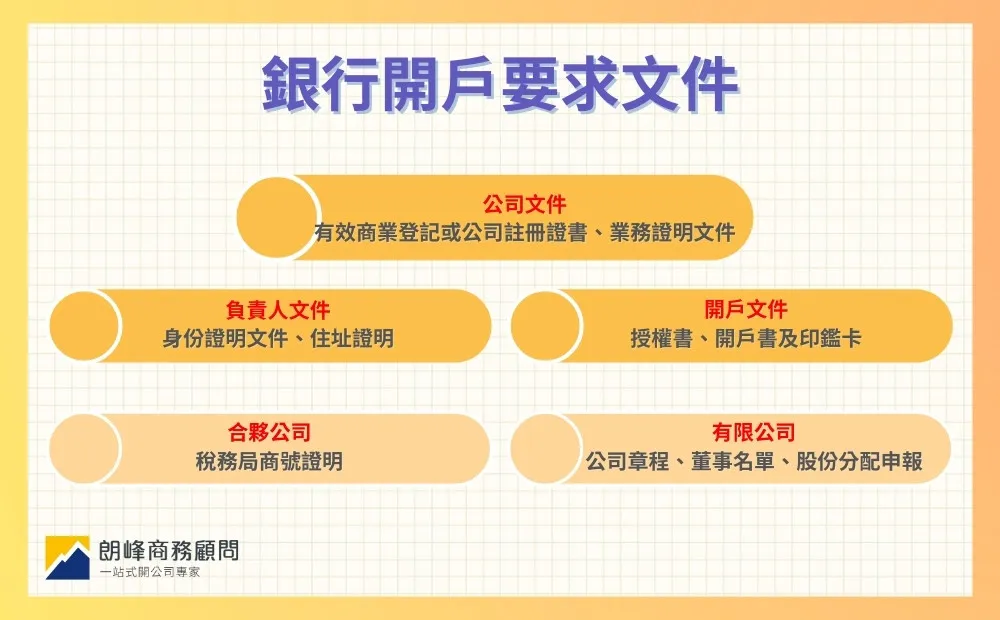
In practice, whether it is a Limited company, sole proprietorship or partnership, the requirements for a company account application differ little. As long as you understand the bank's requirements in advance, prepare the following 3 categories of documents:
Company documents: Valid Business Registration Certificate (BRC), Certificate of Incorporation (CI) and business supporting documents (such as invoices, purchase orders, tenancy agreements and contracts)
Documents of the responsible persons: Relevant documents from the business owner and authorised signatories, such as identification documents and proof of address
Account opening documents: Power of attorney, account opening form and specimen signature card
Partnerships must provide proof of business name from the IRD
Limited companies must provide the Certificate of Incorporation, articles of association, list of directors and resolutions, and return of allotments
Besides the standard documents above, the bank may also ask for additional information on the company's background (source of funds), organisational structure, recent audit reports (if any), or the company's website and product information. If the company is already trading, you may also need to supplement this with a business plan and so on, depending on each bank's requirements.
Why opening a company account is difficult
Today, besides going to a bank branch in person, you can also open an account online or by mobile phone, but opening a company account is still difficult. The information needed to open a company account does not look hard, so why is account opening said to be difficult?
The difficulty in setting up a business account for a company lies in having to provide business supporting documents, which may be goods invoices, sales contracts, financial statements and so on. For a start-up, it is relatively hard to provide enough in the early days of business for the bank to open a company account.
To solve the problem of opening business accounts for start-ups and SMEs, many banks offer business accounts for SMEs with lower account opening thresholds, such as HSBC, Hang Seng Bank, Standard Chartered Bank and Dah Sing Bank, making account opening easier for SMEs.
Comparison of bank company accounts
Although opening a company account is difficult, you should still choose the bank that best suits your company and business first. Factors to consider include the account opening administration fee, the search fee, the time needed to open the account, fee waiver thresholds and the monthly service fee.
Account opening administration fee and search fee
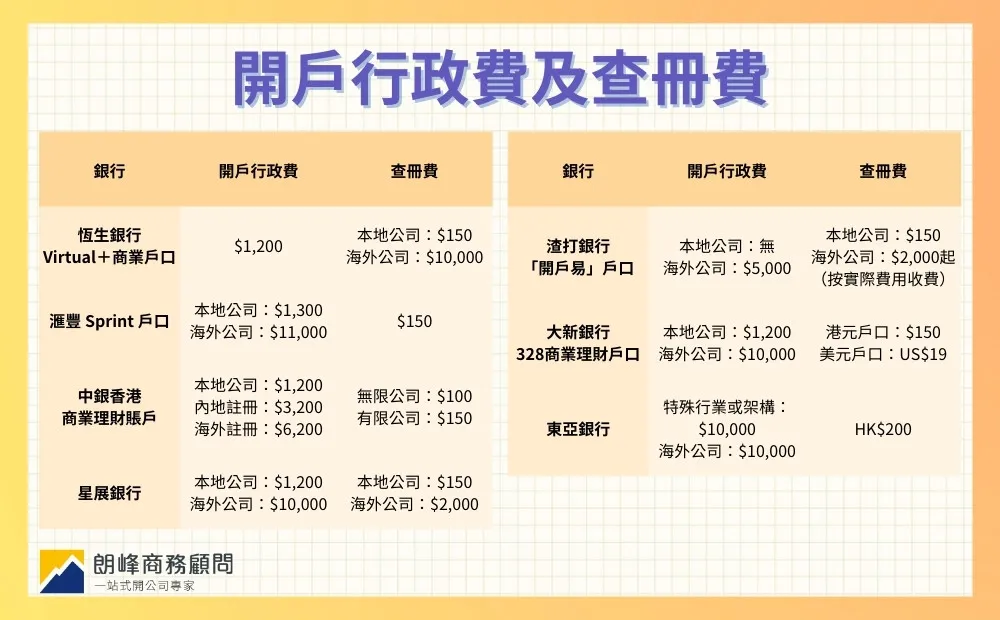
Before opening a business account for a company, the bank must review the company's background, registration information and the information on the responsible persons, and will also charge an account opening administration fee and a business registration search fee. The business registration search fee, also known as the search fee, is used to check the company's information. Some banks charge different fees depending on the place of incorporation or the type of company; for example, the account opening administration fee and search fee for an overseas-incorporated company are higher.
Banks also offer promotions on company account opening fees. For example, the Hang Seng Bank Virtual+ Business Account offers a discount on the account opening administration fee for online account opening.
Hang Seng Bank Virtual+ Business Account
Account opening administration fee: HK$1,200
Search fee: local company: HK$150, overseas company: HK$10,000
Overview of Hang Seng Bank's banking service charges
HSBC Sprint Account
Account opening administration fee: local company: HK$1,300, overseas company: HK$11,000
Search fee: HK$150
Overview of the HSBC Sprint Account
BOCHK Business Integrated Account
Account opening administration fee: local company: HK$1,200, mainland-registered company: HK$3,200, overseas-registered company: HK$6,200
Search fee: unlimited company: HK$100, limited company: HK$150
Bank of China (Hong Kong) website
DBS Bank
Account opening administration fee: local company: HK$1,200, overseas company: HK$10,000
Search fee: local company: HK$150, overseas company: HK$2,000
Standard Chartered Bank “開戶易”
Account opening administration fee: local company: none, overseas company: HK$5,000
Search fee: local company: HK$150, overseas company: from HK$2,000 (charged at actual cost)
Standard Chartered Bank service charges
Dah Sing Bank 328 Business Account
Account opening administration fee: local company: HK$1,200, overseas company: HK$10,000
Search fee: HKD account: HK$150, USD account: US$19
Overview of Dah Sing Bank's general service charges
Bank of East Asia
Account opening administration fee: companies in special industries or with special structures: HK$10,000, overseas company: HK$10,000
Search fee: HK$200
Overview of Bank of East Asia's general charges
Time needed to open an account
Banks currently offer three ways to open an account: applying in person at a branch, or remote account opening services such as online and mobile applications. The days needed to prepare the documents vary from person to person. The times listed below are the approval times after complete documents have been submitted; if the documents are incomplete, more time may be needed.
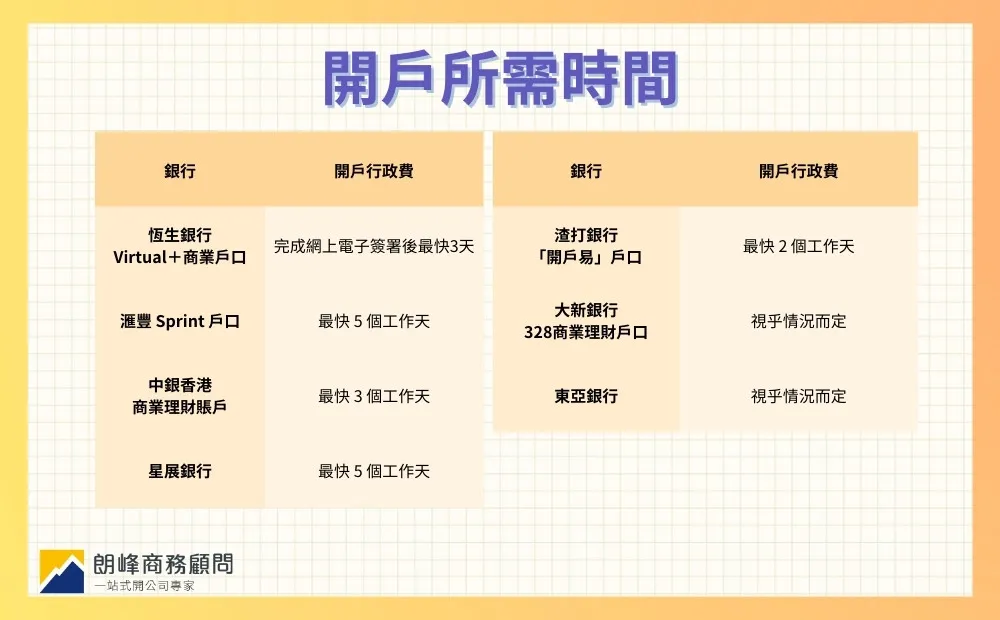
Hang Seng Bank Virtual+ Business Account: as fast as 3 days after completing online e-signing
HSBC Sprint Account: as fast as 5 working days
BOCHK Business Integrated Account: as fast as 3 working days
DBS Bank: as fast as 5 working days
Standard Chartered “開戶易”: as fast as 2 working days
Dah Sing Bank 328 Business Account: depends on the case
Bank of East Asia: depends on the case
Fee waiver thresholds and monthly fees
Many SMEs pay close attention to the monthly service fee on a corporate bank account, since a few hundred dollars every month adds up to a real burden. Unlike personal accounts, corporate accounts carry a monthly service fee set by the bank according to the deposit balance and the type of account, and the fee is waived once the minimum deposit requirement is met. Besides the deposit balance, some banks also take the company's other assets into account when deciding whether to waive the fee.
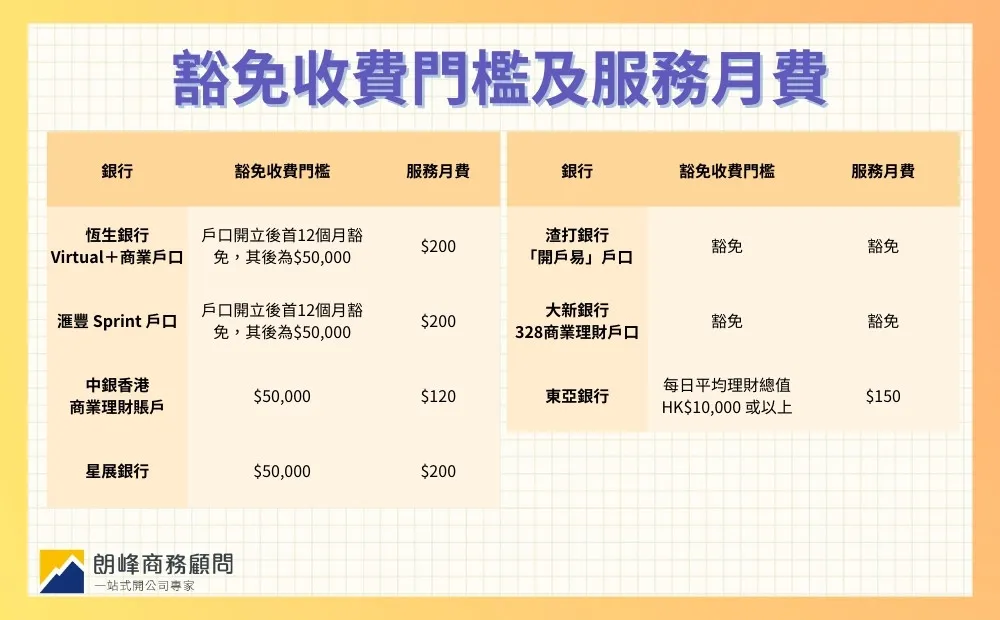
Hang Seng Bank Virtual+ Business Account
Fee waiver threshold: no fee for the first 12 months after the account is opened, then HK$50,000 thereafter
Monthly service fee: HK$200
HSBC Sprint Account
Fee waiver threshold: monthly service fee waived for the first 12 months after account opening, then HK$50,000 thereafter
Monthly service fee: HK$200
BOCHK Business Integrated Account
Fee waiver threshold: HK$50,000
Monthly service fee: HK$120
DBS Bank
Fee waiver threshold: HK$50,000
Monthly service fee: HK$200
Standard Chartered Bank “開戶易”
Fee waiver threshold: waived
Monthly service fee: waived
Dah Sing Bank 328 Business Account
Fee waiver threshold: waived
Monthly service fee: waived
Bank of East Asia
Fee waiver threshold: average daily total wealth balance of HK$10,000 or above
Monthly service fee: HK$150
Summary
Once you understand a bank's account opening requirements and have your documents ready, opening a corporate account is not difficult. If you run into any problems opening a corporate bank account, or would like help with it, get in touch with the SetupHK team. We offer one-stop business consulting services, including company formation, bank account opening, virtual offices and office representative services, so that you can concentrate on building your business.
Further reading: “[Hong Kong company formation guide] The process, costs, timeline and FAQs of setting up a company in Hong Kong explained”