


Hong Kong profits tax is only levied on business profits sourced in Hong Kong, with a two-tier tax rate applicable to limited companies: the first HKD 2 million at 8.25%, and the excess at 16.5%. If the company incurs a loss, it must still submit the tax return on time after receiving it.
Summary of key points
- Hong Kong adopts a territorial source taxation system, and offshore profits can generally apply for exemption.
- The tax rate for the first HKD 2 million of profits for limited companies is 8.25%, and the excess is 16.5%.
- Even if there is a loss or zero income, a tax return must still be submitted.
- New companies typically receive their first tax return about 18 months after establishment.
- Late tax returns may be subject to estimated assessments and penalties.
What is profits tax? Only profits sourced in Hong Kong are subject to taxation.
Profits Tax is levied under Chapter 112 of the Inland Revenue Ordinance, and there is only one core principle:Territorial source taxation.。
Only business profits generated in Hong Kong are subject to tax. If your clients are overseas, contracts are signed overseas, and services are delivered overseas, this portion of profit can generally be applied for exemption,offshore income exemption,but sufficient written evidence must be provided, and the tax authority has the right to verify.
There is no value-added tax, capital gains tax, or dividend tax in Hong Kong. The three current direct taxes target different sources of income:
| Tax items | Taxable subjects | Who needs to pay |
|---|---|---|
| profits tax | Business profits | Companies or sole proprietors |
| salaries tax | Employment income | Employees |
| Property tax | Rental income | Property owners |
As a business owner, the main tax you face is profits tax. If you also have employment income, you can choose toPersonal Assessmentfile a combined assessment, which may legally reduce your overall tax burden.
Who needs to pay profits tax?
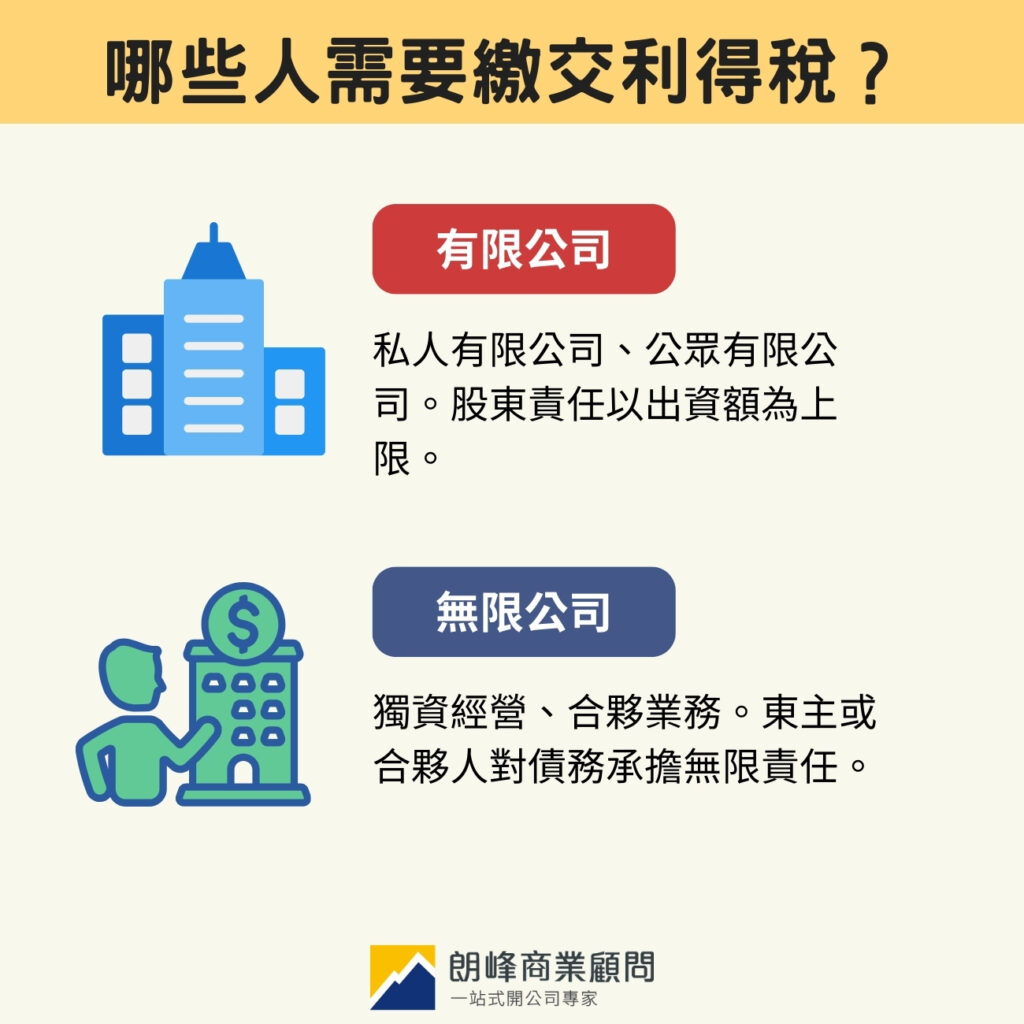
The applicable subjects of profits tax areclassified into two categories based onlegal liability structure:
| Company Type | Specific forms | Legal responsibilities |
|---|---|---|
| limited company | Private limited company, public limited company | Shareholders' liability is limited to their contributions |
| Unlimited | Sole proprietorship, partnership business | Owners or partners bear unlimited liability for debts |
In addition,Enterprises that are not Hong Kong residentsRegardless of whether they are limited companies or unlimited companies, as long as they have a permanent establishment in Hong Kong, they must also declare profits tax on the relevant profits. Even if there is no profit in a certain year, they must still submit the tax return on time after receiving it.
What is the profit tax rate in Hong Kong? The two-tier system allows SMEs to pay nearly half.
Limited companies adopt a two-tier profits tax rate, implemented from the 2018/19 assessment year:
| Profit range | Limited company tax rate | Unlimited company tax rate |
|---|---|---|
| First HK$200 million | 8.25% | 7.5% |
| Amount exceeding | 16.5% | 15% |
Each group can only designateoneentity to enjoy the two-tier system benefits, preventing large enterprises from taking advantage through business fragmentation.
What is the actual impact of the two-tier system?
A limited company with a first-year profit of HK$100 million would only need to pay tax of HK$82,500 calculated at 8.25%. The same amount calculated at the standard tax rate of 16.5% would be HK$165,000, saving half with the two-tier system. This is a significant benefit for startups.
Although the tax rate is fixed, how much you actually pay depends on the calculation of "assessable profits." This involves which expenses can be deducted and which cannot. For detailed deductible items and calculation methods, please refer to the articles below.
Extended reading: "The4. Hong Kong Company Tax Filing Guide: A clear overview of profits tax filing key points》
When will I receive the tax return form? About 18 months after the company is established.
New companies usually receive their first profits tax return (BIR51) about 18 months after establishment. The reason is that the tax bureau allows new companies to complete their first full financial year before starting the assessment. The specific timing depends on yourcompany's year-end date— which is the accounting settlement date you choose. Common choices are March 31 (in line with the tax bureau's fiscal year) or December 31 (in line with the calendar year), which should be confirmed and recorded when starting the company.
The complete process from receiving the tax return form to completing the tax payment
After receiving the BIR51, the entire tax filing process is as follows:
- Receive the profits tax return form (BIR51)
- Arrange for auditing (must appoint a practicing accountant to issue an audit report)
- Fill out the tax return form and tax calculation sheet
- Submit to the tax bureau before the deadline (usually within 1 month, with an additional 2 months for new companies)
- Receive the tax assessment notice
- Pay taxes on time
The entire process from receiving the tax return form to completing the tax payment usually takes 3–6 months.
Why must auditing be arranged in advance?
Auditing is a prerequisite step in the entire process and cannot wait until the tax return form is received to start.
Quality auditors are very busy before and after the tax filing season, and finding someone at the last minute often requires a long wait. If the audit cannot be completed before the deadline, the tax filing will be overdue. It is recommended that companies start organizing their accounts in the first year after establishment and arrange for auditing immediately after the financial year ends, rather than waiting until the last moment.
Does the company still need to file taxes if there is no income or even a loss?
Many people think that if they didn't make money this year, they don't need to file. Butas long as you receive the tax return form from the tax bureau, you must submit it by the deadline, regardless of income.Here are three common situations that are often misunderstood as not needing to file taxes:
- Situation 1: The company has just been established and has not yet started operations.
After receiving the tax return form, fill in that you have not yet started business and submit it within the deadline as usual. You cannot ignore it just because you haven't started doing business.
- Situation two: There is business but a loss for the year.
You must submit a tax return, and the taxable profit should be filled in as zero or a negative number, with no tax payable. The loss amount canbe carried forward to the next year to offset future profits.It is an important tax asset that must be properly declared and relevant accounting records retained.
- Situation three: There is income but the amount is very small.
You must also declare normally; you cannot skip reporting just because the amount is small. The tax authority will not exempt you from the reporting obligation due to your meager profits.
The opportunity cost of being late is higher than filing taxes.
Once estimated taxation is imposed, you need to file an objection, which is a complicated and time-consuming process, far more troublesome than filing on time:
| Violation situations. | Possible consequences. |
|---|---|
| Late submission of tax return. | HK$10,000 fine + triple tax amount. |
| Failure to submit without reasonable explanation. | Up to HK$50,000 fine + triple tax amount + imprisonment for up to 3 years. |
| The tax authority issues an estimated assessment. | The amount is usually higher than the actual tax payable, and the objection application process is complicated and time-consuming. |
In the first year of starting a company, these 3 things should be prepared in advance.
Many entrepreneurs completely overlook tax arrangements in the first year and only start to panic when they receive the tax return form in the 18th month. The following three things should be started from the first day of opening the company:
Choose a year-end date and record it.
The year-end date affects your first tax filing time and declaration category. Once determined, the accounts are settled according to this date every year, and changing it later is complicated, so you should think carefully when starting a company.
Start bookkeeping from the first transaction.
Whether using Excel, accounting software, or hiring an accountant,all income and expenses must be recorded, and documents should be kept for at least 7 years.Without complete accounts, auditors cannot issue reports, making tax filing impossible. The neater the accounts, the lower the audit fees, and the smaller the risk of future tax audits.
Arrange for auditing to start in the 12th month after the company is established.
Don't wait until the tax return arrives to find an auditor. After the fiscal year ends, you should contact them immediately once the accounts are organized. Early arrangements can ensure completion before the deadline and allow more time to address accounting issues, avoiding last-minute fixes.
Frequently Asked Questions
Does a newly established company need to file taxes?
Yes. Even if you have not started operating, you still need to submit the tax return on time after receiving the tax bureau's tax return form. You should declare a zero profit for assessment; you cannot skip it just because you "didn't make money."
Do businesses need to file taxes on losses?
You need to submit the tax return, but no tax payment is required. The loss amount can be carried forward to the next year to offset future profits, which is an important tax asset, so don't overlook it just because there are no profits.
Can I delay filing my taxes?
Yes. After appointing a tax representative, you can usually get an extension; even if you haven't appointed one, you can still apply to the tax bureau before the deadline by explaining the reason.
What will happen if I don't file taxes?
Late submission of the tax return may result in a fine of HKD 10,000 and triple tax, and in severe cases, prosecution may occur, which will also affect the company's business reputation and future financing applications.
What can be deducted from profit tax?
All reasonable expenses incurred to generate business profits can be deducted, with the core judgment being "business relevance," rather than a line-by-line comparison list. Personal expenses must not be mixed in; the rest can be deducted as long as there are receipts and clear business purposes.
Can offshore income be tax-exempt?
In principle, you can apply for an exemption on offshore income, but you must provide sufficient proof, including contracts, transaction records, service delivery locations, and other documents. The tax authority reviews strictly, and applications are not automatically approved, so it is recommended to hire professionals to assist in preparing application materials.
Not sure how to calculate profits tax? Leave it to Longfeng for a one-stop solution.
For first-time entrepreneurs facing profits tax, the most common bottlenecks are usually auditing arrangements, filling out tax returns, and tax calculations. If needed, feel free to contact Longfeng Business Consultants.Booking Enquiry。
Extended Reading:
《Complete guide to starting a company in Hong Kong: processes, costs, and precautions》