


Table of contents
This page lists Hong Kong's statutory holidays and general holidays for 2027 and 2026, with every date and day of the week. It also explains how the two differ, the timetable for increasing statutory holidays from 12 to 17 days, the rules employers must follow, and how to plan your leave in 2027. The page is updated as soon as the next year's holidays are announced.
2027 labour holidays and public holidays
There are 15 statutory holidays in 2027, while general holidays other than Sundays total 17 days.
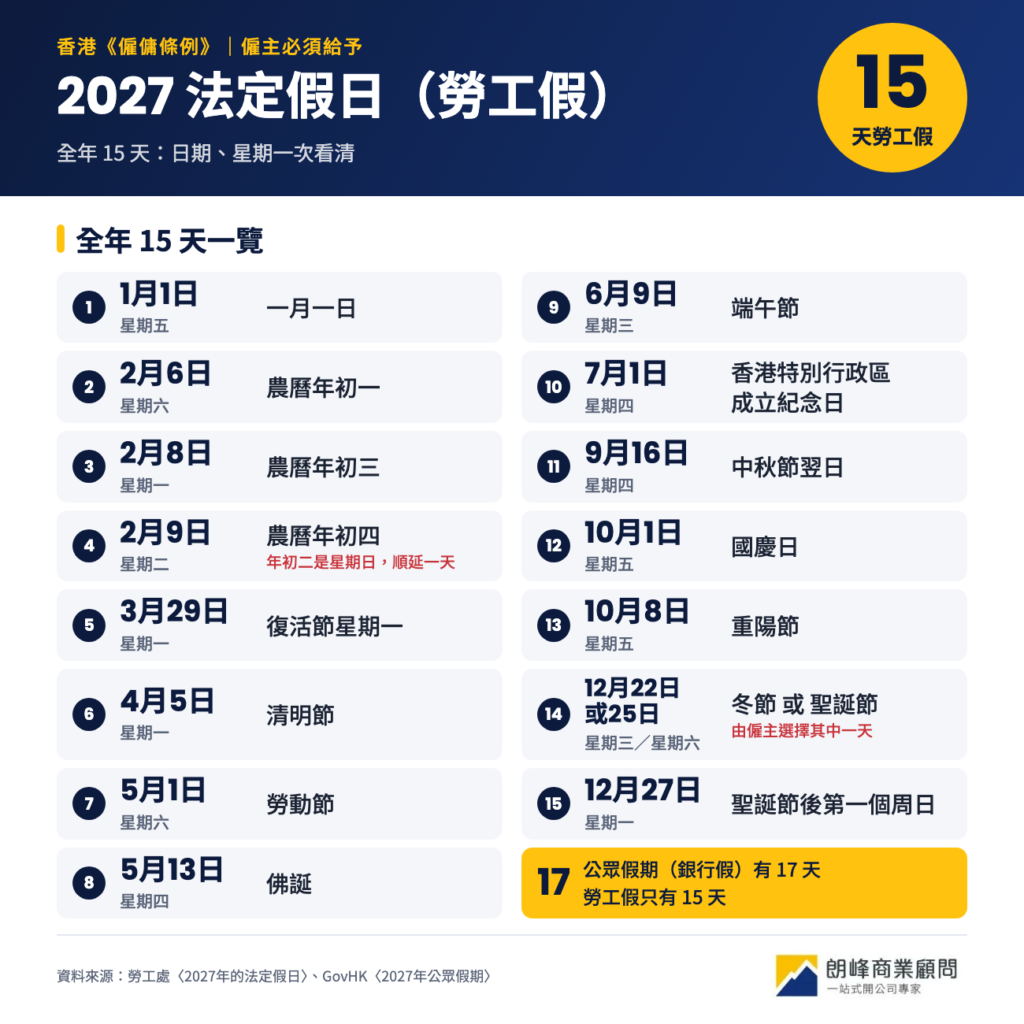
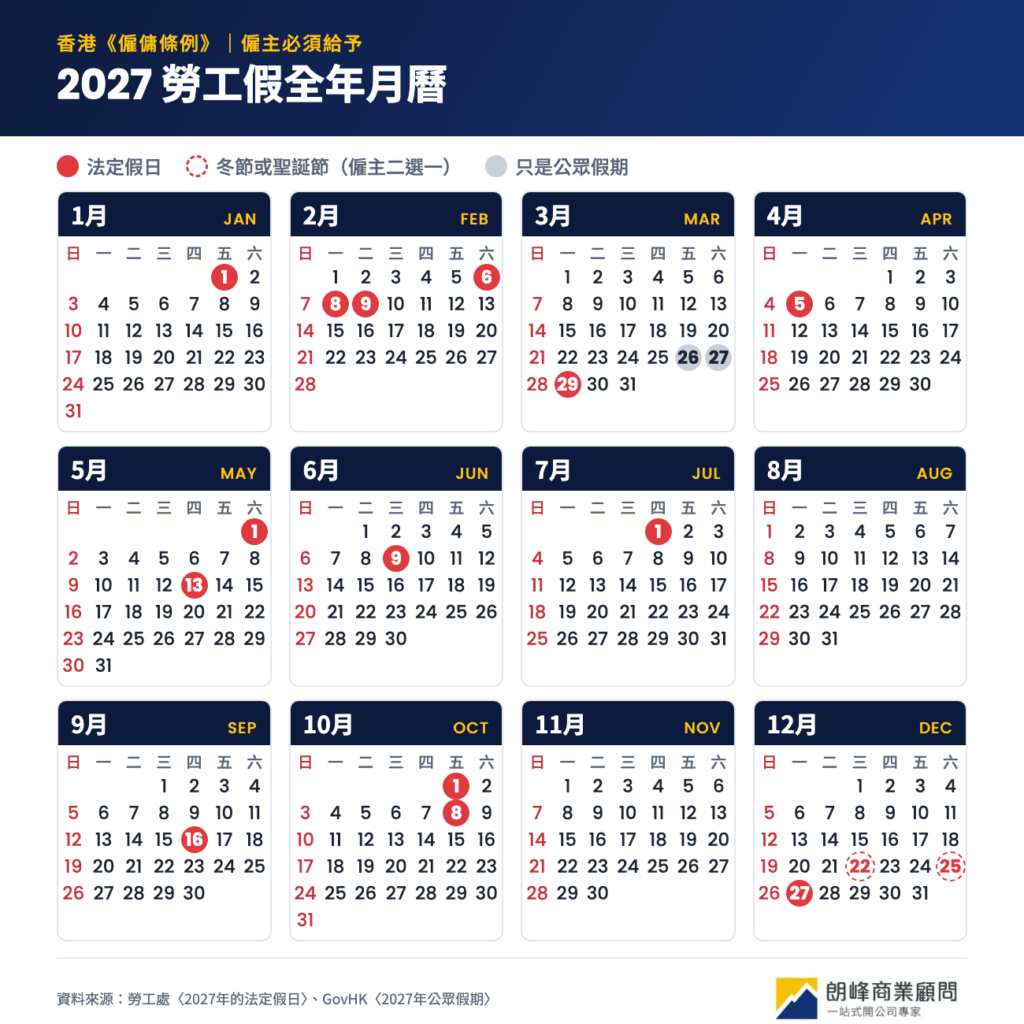
2027 labour holidays (statutory holidays)
| Date | Day | Statutory holiday |
|---|---|---|
| 1 January | Friday | The first day of January |
| 6 February | Saturday | Lunar New Year's Day |
| 8 February | Monday | Third day of Lunar New Year |
| 9 February | Tuesday | Fourth day of Lunar New Year |
| 29 March | Monday | Easter Monday |
| 5 April | Monday | Ching Ming Festival |
| 1 May | Saturday | Labour Day |
| 13 May | Thursday | The Buddha's Birthday |
| 9 June | Wednesday | Tuen Ng Festival |
| 1 July | Thursday | Hong Kong Special Administrative Region Establishment Day |
| 16 September | Thursday | The day following the Mid-Autumn Festival |
| 1 October | Friday | National Day |
| 8 October | Friday | Chung Yeung Festival |
| 22 December or 25 December | Wednesday or Saturday | Chinese Winter Solstice Festival or Christmas Day (at the option of the employer) |
| 27 December | Monday | The first weekday after Christmas Day |
In 2027 the second day of the Lunar New Year (7 February) falls on a Sunday, so that statutory holiday is moved to the fourth day of the Lunar New Year (9 February).
2027 public holidays
| Date | Day | Public holiday |
|---|---|---|
| 1 January | Friday | The first day of January |
| 6 February | Saturday | Lunar New Year's Day |
| 8 February | Monday | Third day of Lunar New Year |
| 9 February | Tuesday | Fourth day of Lunar New Year |
| 26 March | Friday | Good Friday |
| 27 March | Saturday | The day following Good Friday |
| 29 March | Monday | Easter Monday |
| 5 April | Monday | Ching Ming Festival |
| 1 May | Saturday | Labour Day |
| 13 May | Thursday | The Buddha's Birthday |
| 9 June | Wednesday | Tuen Ng Festival |
| 1 July | Thursday | Hong Kong Special Administrative Region Establishment Day |
| 16 September | Thursday | The day following the Mid-Autumn Festival |
| 1 October | Friday | National Day |
| 8 October | Friday | Chung Yeung Festival |
| 25 December | Saturday | Christmas Day |
| 27 December | Monday | The first weekday after Christmas Day |
Good Friday (26 March) and the day following Good Friday (27 March) are general holidays, but are still not statutory holidays in 2027.
2027 statutory holiday leave guide: how many days off can you get in a row?
Conclusion: 2027 is arguably the worst year for employees. Comparing 2022 to 2027, 1 day of annual leave gives at most 4 days, and 2 days give at most 5 days in a row – the fewest in six years – while the number of general holidays falling on a Saturday is 4 days, the most in six years.
The figures below assume Saturdays and Sundays off and are based on the general holidays announced by the Government.
Why is 2027 the worst year for employees?
- 4 public holidays fall on Saturdays: Lunar New Year's Day (6 February), the day following Good Friday (27 March), Labour Day (1 May) and Christmas Day (25 December). For people who already have Saturdays off, these 4 holidays give no extra day off; from 2022 to 2026, only 2 or 3 fell on a Saturday each year.
- Lunar New Year starts on a Saturday, and the second day falls on a Sunday, so only the third and fourth days (8 and 9 February) are weekday holidays. In 2025 and 2026 the first three days all fell between Tuesday and Friday, so 2 days of leave gave 9 days off in a row; in 2027 you need 3 days of leave to get 9 days off.
- Easter and Ching Ming Festival are a week apart: to join Easter (26–29 March) and Ching Ming Festival (5 April), you need to take 4 days of leave.
| Year | General holidays on a Saturday | Longest break with 1 day of leave | Longest break with 2 days of leave | Longest break with 3 days of leave |
|---|---|---|---|---|
| 2022 | 3 days | 6 days (Lunar New Year) | 9 days (Lunar New Year) | 10 days (Christmas) |
| 2023 | 3 days | 6 days (Easter) | 9 days (Lunar New Year) | 10 days (Easter) |
| 2024 | 2 days | 5 days (Christmas) | 7 days (Easter) | 10 days (Easter) |
| 2025 | 2 days | 5 days (Labour Day and Buddha's Birthday) | 9 days (Lunar New Year) | 9 days (Christmas) |
| 2026 | 3 days | 6 days (Lunar New Year) | 9 days (Lunar New Year) | 10 days (Easter) |
| 2027 | 4 days | 4 days (including Buddha's Birthday) | 5 days (Tuen Ng Festival) | 9 days (Lunar New Year) |
SetupHK calculated the table above day by day from the general holidays published on GovHK for 2022 to 2027, assuming Saturdays and Sundays off and counting only breaks that include a general holiday of that year.
How much leave each 2027 break needs
| leave | Leave to take | Days of leave | Days off in a row |
|---|---|---|---|
| Christmas and New Year's Day (2026–27) | 28–31 December 2026 | 4 days | 10 days (25 December 2026 – 3 January 2027) |
| Lunar New Year | 10–12 February | 3 days | 9 days (6–14 February) |
| Easter and Ching Ming Festival | 30 March – 2 April | 4 days | 11 days (26 March – 5 April) |
| The Buddha's Birthday | 14 May | 1 day | 4 days (13–16 May) |
| Tuen Ng Festival | 10–11 June | 2 days | 5 days (9–13 June) |
| Hong Kong Special Administrative Region Establishment Day | 2 July | 1 day | 4 days (1–4 July) |
| Mid-Autumn Festival | 17 September | 1 day | 4 days (16–19 September) |
| National Day and Chung Yeung Festival | 4–7 October | 4 days | 10 days (1–10 October) |
| Christmas and New Year's Day (2027–28) | 28–31 December | 4 days | 9 days (25 December 2027 – 2 January 2028) |
Long weekends without taking leave: New Year's Day (1–3 January), Lunar New Year (6–9 February), Easter (26–29 March), National Day (1–3 October), Chung Yeung Festival (8–10 October) and Christmas (25–27 December).
Limited annual leave? Which breaks to book first
Under the Employment Ordinance, an employee gets paid annual leave for every 12 months of employment under a continuous contract, rising with length of service from 7 days to a maximum of 14 days (from the 9th year of employment). Based on how much leave each break needs in the table above, you could plan it like this:
- With 7 days of annual leave: Easter and Ching Ming Festival (4 days), plus Buddha's Birthday, HKSAR Establishment Day and Mid-Autumn Festival (1 day each), for a total of 23 days.
- With 10 days of annual leave: add Lunar New Year (3 days), for a total of 32 days.
- With 14 days of annual leave: add National Day and Chung Yeung Festival (4 days), for a total of 42 days.
SetupHK tip: the employer sets the dates of annual leave after consulting the employee and must give at least 14 days' written notice to the employee, so apply early if you want a long break. To add general holidays to your phone calendar, subscribe to 1823's iCal Calendar for "Hong Kong Public Holidays".
If you only get statutory holidays
The table above is based on general holidays. If you only get statutory holidays, or you work on Saturdays, your breaks will be shorter:
- Good Friday (26 March) and the day following Good Friday (27 March) are not statutory holidays, so the only Easter statutory holiday is Easter Monday (29 March).
- Around Christmas, the statutory holiday is chosen by the employer: either the Chinese Winter Solstice Festival (22 December) or Christmas Day (25 December), plus the first weekday after Christmas Day (27 December).
- Lunar New Year's Day (6 February) and Labour Day (1 May) fall on a Saturday; if Saturday is your rest day, you get the holiday on another day under the rule in "When a statutory holiday falls on a rest day" below.
SetupHK calculated these breaks day by day from the 2027 general holidays announced by the Government. Working days and holiday arrangements differ between companies, so check your employment contract and company policy.
2026 labour holidays and public holidays
There are 15 statutory holidays in 2026, with Easter Monday added from this year; general holidays other than Sundays total 17 days.
2026 labour holidays (statutory holidays)
| Date | Day | Statutory holiday |
|---|---|---|
| 1 January | Thursday | The first day of January |
| 17 February | Tuesday | Lunar New Year's Day |
| 18 February | Wednesday | Second day of Lunar New Year |
| 19 February | Thursday | Third day of Lunar New Year |
| 5 April | Sunday | Ching Ming Festival |
| 6 April | Monday | Easter Monday |
| 1 May | Friday | Labour Day |
| 24 May | Sunday | The Buddha's Birthday |
| 19 June | Friday | Tuen Ng Festival |
| 1 July | Wednesday | Hong Kong Special Administrative Region Establishment Day |
| 26 September | Saturday | The day following the Mid-Autumn Festival |
| 1 October | Thursday | National Day |
| 18 October | Sunday | Chung Yeung Festival |
| 22 December or 25 December | Tuesday or Friday | Chinese Winter Solstice Festival or Christmas Day (at the option of the employer) |
| 26 December | Saturday | The first weekday after Christmas Day |
Ching Ming Festival (5 April), Buddha's Birthday (24 May) and Chung Yeung Festival (18 October) fall on a Sunday. When a statutory holiday falls on an employee's rest day, the holiday should be given on the day after the rest day. For example, an employee whose rest day is Sunday should have the Chung Yeung Festival holiday on 19 October instead, provided that day is not a statutory holiday, alternative holiday, substituted holiday or rest day.
2026 public holidays
| Date | Day | Public holiday |
|---|---|---|
| 1 January | Thursday | The first day of January |
| 17 February | Tuesday | Lunar New Year's Day |
| 18 February | Wednesday | Second day of Lunar New Year |
| 19 February | Thursday | Third day of Lunar New Year |
| 3 April | Friday | Good Friday |
| 4 April | Saturday | The day following Good Friday |
| 6 April | Monday | The day following Ching Ming Festival |
| 7 April | Tuesday | The day following Easter Monday |
| 1 May | Friday | Labour Day |
| 25 May | Monday | The day following the Buddha's Birthday |
| 19 June | Friday | Tuen Ng Festival |
| 1 July | Wednesday | Hong Kong Special Administrative Region Establishment Day |
| 26 September | Saturday | The day following the Mid-Autumn Festival |
| 1 October | Thursday | National Day |
| 19 October | Monday | The day following Chung Yeung Festival |
| 25 December | Friday | Christmas Day |
| 26 December | Saturday | The first weekday after Christmas Day |
Labour holidays (statutory holidays) vs public holidays
Statutory holidays are commonly called"labour holidays"and are set by the Employment Ordinance (Cap. 57). All employees covered by the Employment Ordinance, regardless of length of service or hours worked, are entitled to statutory holidays.
General holidays are commonly called"bank holidays"and are set by the General Holidays Ordinance (Cap. 149), which defines general holidays as days observed as holidays by all banks, educational establishments, public offices and government departments. Apart from every Sunday, there are 17 days general holidays a year.
| Item | Labour holidays (statutory holidays) | Public holiday |
|---|---|---|
| Common name | Labour holidays | Bank holidays |
| Legislation | Employment Ordinance (Cap. 57) | General Holidays Ordinance (Cap. 149) |
| Who it applies to | All employees covered by the Employment Ordinance | Banks, educational establishments, public offices and government departments |
| Days per year | 15 days in 2026 and 2027, 16 days from 2028, 17 days from 2030 | Every Sunday, plus 17 days |
In 2026 and 2027, for example, Good Friday and the day following Good Friday are general holidays but not yet statutory holidays; also, for the statutory holiday "Chinese Winter Solstice Festival or Christmas Day", the employer chooses one of the two days, while the general holiday is Christmas Day.
How many statutory holidays are there? From 12 to 17 days
Under the Employment (Amendment) Ordinance 2021, statutory holidays increase by one day every two years from 2022, from the original 12 days to 17 days in 2030, matching the number of general holidays (excluding Sundays).
| Effective from | Statutory holiday added | Total statutory holidays |
|---|---|---|
| 2022 | The Buddha's Birthday | 13 days |
| 2024 | The first weekday after Christmas Day | 14 days |
| 2026 | Easter Monday | 15 days |
| 2028 | Good Friday | 16 days |
| 2030 | The day following Good Friday | 17 days |
When the first, second or third day of the Lunar New Year falls on a Sunday, the fourth day of the Lunar New Year is the holiday instead; when the day following the Mid-Autumn Festival falls on a Sunday, the next day is the holiday instead.
What employers need to know
When a statutory holiday falls on a rest day
If a statutory holiday falls on an employee's rest day, the employer should let the employee take the holiday on the following day, provided that day is not a statutory holiday, alternative holiday, substituted holiday or rest day.
Requiring employees to work on a statutory holiday
If an employer requires an employee to work on a statutory holiday, the employer must arrange an alternative holiday within 60 days before or after the statutory holiday and notify the employee in advance:
- Alternative holiday before the statutory holiday: notify the employee, ahead of the alternative holiday, at least 48 hours in advance.
- Alternative holiday after the statutory holiday: notify the employee, ahead of the statutory holiday, at least 48 hours in advance.
If both sides agree, the employer may also arrange a substituted holiday within 30 days before or after the statutory or alternative holiday for the employee.
Holiday pay
An employee who has been employed under a continuous contract for 3 months immediately before the holiday is entitled to holiday pay. The daily amount equals the employee's average daily wages over the 12 months before the holiday (a shorter period if employed for less than 12 months; for consecutive holidays, the first day is used). The employer must pay holiday pay no later than the first payday after the statutory holiday.
A "continuous contract" means the employee has worked for the same employer for 4 weeks or more and at least 17 hours a week; if fewer than 17 hours are worked in a week, that week and the 3 weeks before it must total at least 68 hours. This rule applies from 18 January 2026; employment before then is assessed on at least 18 hours a week.
No payment in lieu of holidays
Whether or not the employee is entitled to holiday pay, the employer must still give the statutory holiday, or arrange an alternative or substituted holiday, and may not pay money in place of the holiday (commonly called "buying out" holidays).
Penalties
An employer who, without reasonable excuse, does not give an employee a statutory, alternative or substituted holiday, or does not pay holiday pay, may be prosecuted and, on conviction, is liable to a fine of up to ,000.
FAQ
How many labour holidays are there in 2027?
15 days. 2027 has 15 statutory holidays, the same as 2026. The number only rises to 16 in 2028 (when Good Friday is added).
Is Sunday a statutory holiday?
No. Every Sunday is a general holiday but not a statutory holiday. An employee employed under a continuous contract is entitled to at least 1 rest day in every 7 days; the rest day is set by the employer, not necessarily Sunday, and whether it is paid or unpaid is agreed between employer and employee.
Do part-time employees get labour holidays?
Yes. Statutory holidays apply to all employees covered by the Employment Ordinance, regardless of hours worked; to get holiday pay, however, the employee must have been employed under a continuous contract for 3 months before the holiday.
Is Good Friday a labour holiday?
Not in 2026 or 2027. Good Friday becomes a statutory holiday from 2028, and the day following Good Friday from 2030. Until then, both are general holidays but not statutory holidays.
How to make the most of your leave in 2027?
2027's holidays are spread out: 1 or 2 days of leave give at most 4 or 5 days in a row, the fewest since 2022. Better value: 1 day of leave for 4 days off (Buddha's Birthday, HKSAR Establishment Day, Mid-Autumn Festival) and 3 days for 9 days off (Lunar New Year). The longest break of the year is Easter plus Ching Ming Festival, which takes 4 days of leave for 11 days off.
Source
- Labour Department: Statutory holidays in 2027
- Labour Department: Statutory holidays in 2026
- GovHK: 2027 public holidays
- GovHK: 2026 public holidays
- Labour Department: Concise Guide to the Employment Ordinance, Chapter 4: Rest Days, Holidays and Leave
- Labour Department: Concise Guide to the Employment Ordinance, Chapter 1: Application of the Employment Ordinance
- Hong Kong e-Legislation: General Holidays Ordinance (Cap. 149)
- Hong Kong e-Legislation: Employment Ordinance (Cap. 57)
The information above was checked against official websites on 1 November 2026.
Update log: on 1 November 2026, the 2027 statutory and general holidays, the holiday graphics and the 2027 leave-planning guide were added.