


Table of contents
Choosing between a limited and an unlimited company is the most important decision before forming a company. The two differ fundamentally in legal liability, tax rates, audit requirements and ability to raise finance. This article looks at three angles (growth, economics and risk) to help you quickly judge which company type suits your business.
- A limited company has separate legal personality and shareholders' liability is limited to the amount they invest. It suits founders with long-term growth plans or larger business volumes.
- An unlimited company has low set-up costs and simple procedures, but the owner is personally liable for the company's debts.
- If you need financing or want to bring in investors, choose a limited company. For a small business or a trial stage, an unlimited company is more practical.
- If your business involves large contracts or construction projects, we strongly recommend a limited company to protect your personal assets.
Limited company vs unlimited company
Before forming a company you first need to choose a company type. Company types in Hong Kong can simply be divided into limited and unlimited companies. The meaning of limited and unlimited, and the most obvious difference between them, is how much liability shareholders have for the company during its operation. The key points of each are below.
Limited company
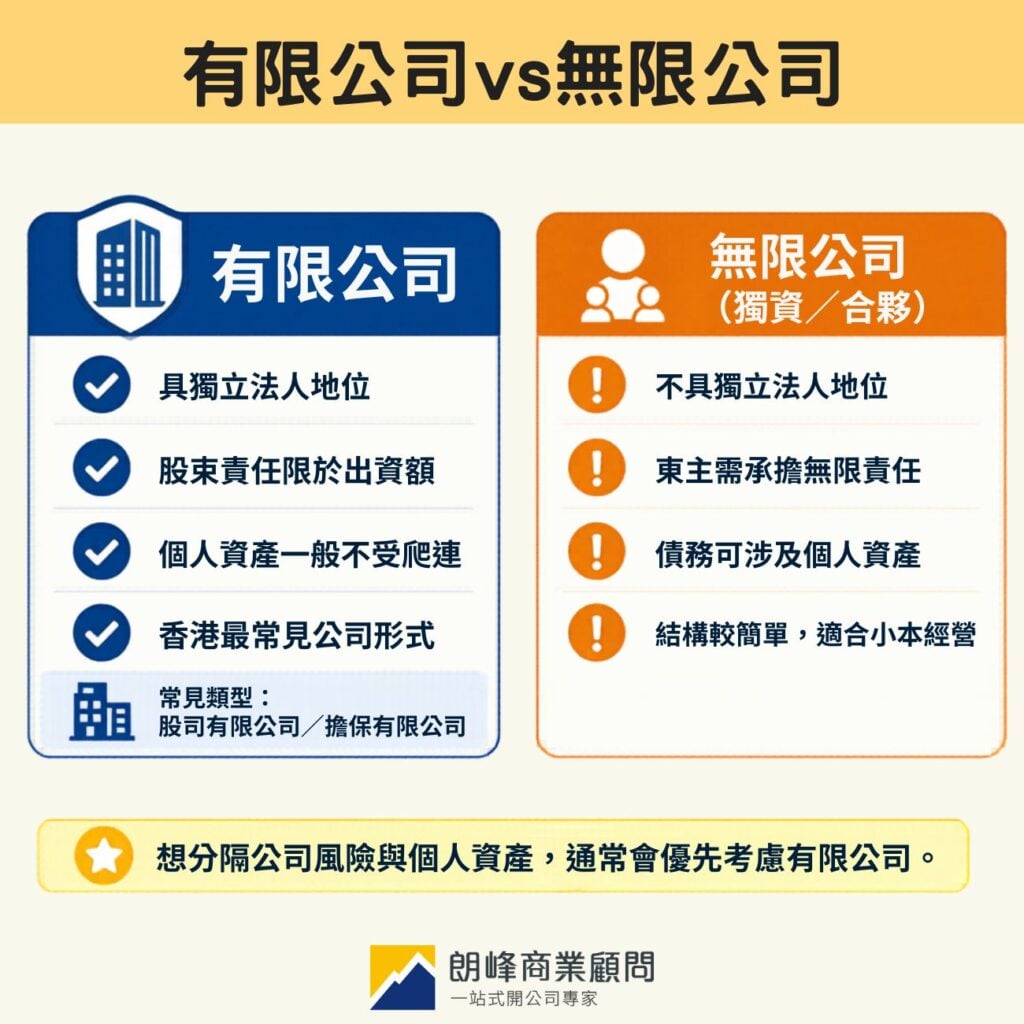
A limited company means a company with limited liability and separate legal personality. When the company has debts, shareholders' liability is limited to the amount they invested, their personal assets are not affected, and creditors cannot pursue shareholders' private assets.
When registering a local company in Hong Kong, you can choose from two categories:
Company limited by shares: members' legal liability is limited to the unpaid amount on the shares they hold. This is the most common form of company in Hong Kong.
Company limited by guarantee: the company has no share capital, and members' liability is limited to the amount they undertake to contribute if the company is wound up. It is common among non-profit organisations and professional bodies.
Unlimited company (sole proprietorship / partnership)
Unlimited company (sole proprietorship / partnership) means unlimited liability – if the business cannot pay its debts, the owner must repay them from personal assets. An unlimited company has no separate legal personality, and the owner can only sign contracts in their own name.
For the full registration process and costs of an unlimited company, see: Hong Kong unlimited company registration: process and costs quick guide
Limited company vs unlimited company?
| Limited company | Unlimited company | |
|---|---|---|
| Eligibility | Hong Kong residents or non-Hong Kong residents: the company secretary must be a Hong Kong resident or a Hong Kong-incorporated limited company | Hong Kong residents, Hong Kong permanent residents or non-Hong Kong residents: a Hong Kong resident must be appointed as the company's agent |
| Responsible authority | Companies Registry | Inland Revenue Department |
| Application form | NNC1 or NNC1G | IRBR 37A |
| Legal status | A separate legal entity that can enter into contracts in the company's name | Not a separate legal entity; can only enter into contracts in the proprietor's personal name |
| Liability for debts | Shareholders' liability is limited to their share capital | The proprietor bears unlimited liability for the business's debts |
| Continuity | Unless it is wound up or dissolved, the company exists indefinitely | If the proprietor or a partner becomes bankrupt or dies, the business must be wound up or dissolved |
| Tax | An independent accountant must be arranged every year to prepare financial reports and carry out an audit, and an audit report must be submitted to the IRD | Only the proprietor needs to file a tax return |
| Tax rate | Assessable profits over HK$2 million: 16.5% Assessable profits under HK$2 million: 8.25% | Assessable profits over HK$2 million: 15% Assessable profits under HK$2 million: 7.5% |
Note: Under the 2026-27 Budget, profits tax for both limited and unlimited companies for the 2025/26 year of assessment will be reduced by 100%, capped at HK$3,000 per case (subject to approval by the Legislative Council).
If your business involves larger contracts, needs financing, or you plan to develop it over the long term, a limited company is the safer choice.
If it is only a small trial business, or you are a freelancer or take on individual projects, the low cost and simple procedures of an unlimited company are more practical.
If you are unsure, we recommend consulting a professional adviser first, to avoid having to restructure later.
Once you have decided on the company type, what is the next step?
After choosing the company type, you can start preparing the registration application.
- Full application process and required documents for a limited company: Hong Kong company formation quick guide: 6 steps
- Application process and costs for an unlimited company: Hong Kong unlimited company registration: process and costs quick guide
Limited company or unlimited company: which to choose when starting a business?
Is it better to open an unlimited or a limited company?
When starting a business for the first time, it is natural to feel unsure. SetupHK sets out the following factors for you to consider, so you can quickly assess whether a limited or an unlimited company suits you better:
Development
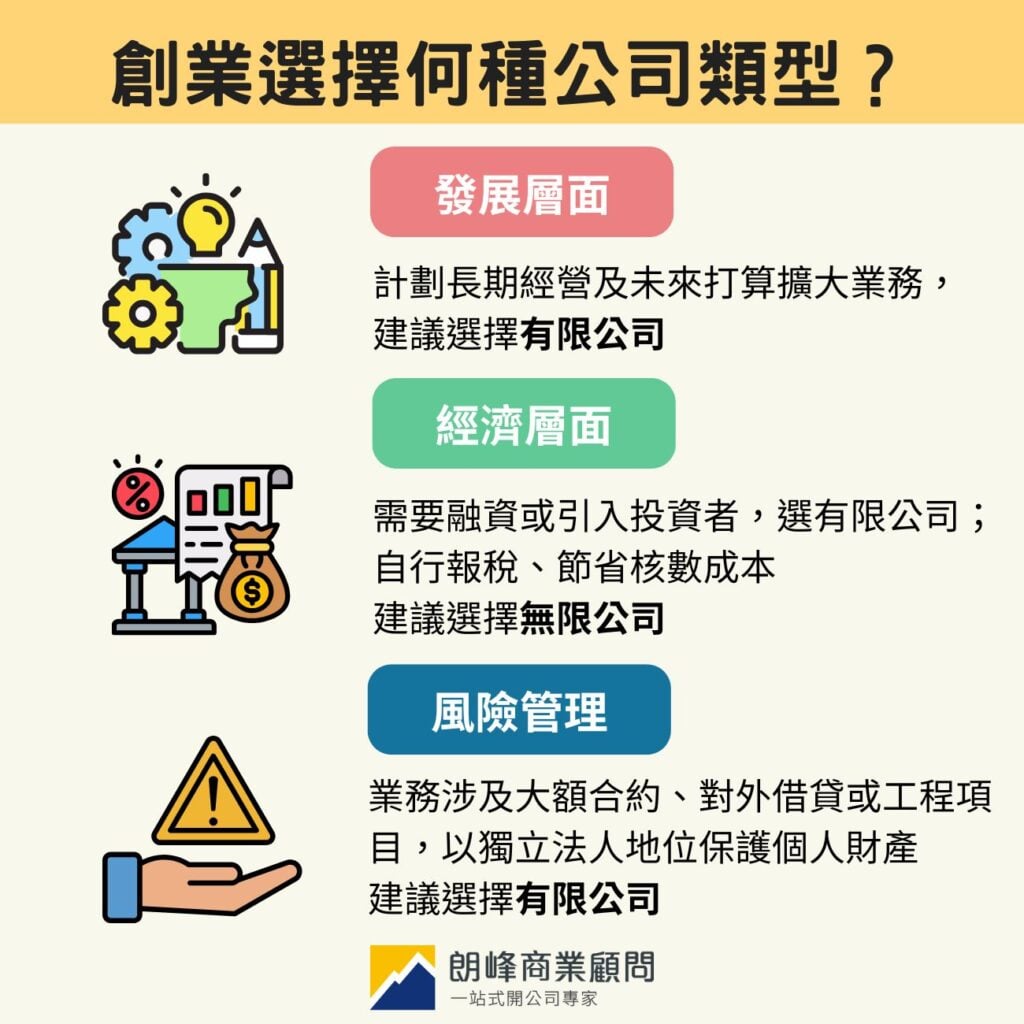
If you plan to operate in Hong Kong for the long term and expand the business in future, setting up a limited company is the better choice.
The structure of a limited company gives much fuller legal protection and a separate legal personality, so the company can keep operating even if it changes hands or one of the shareholders withdraws their investment, giving the business stability and sustainable development.
An unlimited company, on the other hand, has no separate legal personality. If the investor withdraws or dies unexpectedly, the company can no longer continue to operate or develop. However, for small businesses such as food stalls, freelancers and one-person companies, setting up an unlimited company is relatively simpler than a limited company.
Finance
If you need financing or want to bring in investors, choose a limited company. If you only need to file your own tax return and want to save on audit costs, choose an unlimited company.
When a company lacks funds to grow, you may think of finding investors or taking out a loan. If you were an investor or a bank, what kind of company would you invest in or lend money to? Of course, one with transparent income and expenditure that makes a profit. For investors, a limited company is more attractive: shareholders' liability is legally limited to the amount they invested, and the financial statements must be audited by an independent accountant every year, which makes the finances clearer and more definite, so it is more attractive for raising investment funds.
For an unlimited company, the proprietor or partners only need to keep the accounting records and supporting documents and file tax returns on time, and there is no requirement to have the financial statements audited, so an unlimited company is less attractive to investors.
Risk management
If your business involves large contracts, external borrowing or construction projects, we recommend a limited company, so that its separate legal personality protects your personal assets.
The main feature of a limited company is that it has a separate legal personality. This means that when the company runs into debt problems or legal proceedings, the shareholders' personal assets are generally not affected unless the shareholders have signed certain guarantee documents, and individuals are not affected by the proceedings.
Because an unlimited company has no separate legal identity, the owners must sign contracts in their personal capacity and are personally liable for the company's debts without limit. If the company is in debt, the proprietor must use personal assets to settle it and bears the business risk. If the business involves large amounts, such as engineering, wholesale or trading, an unlimited company is not recommended.
FAQ
What is the difference in tax rates between limited and unlimited companies?
Profits tax rate for limited companies: 8.25% on the first HK$2 million of profits and 16.5% on the remainder. The rate for unlimited companies is slightly lower: 7.5% on the first HK$2 million and 15% on the remainder. However, a limited company must arrange an independent accountant to audit its accounts every year, so the audit fee needs to be counted in the real cost.
Can an unlimited company be converted into a limited company later?
Not directly. If it is needed later, the approach is to form a separate limited company and then have the limited company acquire the unlimited company's business assets. If you expect the business to grow from the start, forming a limited company directly is easier.
If I am starting a business alone, is a limited company suitable?
Yes. Hong Kong law allows one person to be both the sole director and the sole shareholder, so a one-person company can perfectly well be a limited company. However, the company secretary must be appointed separately and cannot be the same person as the director.
Does an unlimited company have shareholders?
No. An unlimited company is either a sole proprietorship (one owner) or a partnership (two or more people). There is no concept of shareholders; the owner or partners directly own and run the business in their personal capacity.
Summary
Choosing a company type is the first step in starting a business. Once decided, you can start preparing the registration application. Not sure how to choose an agent?
How do you choose a Hong Kong company formation service without being caught out?
If you still have questions about limited versus unlimited companies, or want someone to help you assess the most suitable structure, please contact the SetupHK advisory team. We offer a one-stop company formation service so you avoid detours and can focus on growing your business.
Further reading:
Hong Kong company formation quick guide: 6 steps, costs and required documents
Hong Kong unlimited company registration: process and costs quick guide
3 things to prepare before forming a company
What is the difference between a shareholder and a director?
