


Table of contents
You do not necessarily need to form a company to run an online shop, but if you trade continuously for profit you must have business registration. Personal registration is enough at the start; upgrade to a limited company when the business expands or when you need to protect personal assets.
Key takeaways
- Regular listings, stock and active promotion mean continuous trading, which requires business registration
- Annual fee for personal business registration is about HK$2,350
- Annual upkeep cost of a limited company is about HK$5,000–$15,000
- Sole proprietorship: 7.5% tax rate on the first HK$2 million of profit
- Limited company: 8.25% tax rate on the first HK$2 million of profit
- Some e-commerce platforms (such as HKTVmall) require sellers to be limited companies
When must an online shop have business registration?
Requirements of the Business Registration Ordinance
Under Hong Kong's Business Registration Ordinance (Cap. 310), anyone “carrying on a business” in Hong Kong must register within 1 month of starting the business, and this applies equally to online businesses.Inland Revenue Department is defined simply and directly: an activity carried on continuously for the purpose of making a profit, including selling goods or providing services online.
Occasionally selling unused items on Carousell does not amount to “carrying on a business” and needs no registration. But if you regularly post products on IG, hold stock or actively promote, then as long as these three features are met, you basically need to register.
When to upgrade from sole proprietorship to a limited company
Personal business registration (sole proprietorship) is enough for the early stage of a business, with simple procedures and low cost. But when the following situations arise, we recommend seriously considering an upgrade to a limited company:
- You start to have large inventory, warehousing or logistics costs
- You need to bring in partners or outside investment
- You plan to work with corporate clients (who usually contract only with limited companies)
- You worry that business debts could reach your personal assets
The core advantage of a limited company is “limited liability”. Shareholders lose at most the amount they put in, and personal savings and property are not exposed to business risk.
What tax advantages does a limited company have?
Hong Kong applies different versions of the two-tiered profits tax to sole proprietorships and limited companies:
| Item | Personal business registration (sole proprietorship) | Limited company |
|---|---|---|
| Tax rate on the first HK$2 million of profit | 7.5% | 8.25% |
| Portion above HK$2 million | 15% | 16.5% |
| Deduction flexibility | Lower | Higher (salaries, rent, equipment depreciation and so on can be deducted) |
| Audit requirement | No | Yes (qualifying small companies may be exempt) |
Although a personal business starts at a slightly lower tax rate, a limited company has more flexibility in profit distribution and remuneration arrangements, giving wider overall scope for tax planning. The higher the profit, the more obvious the gap.
Further reading: “Complete guide to Hong Kong profits tax: key tax points for first-time founders”
Company formation advice for different situations
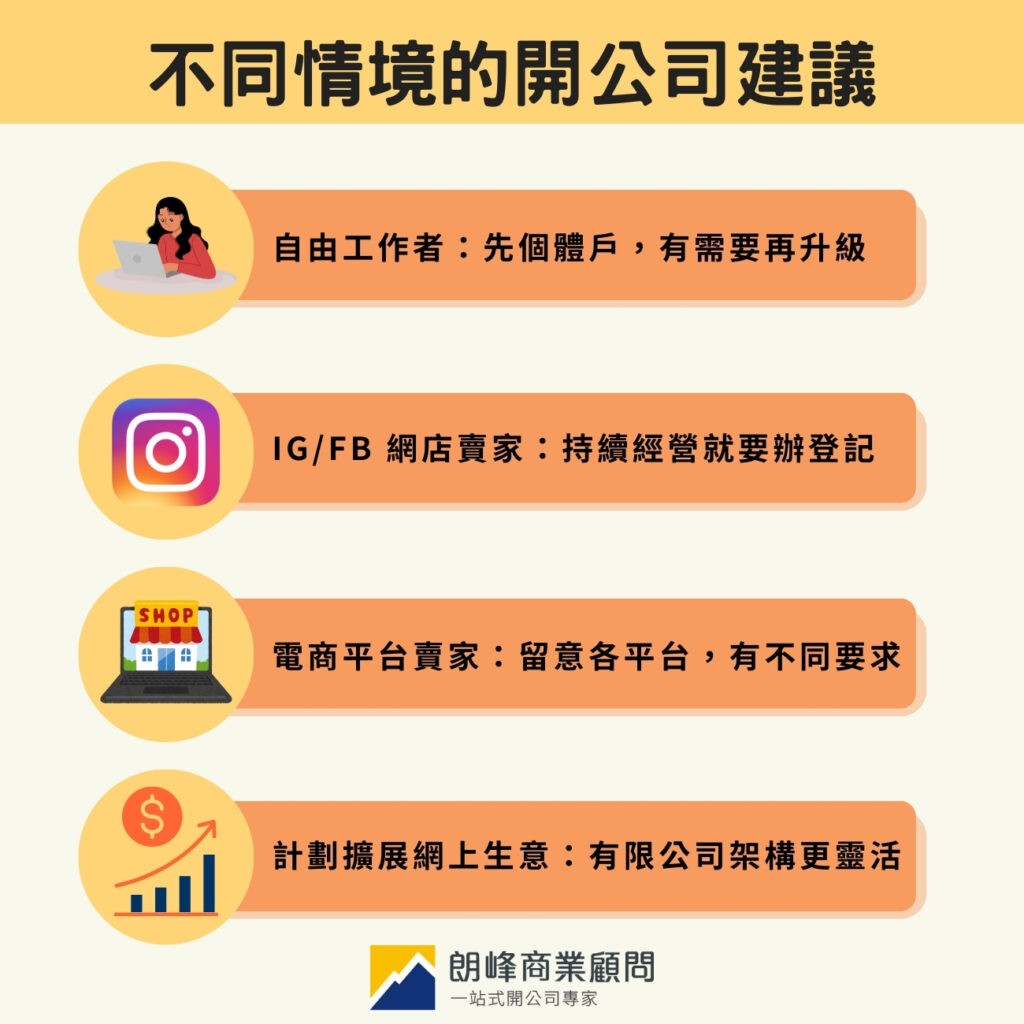
Freelancers: start as a sole proprietor, upgrade when needed
For designers, programmers, photographers and the like, personal business registration is enough at first. When income keeps growing, clients start to be mainly companies, or you need help to share the workload, the professional image and limited liability protection of a limited company become very practical. In B2B settings, many corporate clients are only willing to contract with limited companies, a practical consideration that cannot be ignored.
IG/FB online shop sellers: continuous trading requires registration
The IRD considers overall whether a business is continuous, and common reference factors include regular listings, stock and active promotion. The more of these conditions are met, the more likely the business is to be regarded as continuous trading requiring business registration. Personal registration is enough at first; once monthly sales grow steadily, switching to a limited company lets you open a separate business bank account, which makes fund management clearer and later applications for government funding smoother.
E-commerce platform sellers: note that each platform has different requirements
As long as you sell on a platform continuously for profit, you need to register your business. Note that some platforms (such as HKTVmall) explicitly require merchants to be limited companies. If you are in cross-border e-commerce, a limited company is also more convenient for applying for import and export licences and opening multi-currency accounts.
Online businesses planning to expand: a limited company structure is more flexible
If you plan to bring in investment, apply for government funding (such as the BUD Fund – the Dedicated Fund on Branding, Upgrading and Domestic Sales – or the Technology Voucher Programme), or intend to sell the business later, a limited company is almost a necessity. Shares can be transferred and the company continues to exist, which is far more flexible than a sole proprietorship.
What do you actually need to prepare for online shop business registration?
To apply for business registration you must provide the business name, business address, nature of business and commencement date. You can apply online via the Inland Revenue Department website, or submit in person at the Business Registration Office.
Current fees are as follows (2026/27):
| Type | Fee |
|---|---|
| 1-year certificate | HK$2,350 |
| 3-year certificate | HK$6,170 |
You can use your home address as the business address, but first confirm that the estate's deed of mutual covenant and your tenancy do not prohibit running a business from home. In addition, a home address is shown publicly on the business register; if you are concerned about privacy, consider renting a virtual office instead. After registration you must file a profits tax return every year, and keep all accounting records for at least 7 years for the IRD to inspect.
Further reading: “[Registered address] Can a virtual office be used as a business registration address? Requirements and how to change the address explained”
Forming a company vs sole proprietorship: differences at a glance
| Personal business registration | Limited company | |
|---|---|---|
| Basic annual cost | About HK$2,350 | About HK$5,000–$15,000 |
| Liability risk | Unlimited (personal assets exposed) | Limited (loss capped at the amount invested) |
| Business image | Fair | Stronger |
| Financing / funding applications | Harder | Easier |
| Accounting and audit requirements | No | Yes (small companies may be exempt) |
| Best suited to | Early stage, small scale, low risk | Expanding, high profit, need to protect personal assets |
FAQ
How much income means I need to form a company?
Hong Kong law sets no income level at which you must form a company; what matters is whether the business is continuous and carried on with the intention of making a profit. In practice, however, once annual profit exceeds HK$500,000-1,000,000, the tax advantages of a limited company start to become clear, and it is more worthwhile to seriously assess an upgrade at that point.
Does an IG shop need business registration?
Regular listing of products, keeping stock and actively promoting are signs of continuous trading, and the law requires business registration. Occasionally selling unused personal items is not covered.
How do I file tax for an online shop?
After you receive the profits tax return from the IRD, simply complete it according to the business's income and expenses. Remember to keep all receipts and accounts from the day you start trading, for at least 7 years, for the IRD to check later.
Can I convert from a sole proprietorship to a limited company later?
Yes, but it is not a direct conversion. Instead, you need to incorporate a new limited company, then transfer the business assets, customer contracts and so on one by one, and the existing personal business registration must also be cancelled separately. We recommend getting professional help to avoid tax or compliance gaps.
Not sure which registration to choose? SetupHK can help you sort it out
Whether to register as a sole proprietor or set up a limited company has no standard answer; it all depends on the size and direction of your business. SetupHK offers one-stop company registration and business registration services. If you still have questions about applying, feel free to Enquire, and let us help you find the most suitable option.
Further reading: “Complete guide to forming a company in Hong Kong: process, costs and key points”