


Can a person open a limited company? Understand the rules for a single shareholder and director to open a company in 3 minutes.
Hong Kong law allows a person to serve as both the sole shareholder and the sole director, and a one-person limited company is completely legal. However, the company secretary cannot be the sole director and must be appointed separately from a qualified person.
Summary of key points
- A single natural person can serve as both the sole shareholder and the sole director.
- The company secretary cannot be the sole director and must be appointed separately.
- Shareholder liability is limited to the amount of capital contributed, and personal assets are not affected by company debts.
- Shareholders or directors can be added at any time in the future, providing much more flexibility than sole proprietorships.
Is a one-person company legal? A clear look at the three major regulations regarding shareholders, directors, and secretaries.
Number of shareholders: at least one is sufficient.
According toCompanies Ordinance Chapter 622.In Hong Kong, a private limited company requires at least one shareholder, with a maximum of 50. In other words, one person can completely hold 100% of the shares of the company 100% and have full control over all major decisions, which is legally unproblematic.
Number of directors: having a sole director is completely legal.
Section 453 of the Companies Ordinance stipulates that every private limited company must have at least one director. The sole shareholder can also serve as the sole director, which isCompanies Registryan accepted legal arrangement and quite common in Hong Kong.
Company secretary: the sole director cannot serve concurrently.
According to Sections 474 and 475 of the Companies Ordinance, every limited company must appoint a company secretary, butif the company has only one director, that director cannot also serve as the company secretary.A qualified Hong Kong resident or an entity holding a Trust and Company Service Provider license (TCSP license) must be appointed as the company secretary, which is a mandatory legal requirement with no exemptions.
How does a single shareholder and director operate?
Legal feasibility.
There is absolutely no problem. The structure of a single shareholder and director has been confirmed as legal in multiple court cases in Hong Kong and is a mature and stable business arrangement. As the sole shareholder and director, you can decide the company's direction, sign contracts, and distribute profits without needing to negotiate with anyone, with complete control in your hands.
What daily tasks do you need to handle yourself?
The biggest challenge of a sole proprietorship is that everything is shouldered by you alone. In addition to business decisions and contract signing, statutory compliance work cannot be overlooked either:
| Matters | Description |
|---|---|
| Strategy and Operations | Develop a growth plan and manage daily operations |
| Contract Signing | All external agreements must be authorized by the board |
| Financial Management | Personal and company finances must be kept completely separate |
| Statutory Reporting | Annual returns and profit tax returns must be submitted on time |
It is recommended to establish a complete document record system from day one. All resolutions and transaction records must be properly kept for at least 7 years in accordance with Section 51C of the Taxation Ordinance.
One-Person Limited Company vs Sole Proprietorship
Both are decided by one person, but their legal nature is completely different, with far-reaching implications:
| Comparison items | One-Person Limited Company | Sole Proprietorship |
|---|---|---|
| legal status | Independent legal entity, separate from shareholders | The owner and the business are the same legal entity |
| Personal Liability | Limited to the amount of capital contribution, personal assets are protected | Unlimited liability for all business debts |
| taxation | Profit tax on the first 2 million is 8.25%, thereafter 16.5% | Profits are included in personal income, with a maximum standard tax rate of 17% |
| Continuity | Does not terminate due to the death or exit of shareholders | Terminated upon the death or bankruptcy of the owner |
| Compliance requirements | More (audit, annual reporting, etc.) | Less |
What are the advantages of a sole proprietorship? What risks should be noted?
Three major advantages of a sole proprietorship
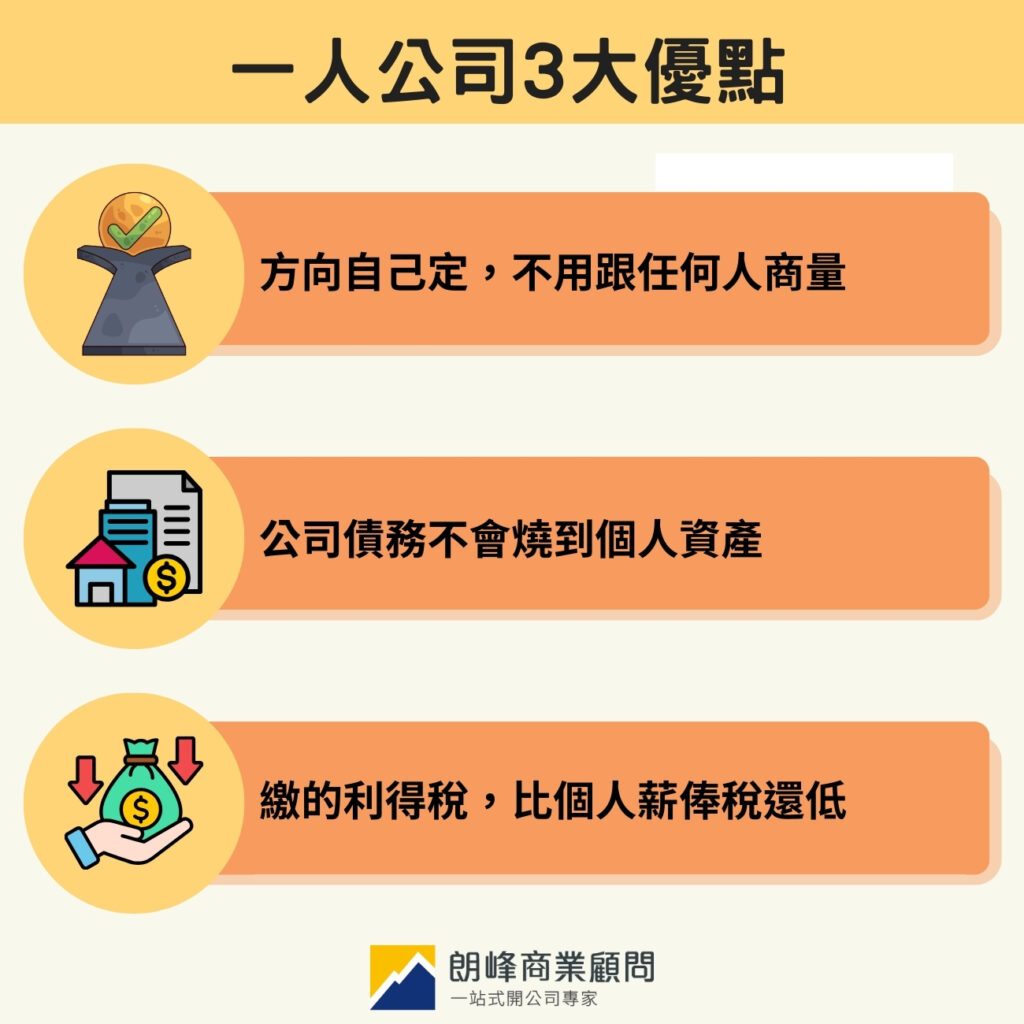
The three most attractive aspects of a sole proprietorship are: setting your own direction without consulting anyone; company debts will not affect personal assets; the first 2 million in profits only requires paying 8.25% in profit tax, which is lower than the personal salary tax standard rate of 17%. Additionally, the business image of a limited company is more trusted by banks and clients than that of a sole proprietorship, making future financing easier.
Five risks that cannot be ignored
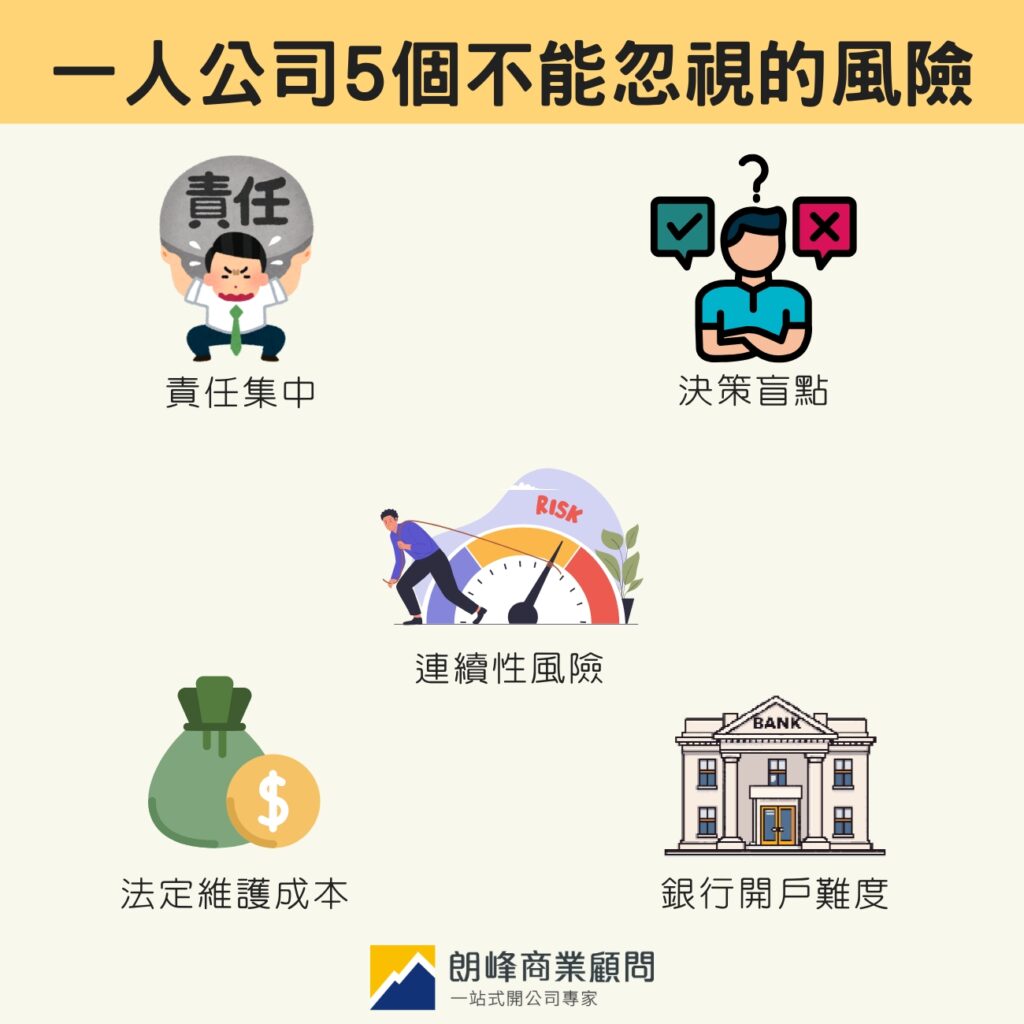
Although a sole proprietorship is not subject to other partners, all responsibilities and pressures fall on one person. Here are the risks encountered by a sole proprietorship:
- Concentrated responsibility: All responsibilities rest on one person, including ensuring the company files and pays taxes on time; any negligence may result in fines.
- Decision-making blind spots: Without other directors to oversee, it is difficult to receive reminders when mistakes occur, leading to relatively higher risks in major decision-making.
- Continuity risk: If you are unable to fulfill your duties for any reason, the company's operations may immediately fall into difficulty.
- Statutory maintenance costsAudit fees, company secretary fees, and other expenses are higher than those of sole proprietorships and are considered necessary expenditures.
- Difficulty in opening a bank accountIn recent years, banks have tightened their due diligence on one-person companies, so it is recommended to prepare sufficient business documentation before opening an account.
Frequently Asked Questions
Can a person open a limited company?
Yes. The Companies Ordinance clearly allows a single natural person to serve as both the sole shareholder and the sole director, and this structure is completely legal and quite common in Hong Kong.
Do you need to hire a secretary separately?
Yes, this is a mandatory legal requirement with no exemptions. The sole director cannot also serve as the company secretary and must appoint a qualified person or licensed company separately. Most one-person companies choose to outsource to professional secretary service providers for convenience and peace of mind.
What are the differences from sole proprietorships?
The most critical difference lies in legal liability. Shareholders of a limited company have their liability capped at their investment amount, and personal assets are protected by law; sole proprietors, on the other hand, bear unlimited personal liability for all business debts. In terms of tax structure, depending on income levels, limited companies are usually more advantageous.
Can shareholders be added later?
Yes, and the procedures are relatively simple; shareholders or directors can be added through an ordinary resolution. This is one of the flexible aspects of a limited company compared to a sole proprietorship, as it allows for the introduction of partners or investors at a certain stage of business development without the need to establish a new company.
Want to set up a one-person limited company in Hong Kong? Longfeng Business Consultants can help you get it done.
The structure of a one-person company may seem simple, but details such as the appointment of a company secretary, statutory filing deadlines, and the separation of personal and company finances all have legal requirements. If you are unsure of what to do, Longfeng Business Consultants offers related services, welcome.Booking Enquiry。
Extended reading: "TheComplete guide to starting a company in Hong Kong: processes, costs, and precautions》