


Hong Kong Company Naming Guide: 3 Major Naming Rules, Prohibited Words, and How to Check Registration in One Article
The name of a Hong Kong company is limited to Traditional Chinese or English, and must end with "Limited" or "有限公司" written in full; sensitive words must be approved in advance, and availability must be confirmed through ICRIS before submission.
Summary of key points
- The name can only be entirely in Chinese, entirely in English, or one in Chinese and one in English; mixing Chinese and English letters is prohibited.
- The ending must be fully written as "Limited" or "有限公司"; "Ltd." is not accepted.
- Words like bank, trust, and public office must be approved by the corresponding regulatory authority before use.
- The results of the ICRIS search are for reference only; the final approval authority lies with the Registrar of Companies.
- Company name registration does not equate to obtaining trademark rights; brand protection must be applied for separately with the Intellectual Property Department.
Three major regulatory restrictions on naming a Hong Kong company.
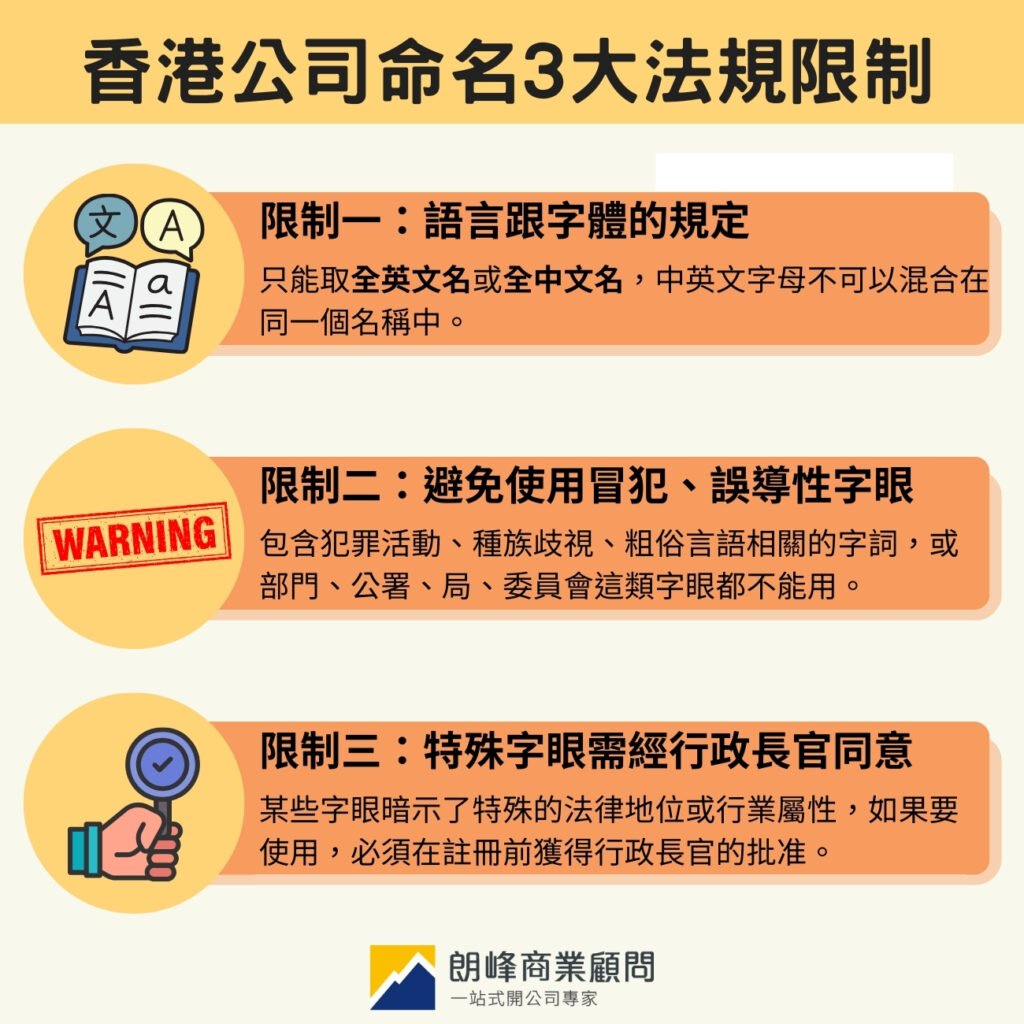
The Hong Kong Companies Ordinance has clear regulations regarding company names. Before conceptualizing a brand, please confirm whether it meets the following three points to avoid rejection due to regulatory violations.
Restriction 1: Regulations on language and font.
The combination of names for Hong Kong companies is quite simple, usually limited to one of the following three forms:
- Entirely English name.
- Entirely Chinese name.
- Simultaneous registration of Chinese and English names.
It is particularly important to note that,Chinese and English letters cannot be mixed in the same name.(For example: the writing style "Happy 貿易 Limited" is not allowed). In addition, there are mandatory regulations for the ending:
- English name.: If you are registering a limited company, it must end with “Limited” (Please use the full spelling; “Ltd.” is not acceptable).
- Chinese Name: If you are registering a limited company, it must end with the words "Limited" and can only beTraditional Chinese characters
Restriction Two: Avoid using "offensive" or "misleading" terms
Although the business environment in Hong Kong is free, the Registrar has the authority to reject certain names; the following situations may be factors for rejection:
- Offensive
Words related to criminal activities, racial discrimination, vulgar language, or names suggesting connections to organized crime will be considered offensive names and rejected.
- Misleading
Words that easily lead people to mistakenly believe they are associated with the Hong Kong government or the Central People's Government departments are not allowed. For example:Department, Office, Bureau, CommitteeSuch terms should generally be avoided by private companies to prevent being deemed as intentionally misleading the public by the Registrar.
Restriction Three: Special terms require "Chief Executive's consent"
Certain terms imply a special legal status or industry characteristics; if you want to use them, you must obtain the Chief Executive's approval before registration. TheseSensitive termsUsually involve regulated industries, including:
| Sensitive terms | English Correspondence |
|---|---|
| Chamber of Commerce | Chamber of Commerce |
| Bank | Bank |
| Trust | Trust |
| Tourist Association | Tourist Association |
| Kaifong | Kaifong |
If your business is not related to the above special industries, it is recommended to avoid these terms directly.
How to confirm that the company name is not duplicated? Practical tutorial on company name registration
After confirming that the name does not violate regulations, the next step is to confirmif someone has already used itThe Hong Kong Companies Registry stipulates that the name of a new company cannot be the same as that of an existing company.
Definition of name duplication
Many entrepreneurs think that adding an adjective counts as a new name. In fact, according to regulations, the following situations will be considered "the same name," leading to registration failure:
- Meaningless function wordsFor example, “The ABC Limited” and “ABC Limited” are considered the same
- Company category vocabularyFor example, “ABC Company Limited” and “ABC Limited” are considered the same
- Differences in fonts and symbolsFor example, “A-B-C Limited” and “ABC Limited” are considered the same
Make good use of the online registration center (ICRIS)
1. The most accurate way to confirm if a name is available is to use the government's official tool "2. the Companies Registry Online Search Centre (ICRIS)」。
- 3. Access the "Companies Registry Online Search Centre (ICRIS)"
- 4. Select "No Account User" to log in
- 5. Click on "Search" > "Company Name"
- 6. Enter the desired name (it is recommended to search Chinese and English separately)
- 7. If the search result shows "No records," and there are no extremely similar existing companies, it usually indicates a higher probability that the name is available
It is important to note that ICRIS can only filterexactly the samenames and cannot determine whether a name is "too similar" to others; this part of the risk needs to be paid extra attention.
Extended reading: "The8. 【Hong Kong Company Search】How to conduct a search procedure through the Companies Registry? 5 major search steps without help》
9. If there are no issues with the search, why should you still pay attention to shadow name risks?
10. Although the search center is open to the public, the system will only tell you11. whether the names are exactly the same12. . Below are areas that still require special attention beyond the search.
13. Avoid "shadow names" and potential infringement risks
14. A "shadow name" refers to a new company name that, although not duplicated with others, is too similar to a well-known brand15. , which can easily mislead the public into thinking the two companies are related.16. For example, if there is a well-known company called "Chanel Limited," and you name your company "Chanel International Limited," although the wording is different, it can easily mislead the public, which is a typical shadow name.
17. Once a complaint is upheld, the Hong Kong Companies Registry will issue an order requiring you to change your name within a deadline. In severe cases, the other company may also sue you for "counterfeiting" or trademark infringement, leading to substantial compensation.
18. Successfully registering a company name means you have trademark protection, right?
19. This is a misconception held by many entrepreneurs:
This is a common misconception among many entrepreneurs:The company name being successfully registered does not equate to owning trademark rights.
The two are completely independent legal systems. A company name registered with the Companies Registry grants you the right to operate legally in Hong Kong under that name; trademarks, on the other hand,Intellectual Property Departmentare applied for to protect the exclusive use of brand logos in specific categories of goods or services. Even if a company name is registered, others can still apply for a trademark on the same name ahead of you.
If you plan to use the company name for brand promotion, it is recommended to apply for trademark registration simultaneously to obtain full protection.
Frequently Asked Questions
Can I register a Hong Kong company name in Simplified Chinese?
No. The legal Chinese name of a Hong Kong company must be in Traditional Chinese. If your brand name is originally in Simplified Chinese, it must be converted to Traditional Chinese during registration, but there are no such restrictions on business cards or advertising designs.
What are the naming rules for unlimited companies (sole proprietorship/partnership)?
Unlimited companies have a higher degree of naming freedom, usually usingterms like business, studio, consultantand so on, or not adding any suffix at all. However, "Limited" or "有限公司" must not be used as a suffix to avoid misleading the public.
Can the name include "International" or "Group"?
Generally, it is possible. Hong Kong has relatively loose restrictions on terms like international, group, and holding, as long as the name does not overlap with others and does not contain regulated sensitive words, ordinary small and medium-sized enterprises can also use these titles.
Do the meanings of the Chinese name and the English name have to be the same?
No need. The Chinese name is "朗峰", and the English name is "SetupHK". The two can have no semantic connection as long as each complies with the regulations.
Does the company's English name need to be registered?
Depending on the situation. You can register only a Chinese name, only an English name, or both. For the convenience of international business dealings and bank account opening, it is usually recommended to have at least one English name.
Can the name contain symbols?
Some punctuation marks (such as hyphens -, parentheses (), apostrophes ‘) are usually allowed, but symbols like @, $, # are generally not permitted.
Can the company name be changed?
Yes. Submit the NNC2 form to the company registry and pay a handling fee of HKD 295, which can be processed through a special resolution. After the name change, all business documents and bank accounts must be updated simultaneously. If it is due to a mandatory name change directive from the company registry, there will be a deadline, and late submissions may face fines.
Does a search showing availability guarantee that it can be used?
Not necessarily. ICRIS only filters out exactly identical names, and the final approval authority lies with the Registrar of Companies. Even if the search shows availability, it may still be rejected due to misleading names, inclusion of unapproved sensitive terms, or being too similar to existing companies.
Can a rejected name be refunded?
Company registration fees are generally non-refundable. You may modify and reapply based on the reason for rejection, or file an appeal with the Companies Registry. It is recommended to prepare 2 to 3 alternative names in advance to reduce the loss from rejection.
Not sure about the name? Let Longfeng Business Consultants help you screen it in advance.
Although ICRIS can filter out duplicate names, for some gray areas, rich practical experience is often needed to make judgments, to avoid receiving name change instructions from the registration office in the future, or even facing infringement risks. If you still have concerns about naming, it is recommended to consult a professional consulting company like Longfeng Business to help you screen it.
Extended reading: "TheComplete guide to starting a company in Hong Kong: processes, costs, and precautions》