



Can the company secretary do it themselves? A complete analysis of legal qualifications, DIY risks, and outsourcing costs.
Hong Kong residents can serve as company secretaries themselves, but the sole director of a one-person company cannot also serve as the secretary. DIY can save annual fees of about HK$1,500–$3,000, but any mistakes must bear legal responsibility; most startups recommend outsourcing for more security.
Summary of key points
- The company secretary must be a Hong Kong resident or a licensed company.
- Non-Hong Kong residents cannot serve as company secretaries.
- The sole director of a one-person company cannot also serve as the secretary.
- The biggest risk of DIY: failure to submit or late documents, both the secretary and the director may face legal liability.
- It is only recommended to consider DIY for those with a legal background, simple business, and ample time.
Who is qualified to be a company secretary? First, look at these two regulations.
Non-Hong Kong residents do not meet the qualifications, and the director of a one-person company cannot also serve as the secretary.
According toSection 474 of the Companies Ordinance.It is specified that a company secretary can only be appointed by three types of people:
- Individuals residing in Hong Kong.
- Licensed practicing company secretaries.
- Licensed companies registered in Hong Kong.
In addition, according to Section 475 of the Ordinance, the sole director of a one-person company cannot simultaneously serve as the secretary. Even if you are completely sole proprietorship and manage everything alone, legally you still need to find another qualified person or appoint a licensed company to take on the role of secretary.
Meeting the qualifications is just a threshold; actual operational capability is the key.
Passing the qualification threshold is just the first step. The daily tasks that the secretary needs to handle mainly include:
- Maintaining the register of shareholders and directors.
- Preparing and recording board meetings and shareholder meetings.
- Handling share transfer documents.
- Submitting annual returns and statutory notices (changes in information must be reported within 15 days).
- Safekeeping of the company's statutory books and important documents
- Safekeeping and supervising the use of the company seal
Each item has a strict statutory deadline; missing one may result in fines or even legal liability. For companies with simple operations, secretarial work may only require a few hours each month; however, once the business starts experiencing personnel or structural changes, the time investment may far exceed this, which is easily underestimated in the early stages of entrepreneurship.
Extended reading: "TheWhat is a company secretary? Definition, duties and conditions of appointment in one article》
Is DIY company secretarial work really cost-effective?
The only advantage of DIY: saving HK$1,500–$3,000 in outsourcing fees each year
The most direct benefit of DIY is cost savings. Acting as your own secretary can eliminate the annual outsourcing fee, which is indeed attractive for cash-strapped startups. Additionally, doing the secretarial work yourself provides a more direct understanding of the company's compliance status, helping to enhance corporate governance.
The biggest risk: failing to submit documents or being overdue, the secretary may be prosecuted alongside the directors
The cost of saving money is bearing all legal responsibilities. According to the Companies Ordinance, if a secretary knowingly allows the company to violate regulations, they may face fines or even imprisonment, with responsibilities similar to those of directors. The three most common mistakes in DIY are:
- Late submission of the annual return: Missing the deadline and only realizing the problem upon receiving a fine notification
- Failing to notify the company of changes within 15 days: Not timely reporting to the Companies Registry after changes in directors or shareholders, resulting in discrepancies between the statutory books and the actual situation
- Failing to notify the tax authority: Changes in the company address must be simultaneously notified to both the Companies Registry and the tax authority; failing to notify one party may result in missing important correspondence
Extended reading: "TheWhat is the annual return? 2025 Annual Return NAR1 form template and notes, how much is the fine for forgetting to submit the annual return?》
What value can outsourced secretarial services provide?
Three main practical values of outsourcing: proactive reminders / document handling / saving time and effort
The greatest value of professional secretarial services is not justdoing the work for you, but more abouthelping you remember what to do and when to do it. Service providers will proactively remind you of statutory deadlines, prepare and submit various documents on your behalf, and handle company change declarations, fundamentally eliminating the risk of missed reports.
For entrepreneurs fully committed to their business, this is almost the most cost-effectivepeace of mind fee. Some service providers also offer additional services, such as providing a company registration address and receiving government correspondence, allowing startups to have a one-stop reliance for administrative matters.
Information security management and hidden fees should be confirmed clearly before signing
Although outsourcing has many conveniences, there are two things worth confirming in advance:
- Data security: Outsourced secretaries need to access statutory company documents and shareholder information, it is recommended to choose service providers holding a TCSP license, which can be verified directly through the company registry website.
- Hidden charges.: Some service providers may charge additional fees for company changes, expedited applications, or extra document copies beyond the basic annual fee, so the complete fee structure should be confirmed before signing to avoid unexpected expenses later.
DIY vs Outsourcing at a glance: Cost, Risk, Suitable Audience Comparison Table
| Comparison items | DIY | Outsourcing |
|---|---|---|
| Direct costs | Zero (time is self-paid) | Annual fee approximately 1,500–3,000 HKD |
| Professional knowledge | Must be self-mastered | Handled by professionals |
| Legal risks | Higher (errors are self-borne) | Lower (service provider ensures quality) |
| Time investment | Requires regular follow-up | Basically saves effort |
| Suitable audience | Those with a legal background and simple business | Most startups |
For most startups, outsourcing is a more reliable choice.
Only if you meet these 3 conditions is it truly suitable to consider DIY
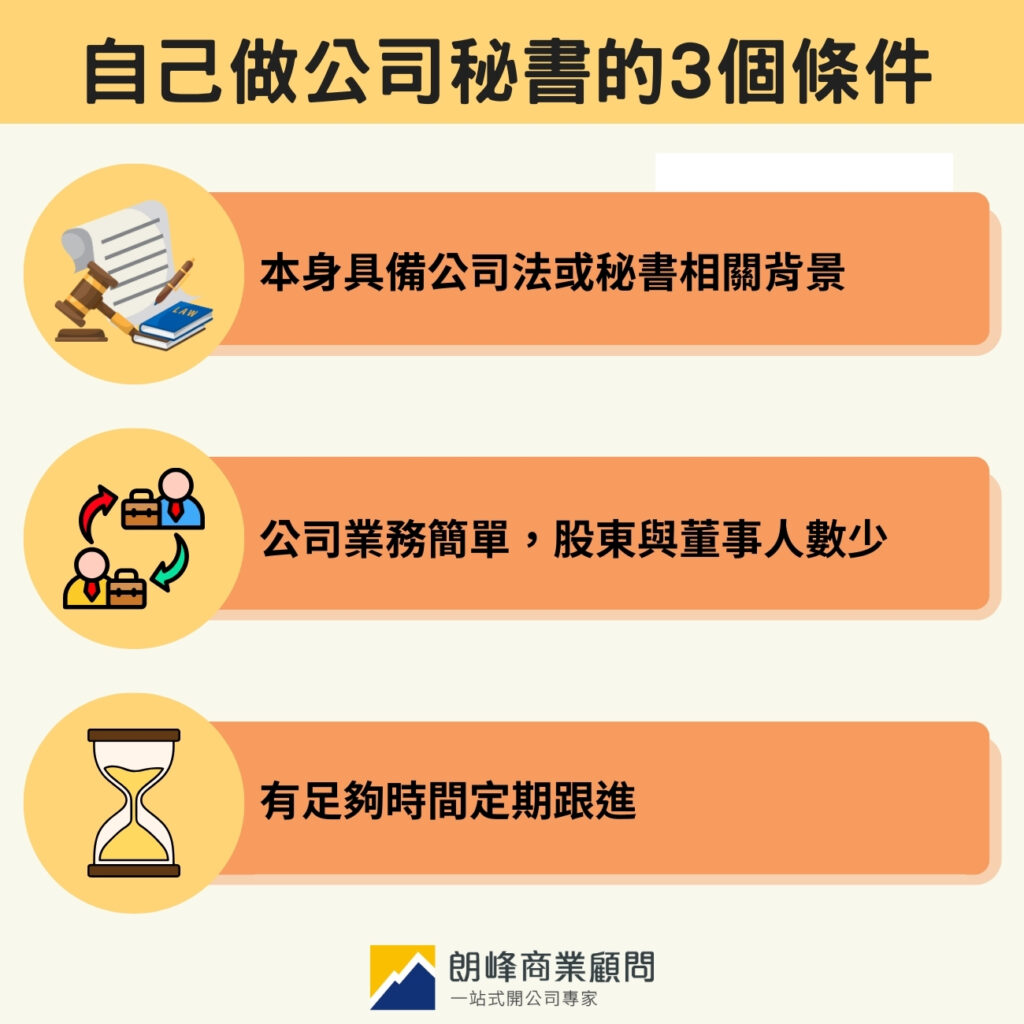
Not everyone is unsuitable for DIY. If you meet the following three points, acting as a secretary on your own is feasible:
- Have a background in company law or related secretarial work, familiar with the main provisions and reporting procedures of the Companies Ordinance
- The company's business is simple, with few shareholders and directors, a stable structure, and infrequent changes
- Have enough time for regular follow-up, and will not neglect statutory deadlines due to busy business
Even so, it is still recommended to refer toThe Hong Kong Chartered Governance Institute (HKCGI)Resources or related training courses, and create a calendar reminder system to ensure that no reporting deadlines are missed. If uncertain situations arise, consulting professional advice early is always more cost-effective than remedying the situation afterward.
Frequently Asked Questions
Can a director also serve as a secretary?
If the company has only one director, they cannot hold another position by law. If there are two or more directors, one of them may also serve as the secretary, but attention must still be paid to the functional independence under the dual role to meet corporate governance requirements.
What specific risks are associated with a DIY secretary?
The most common issues are fines for late submission of the annual return and failure to notify company changes within 15 days. In severe cases, both the secretary and directors may face legal liabilities, and it is not just a simple administrative issue.
Can we DIY now and outsource later?
Absolutely. A company can change its secretary at any time, as long as a notification (Form ND2B) is submitted to the Companies Registry within 15 days after the change, and ensure that the new secretary meets the qualifications and completes the document handover; the process is not complicated.
Unsure if DIY is suitable for you? Let Longfeng Business help you assess.
Saving on outsourcing costs is good, but the cost of rectifying compliance issues is often higher. Longfeng Business provides company secretary services in Hong Kong, with transparent fees and full follow-up on statutory matters, allowing you to focus on business development with peace of mind. WelcomeBooking Enquiryto learn about the most suitable plan for you.
Extended reading: "TheComplete guide to starting a company in Hong Kong: processes, costs, and precautions》