

![2025 Labour Holidays] Can't tell a statutory holiday from a general holiday? Employers must see! 2025 Holiday List](https://setuphk.com/wp-content/uploads/2024/12/2025-statutory-holiday-3.webp)
2025 Labour Holidays] Can't tell a statutory holiday from a general holiday? Employers must see! 2025 Holiday List
According to the Employment Ordinance, starting from 2022, the number of statutory holidays will increase by one day every two years until it reaches 17 days in 2030. This year is no exception, with a total of 14 holidays as last year (2024), and employers can choose either Winter Solstice or Christmas as statutory holidays this year! As an employer, it is important for you to understand the difference between labour holidays and general holidays in order to make proper arrangements for your work and avoid violating the relevant laws. This article will provide you with detailed information!
Labour Holidays vs Public Holidays
For a wage earner, a job with "bank holidays" may be a dream come true, but for an employer or someone who has just started a new business, being able to take a holiday on a "red day" is enough!
But do you really understand the difference between "Bank Holiday" and "Red Day"? Are labour holidays and statutory holidays the same?
Statutory Holiday
Statutory holidays are more commonly referred to as "red days" or "labour holidays".
The main point to note in particular is that under the Employment Ordinance, all employees are entitled to 12 statutory holidays a year, and statutory holidays are applicable to all employees regardless of how long they have worked, whether or not they are employed under a continuous contract, and even to foreign domestic helpers. Moreover, the number of labour holidays will be increased gradually from 2022 onwards, and the number will eventually be increased to 17 in 2030.
In 2025, the statutory holidays in Hong Kong will continue to be the same as last year's (2024) addition of the first Sunday after Christmas (26 December), with the same total of 14 days. 2025 employers can choose either the winter solstice, 21 December, or Christmas Day, 25 December, as a statutory holiday!
General Holiday
According toGeneral Holidays OrdinanceThe number of general holidays in a year is as follows 17 daysThe law also specifies that every Sunday is a general holiday, which applies to employees of banks, educational establishments, public bodies and government departments, and is therefore customarily referred to as a "bank holiday". In addition, the law also specifies that every Sunday is also a general holiday.
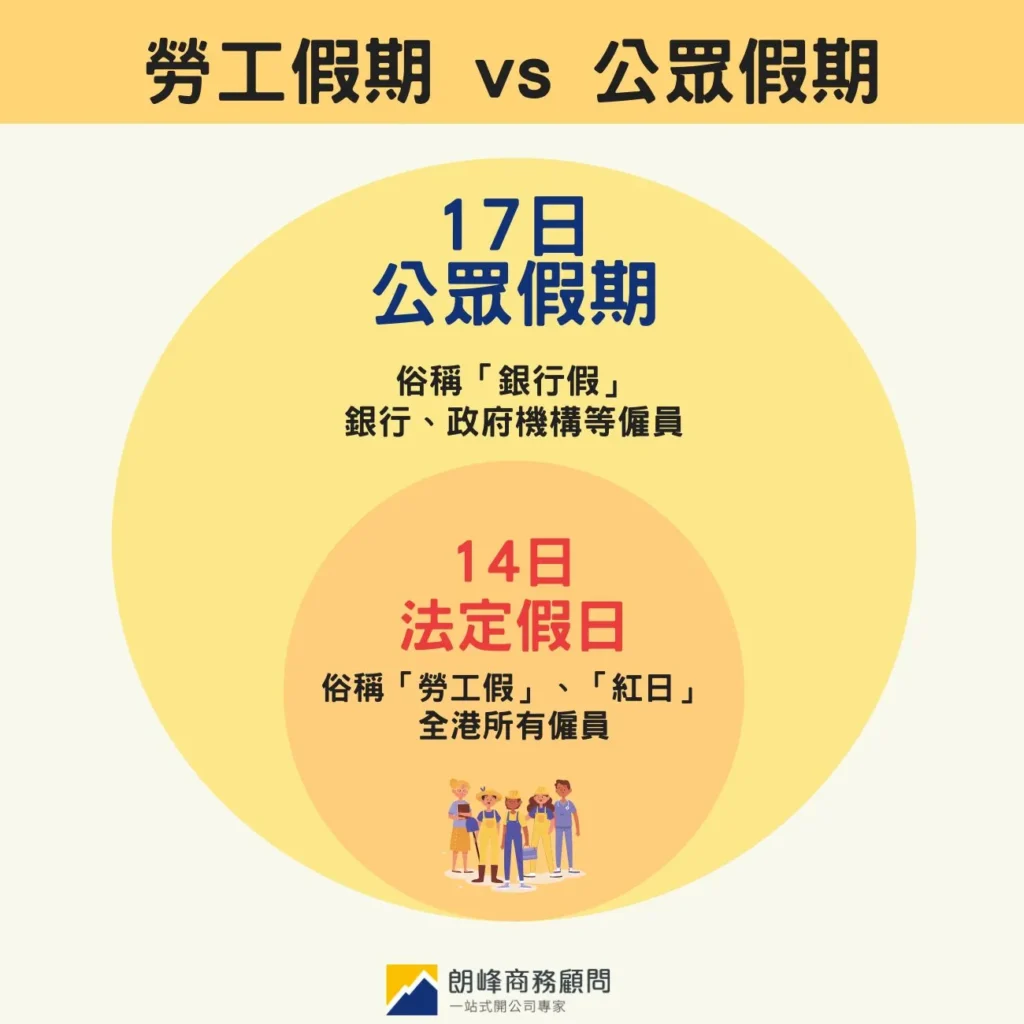
From the number of holidays, we know that the current number of general holidays (bank holidays) is three days more than the number of statutory holidays (labour holidays).
Implementation timetable for increasing the number of statutory holidays in Hong Kong to 17 days
According toEmployment (Amendment) Ordinance 2021From 2022 to 2030, the number of statutory holidays will be gradually increased from 12 to 17, with the additional holidays to be selected from days not currently covered by general holidays.
Phased Implementation Plan
| commencement date | statutory holidays |
| 2022/1/1 | Buddha's Birthday (Implemented) |
| 2024/1/1 | First Sunday after Christmas (Boxing Day) (Implemented) |
| 2026/1/1 | Easter Monday |
| 2028/1/1 | Good Friday |
| 2030/1/1 | The day following Good Friday |
2025 List of Labour Holidays (Statutory Holidays)
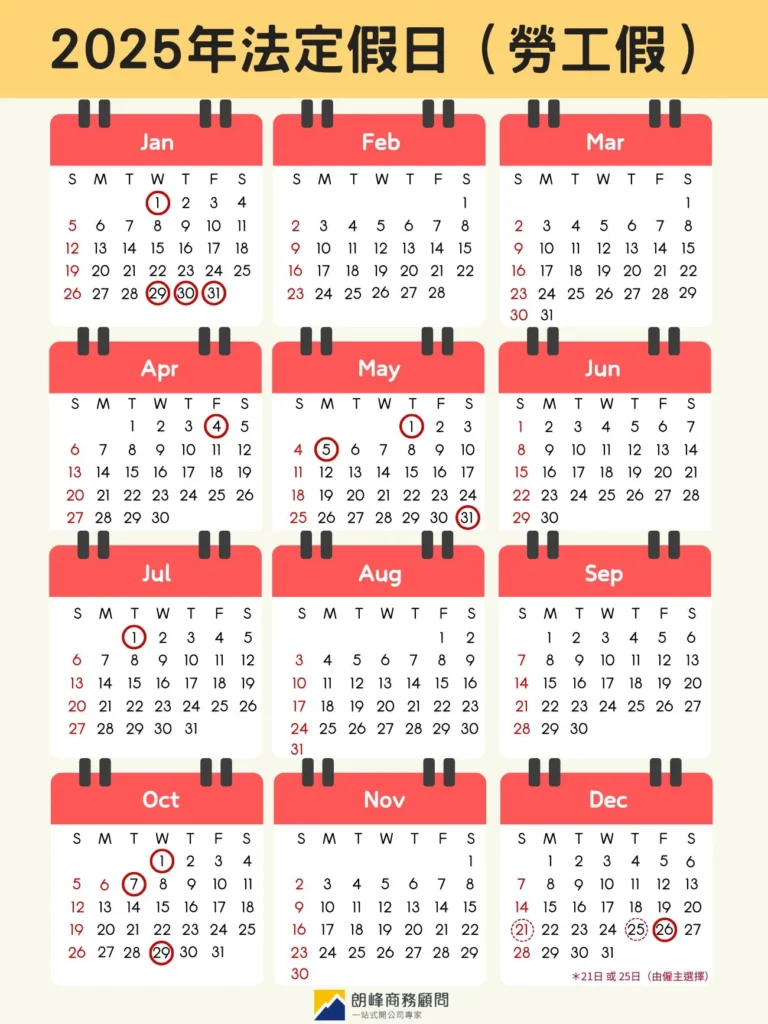
| statutory holidays | dates |
| 1 January | 1 January (Wed) |
| Lunar New Year's Day | 29 January (Wed) |
| The second day of the Lunar New Year | 30 January (Thu) |
| The third day of the Lunar New Year | 31st January (Fri) |
| Qingming or Pure Brightness Festival or Tomb Sweeping Day (in early April) | 4 April (Fri) |
| Labour Day | 1 May (Thu) |
| Buddha's Birthday | 5 May (i) |
| Dragon Boat Festival (5th day of the 5th lunar month) | 31st May (Sat) |
| Hong Kong Special Administrative Region Establishment Day | 1 July (Tue) |
| National Day | 1 October (Wed) |
| The day following the Mid-Autumn Festival | 7 October (Tue) |
| Chung Yeung Festival | 29 October (Wed) |
| Winter or Christmas (employer's choice) | 21 December (Sun) or 25 December (Thu) |
| First Sunday after Christmas | 26th December (Fri) |
List of General Holidays (Bank Holidays) in 2025
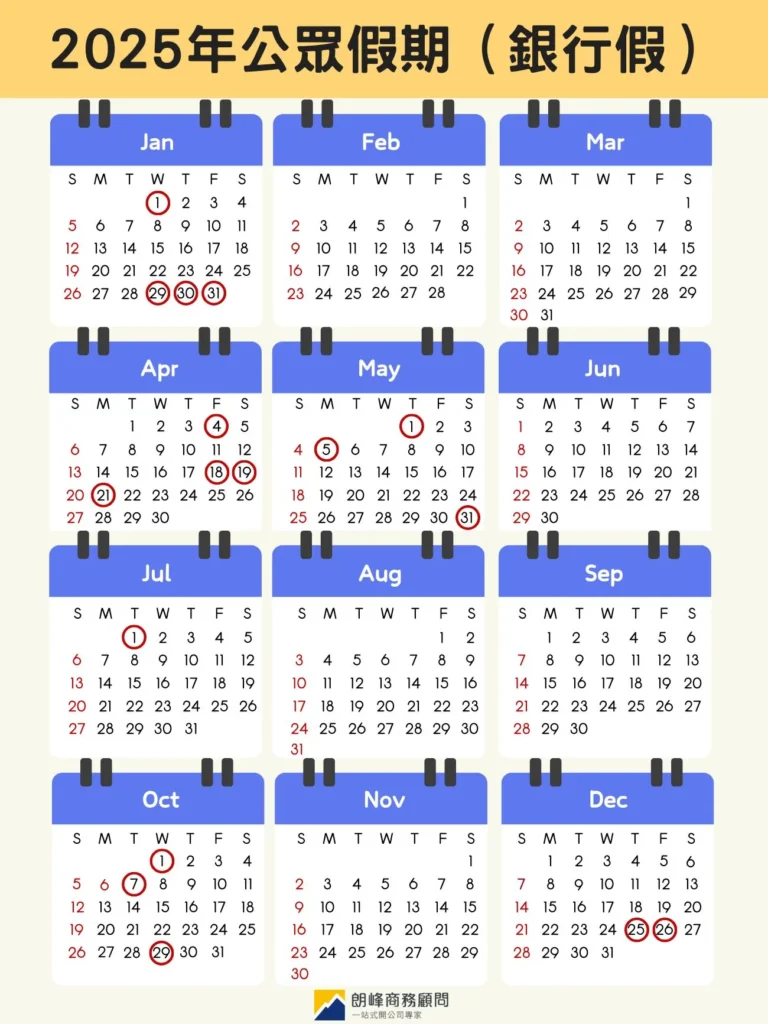
| Public Holidays | dates |
| 1 January | 1 January (Wed) |
| Lunar New Year's Day | 29 January (Wed) |
| The second day of the Lunar New Year | 30 January (Thu) |
| The third day of the Lunar New Year | 31st January (Fri) |
| Qingming or Pure Brightness Festival or Tomb Sweeping Day (in early April) | 4 April (Fri) |
| Good Friday | 18 April (V) |
| The day following Good Friday | 19 April (vi) |
| Easter Monday | 21 April (I) |
| Labour Day | 1 May (Thu) |
| Buddha's Birthday | 5 May (i) |
| Dragon Boat Festival (5th day of the 5th lunar month) | 31st May (Sat) |
| Hong Kong Special Administrative Region Establishment Day | 1 July (Tue) |
| National Day | 1 October (Wed) |
| The day following the Mid-Autumn Festival | 7 October (Tue) |
| Chung Yeung Festival | 29 October (Wed) |
| Christmas | 25th December (Thu) |
| First Sunday after Christmas | 26th December (Fri) |
Frequently Asked Questions on Statutory Holidays (Employers)
Who are the statutory holidays applicable to?
All employees are entitled to statutory holidays regardless of length of service or contract type. Employees are entitled to holiday pay (calculated on the basis of the average daily wage for the 12 months preceding the holiday) if they have been continuously employed for a period of three months.
What is continuous employment? What are the conditions of continuous employment?
An employee is in continuous employment if he/she has worked for the same employer for four consecutive weeks or more, with at least 18 hours per week. Even part-time employees are entitled to paid leave, provided they fulfil the conditions.
What should I do if I need my staff to work on statutory holidays?
For some industries (e.g. the catering industry), statutory holidays are often peak business periods. If employees are required to work on statutory holidays, employers are required to arrange for compensatory time off, i.e. "alternative holiday", which has to be taken within 60 days before or after the statutory holidays.
Attention:
- Employers are required to give at least 48 hours' notice, which may be in writing, orally or by posting a notice.
- An "alternative holiday" cannot overlap with other statutory holidays or substitute holidays.
- Employers and employees may agree to schedule holidays within 30 days of each other.
Can I get overtime pay in lieu of compensatory time off?
No! According to the law, statutory holidays must be replaced by time off and cannot be replaced by money (i.e. "bought time off"). Offenders are liable to a HK$50,000 fine.
What happens when holidays overlap with rest days?
If a statutory holiday falls on an employee's rest day, he/she is required to take compensatory leave on the day following his/her rest day; if the following day also falls on a statutory holiday, he/she is required to make alternative arrangements for compensatory leave.
Frequently Asked Questions on Statutory Holidays (Employees)
Can an employer not pay rest day pay?
Whether rest days are paid or not has to be agreed between the employer and the employee. However, according to the law, an employee must have one rest day for every seven days of work. Employers are not allowed to make working on a rest day a condition for bonus or year-end bonus, otherwise it is an invalid clause.
Can employers ask their employees to work continuously without rest?
No! Employees are required to have at least one day off (24 hours) for every 7 days of work. Employers are liable to a maximum fine of HK$50,000 for non-compliance. However, employers can arrange alternative rest days with the consent of employees.
Conclusion
A clear understanding of the rules on labour holidays and general holidays will enable you to make reasonable arrangements for work and rest. Employers should avoid violating the law, employees should protect their rights and interests, and both parties should be able to combine work and rest in a satisfactory manner, so that everyone will be happy!
Want to know more about what's happening in Hong Kong? Enter your email address now to subscribe to our newsletter! Lafont Business helps you to go further and grow bigger!